YouTube | Spotify | Apple Podcasts
Cheer Dads Belong Here Too: A Conversation With Alex Russell of the Cheer Dad Podcast
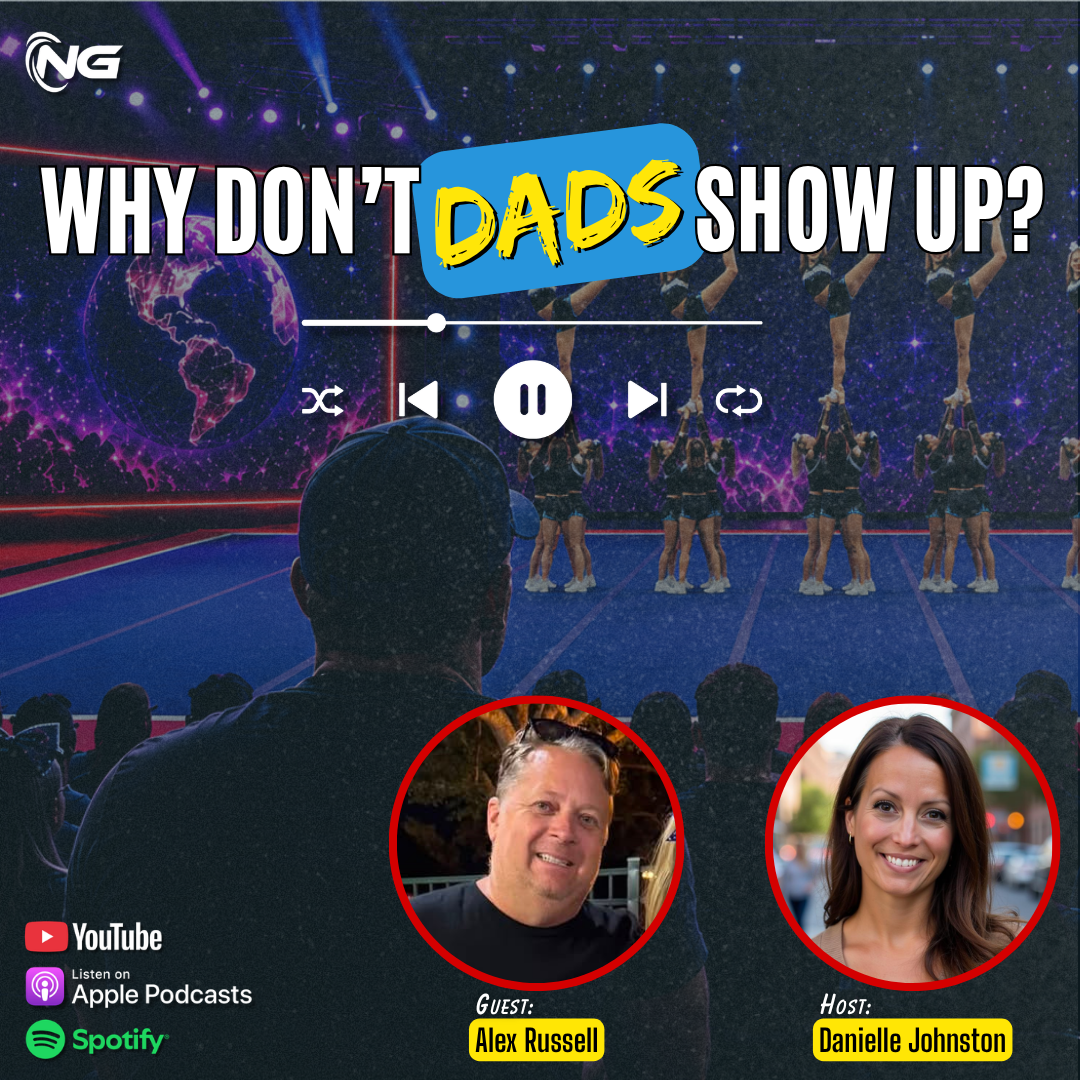
Hey guys, welcome back to another episode of the Full Out Cheer Podcast! This week I sat down with a cheer dad a lot of you probably already know, because he’s one of the hosts of the Cheer Dad Podcast. Alex Russell and his co-host Jerry have been climbing the rankings right alongside us, and this year both of our shows landed in the top ten nominations for the Cheer Awards. So I wanted to bring Alex on to talk about something I don’t think gets talked about enough: cheer dads.
We got into why dads are so underrepresented in this sport, what a twelve-year cheer journey looks like from a father’s point of view, and what he wishes every coach and gym owner understood about the parents sitting in their lobby. Here’s our conversation.
Why Cheer Dads Started Their Own Podcast
Alex has been in the cheer world for twelve years now, ever since his daughter Haley started, and he’s always felt like dads get left out of the conversation. Early on, he got tired of the cheesy “cheer dad” shirts sold at competitions and started designing his own. His most popular one featured a blurred-out stunt image with the caption, “If your hand is on my daughter’s butt, you better be her back spot” — and he says moms at every competition couldn’t get enough of it.
That same instinct to give dads a voice is what led him to start the Cheer Dad Podcast last June. He’d been listening to shows like Cheer Mom with Kirsten and Let’s Talk Cheer with Jason Larkins, but noticed there wasn’t really anything out there made specifically for dads. So he called up his buddy Jerry and pitched him three words: “Cheer dad podcast.” Jerry was in immediately, and they’ve been rolling with it ever since.
From Ballet Dropout to All Star Cheerleader
Like a lot of cheer families, Alex and his wife stumbled into the sport almost by accident. Haley started in ballet at age three (which went about as well as you’d expect with a three-year-old), then moved to gymnastics with a friend for about a month before flatly announcing she was done. Cheer came next, starting with a rec class around age four and a half, where she thrived under a young, enthusiastic coach.
When Haley asked about trying out, Alex and his wife held off for another year of rec classes first. As he put it, cheer really needs to change the word “tryouts” to “placements,” because it had them picturing rejection instead of just finding the right team. At six, Haley finally landed on her first mini team, and it’s been full send ever since. She’s seventeen now, has moved through a couple of gyms, and recently found her stride at Brandon All-Stars.
The Noise-Canceling Headphones Era
Alex was honest about how uncomfortable it felt being one of the only dads in the gym in those early years. His job had more scheduling flexibility than his wife’s, so he was usually the one sitting through rec classes and practices, surrounded by moms of teenage girls talking about, in his words, “teenage girl problems” he had no interest in overhearing.
His solution was a pair of noise-canceling headphones. He’d sit in the gym half-watching Haley and half-listening to music or TV, keeping to himself because he genuinely felt out of place. It wasn’t until team group chats started forming and he got to know the other parents that the headphones started coming off. Even now, moving to a bigger gym meant seeing more dads around, but he says the dads are still outnumbered.
Confusing, Not Intimidating: Cracking the Scoring Code
I asked Alex whether the sport itself feels intimidating to dads, especially compared to something like football or basketball where most people already understand how scoring works. His answer: it’s not intimidation, it’s confusion, and honestly moms struggle with it just as much as dads do.
For years, he judged teams entirely on what he called “razzle dazzle” — if a team looked flashy and put on a show, he assumed they’d win, and he was constantly baffled when a less flashy team scored higher. It wasn’t until he had Gabby Morrow from Scorch Sheets on his podcast a few months ago that he finally started to understand what actually drives a score. He still catches himself falling back on the razzle dazzle theory, but he’s convinced the only people who truly understand scoring are the judges — and maybe not even all the coaches.
What It Means to Daughters When Dad Shows Up
This was the part of our conversation that got Alex a little emotional. He talked about how, for years, Haley would come off the mat after every routine, win or lose, and look for him first for a hug. That’s changed a bit now that she’s seventeen and more interested in running off with her friends, but he still treasures the moments she comes over to acknowledge him.
We talked about how a teenager isn’t likely to say “thanks for always being there,” but that doesn’t mean it doesn’t register. Watching my own kids age out of our program, I can say it absolutely does matter, even when they can’t quite put it into words yet.
What Cheer Dads Wish Coaches Would Do
If Alex ran a gym, the number one thing he’d change is how information gets communicated to parents. Two weeks before Summit this past season, Haley’s coach finally sat the parents down and walked through the score sheet in detail: here’s our max, here’s where we’re actually scoring, here’s what’s costing us points. Alex said it was the first time all year the parents actually understood what was happening, instead of just guessing that the team needed “more razzle dazzle.”
His wish is that gyms would do that breakdown at the start of every season and after every single competition, even if it’s just a quick recorded video sent to the team group chat rather than a thirty-minute meeting on the patio. Give parents the real picture, and most of the second-guessing disappears on its own.
Why Families Really Change Gyms
Both of Haley’s gym changes over the years have been entirely her call, not her parents’. Alex and his wife have always treated cheer as a hobby sport rather than a path to a scholarship, though he noted that’s shifting somewhat as more scholarship opportunities open up. When Haley wanted to move to Top Gun for a season, they supported it, and it helped her grow. When Top Gun later started to feel like it was draining her love of the sport, she asked to move to Brandon All-Stars, where she’s found her spark again.
Alex pointed out that a lot of gym changes across the sport come down to frustrated parents rather than the athletes themselves. The more a gym keeps parents informed and involved, the less likely they are to go looking elsewhere out of frustration alone.
The Life Skills That Outlast the Sport
When people tell Alex that cheer “isn’t really doing anything” for his daughter without a scholarship on the table, his response is simple: it’s teaching her life skills that will matter far beyond the mat. Following directions, working under pressure, functioning as part of a team, and performing in front of thousands of people with total confidence are all things that carry over directly into college and career.
He also brought up resilience specifically. Haley’s toughest season, by her own account, was also the one where she gave everything she had despite it being mentally exhausting. That kind of grit, Alex said, is exactly what shows up later when life gets hard in other ways.
Making Room for Dads in Gym Culture
So how can gyms make dads feel more included? Alex’s suggestions were pretty practical: put a game on the lobby TV during practice, especially during football season, and just make the space feel a little more welcoming to dads who don’t know anyone yet. He gave a shoutout to the State cheer and dance competition in Daytona Beach, which always lands during playoff weekend and projects the games onto TVs in the vendor area, drawing dads together while they wait for their turn on the floor.
But he was also clear that gyms can only do so much. At the end of the day, showing up has to be a mindset the dad chooses for himself. You don’t have to go full Dad Fury with the chains and the jacket — just show up in a t-shirt, get to know the other parents, and the awkwardness fades fast once you’re not the only dad in the room.
His Advice to Any Skeptical Dad
I asked Alex what he’d say to a dad who’s on the fence about getting involved in his daughter’s cheer journey. His answer: if it’s something she really wants to do, just do it, and do it all the way. Show up, ask questions, learn the sport, and get to know the other parents, especially the other dads. Half-showing up, he said, isn’t really an option — you’re either in it or you’re one of the dads who gets left out.
Where to Find the Cheer Dad Podcast
If you want to hear more from Alex and Jerry, search “Cheer Dad Podcast” wherever you listen, including Apple and Spotify, plus Facebook, Instagram, and TikTok. Episodes run about an hour, made for the car ride to practice or the flight to your next competition.
One fun bit of trivia: their logo, the bearded dad with a bow tucked into his beard, actually started as a silhouette Alex adapted years ago for a cheer apparel line he tried to launch, before he repurposed it for the podcast with a little help from AI. They’ve since started using AI-generated cartoon thumbnails for each guest, which has become a fun signature of the show.
Thank you so much to Alex for coming on and helping educate the rest of us on all things cheer dads. If you’re a dad on the fence about getting more involved, I hope this one gave you a nudge. And Alex, we’d love to have you back, maybe with Jerry next time.
If you enjoyed this episode, you may also like “Toxic Parents: How They Start (And How to Stop Them)”