YouTube | Spotify | Apple Podcasts
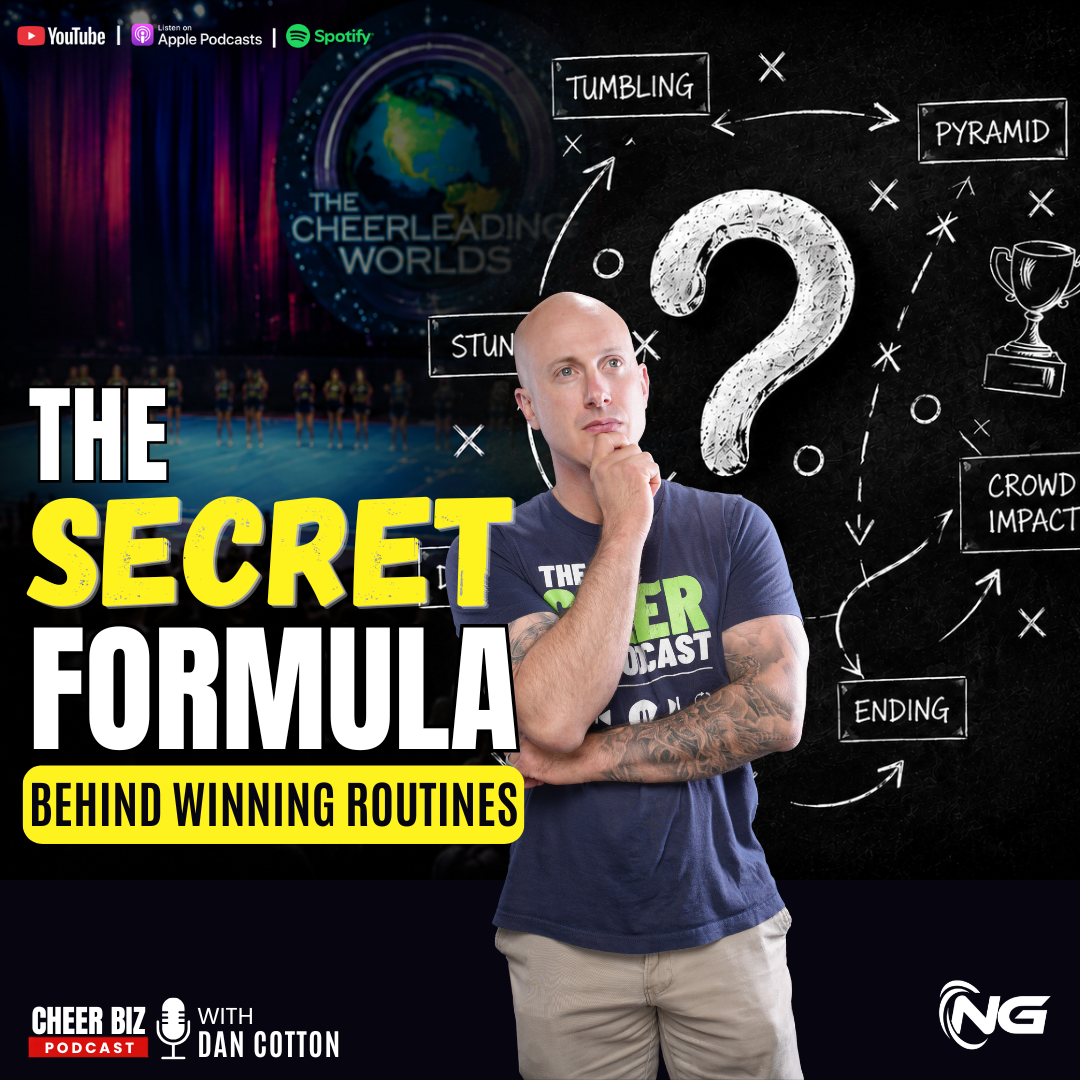
Five Mistakes Coaches Make Studying Winning Cheer Routines
In this solo episode of the Cheer Biz Podcast, host Dan Cotton shares the recurring mistakes he sees gym owners and coaches make when they study championship-winning routines for inspiration, drawing on years of camp choreography, staff film sessions, and a career spent watching what actually separates the routines that win from the ones that don’t.
A Camp Season Confession
Dan Cotton opens this episode of the Cheer Biz Podcast by admitting where the idea came from: he is deep in camp season, spending hours watching routines for choreography inspiration, and it has gotten him thinking about how gym owners and coaches typically study the routines that win big events. Before diving in, he points listeners toward two active communities, Cheer Gym Owners and All-Star Cheer Coaches and Owners on Facebook, both of which he says are full of valuable discussion and advice. He also flags the status of the Cheer Biz Accelerator events: the Reno event has officially sold out, the Warrensburg event in October is nearly full, and one spot remains open at the November event in Oregon for gym owners looking to grow their businesses.
With the housekeeping out of the way, Dan gets into the heart of the episode: a rundown of five things he believes people consistently get wrong when they analyze the teams that win end-of-season events like Summit and Worlds. This isn’t a new hobby for him. Every year, his staff holds a retreat at the end of the summer specifically to watch standout routines and break down what separates them from the rest of the field. Over time, that process has surfaced patterns in how people misread what actually makes a routine successful.
Chasing Skills Instead of Execution
The first mistake Dan identifies is an overemphasis on individual skills. When people watch a routine from a program that won a D1 Summit, D2 title, or All-Star Worlds, they tend to fixate on the hardest elements performed, whether that’s a back handspring step-out sequence, an all-squad tumbling pass, or a difficult inversion on a level two team. They treat that skill as the game-changer, the single moment that explains the win, and then try to build their own routines around replicating it.
Dan pushes back on this instinct. He points to Kyle Gadke, who makes the same observation every season heading into Summit: nearly every team in serious contention is already maxing out its stunt difficulty. Everyone is hitting big numbers in tumbling and stunting, which means difficulty alone stops being the differentiator. What actually separates winning routines, Dan argues, is execution, not the raw difficulty of the skills being attempted.
He also cautions against reading too much into which specific skills a winning team happened to compete. If a level four team wins while competing full-ups, that doesn’t mean full-ups are now required to win. Dan says he has already heard chatter about hand-in-hands becoming a must-have skill in level four next season, and he’s clear that, per the score sheet, that assumption isn’t accurate. Teams can win without ever competing an inversion. Chasing specific skills because a winning team happened to perform them is, in his words, a fool’s errand.
Watching Sections, Not the Whole Package
The second mistake is evaluating routines in isolated clips rather than as a complete package. Dan describes how easy it is to watch a single stunt section, love a specific sequence, and decide to copy it wholesale because it looks like the winning formula. What gets lost is that judges aren’t just scoring individual sections in a vacuum, they’re experiencing the entire routine as it builds.
A truly great routine, Dan explains, creates tension and drama and functions like a living thing. It’s not simply stunt to stunt and skill to skill. There’s an intentional build, a pyramid moment that resolves into a tumbling passage, which then refreshes into a toss section before moving into another stunt sequence. Watching only a section means missing how those pieces are sequenced to keep a judge engaged and emotionally invested, almost like courses in a twelve-course meal that only make sense together. Dan believes the choreographers and routines that consistently succeed are the ones built with that full arc in mind, not just a collection of impressive isolated moments.
Successes Matter More Than Errors
Dan’s third point, one he also touched on in his recent hit-zero episode, is that people spend too much energy scrutinizing a winning routine’s mistakes rather than appreciating what it did well. It’s common to watch a champion routine, spot a bobble or a visible error, and wonder how the team still won. Dan’s answer is straightforward: look at how well everything else in the routine was performed. The successes carry far more weight than the errors, and that’s where he thinks people should be redirecting their attention when they study these routines.
Pace, Score Sheets, and Context
The fourth mistake involves overlooking pace and the specific score sheet a routine is being judged against. Dan brings up Orange as an example of a routine that was phenomenal, clean, and enjoyable to watch without being the most difficult routine on paper by World score sheet standards. He stresses that pace directly affects how a routine feels to judges, and that comparing routines across different score sheets, open, varsity, United, or USASF, isn’t an apples-to-apples exercise. A routine that scores beautifully on the open score sheet might not translate the same way on the varsity score sheet, and the USASF score sheet in particular is comparative, which changes the calculus further. Dan’s advice is to look for inspiration specifically from routines built on the score sheet you’re actually trying to hit.
He shares a recent conversation with Danielle, who choreographs for Twisters, about this exact issue. The open score sheet does reward creativity and pace, but their best-scoring routines aren’t necessarily the ones dripping with creative flourishes. Instead, they’re routines that hit the score sheet cleanly: they get the skills, carry an extra element, maintain a good pace, and maybe open with a slightly creative entry, without piling on unnecessary complexity, like a barrel roll into a drag, a spin to the ground, a flip upside down, a handstand, a pop to a cradle, and then a 360 switch-up. When athletes are worn out executing moves that don’t meaningfully drive the score sheet forward, execution suffers across the whole routine. Dan has seen routines like that win before, but across United, Open, and USASF score sheets alike, he hasn’t seen the over-the-top, flash-heavy approach consistently score at the top. He compares it to his own team’s camp dance: genuinely fun to watch, but built for a completely different purpose than a competitive routine, and not something you’d ever actually compete.
Why Video Never Tells the Full Story
The final mistake Dan covers is trusting video alone to judge a routine’s true impact. He describes the common experience of watching a team on video, feeling confident you could beat them, or not understanding why everyone is talking about them, only to watch that same routine live and immediately understand the hype. There’s a palpable, physical sensation when a truly great team takes the mat that simply doesn’t translate through a screen.
That gap is even wider on platforms like FloCheer, where sound often isn’t included. Without the music, and without the crowd’s energy in the arena, a routine loses a layer of feeling that’s central to how it’s actually experienced live. Dan’s takeaway is that anyone studying routines for inspiration needs to account for what a video can’t capture, the atmosphere, the music, and the crowd, all of which shape how a routine truly lands.
Wrapping Up a Busy Camp Season
Dan wraps up by acknowledging this was a shorter episode, a byproduct of being deep in the middle of camp season and admittedly a little tired. His team just wrapped its first Oregon camp, and he teases a future episode dedicated to that experience, including a skill-related incident and an injury the team dealt with, along with how he personally works through moments like that.
Before signing off, Dan thanks listeners for their support throughout the summer and mentions the Cheer Biz Podcast’s nomination for Best Cheer Podcast. He doesn’t yet know the outcome, but he’s grateful to everyone who voted during the initial rounds, noting how much it meant to see the level of support the show received.
As always, Dan invites listeners to keep the conversation going by joining the Cheer Gym Owners and All-Star Cheer Coaches and Owners groups on Facebook, where gym owners and coaches continue to swap advice on exactly these kinds of choreography and competition questions. Thanks for tuning in to this episode of the Cheer Biz Podcast, and catch the next one soon.
If you enjoyed this episode, you may also like “How I motivate my athletes in 2024″.
YouTube | Spotify | Apple Podcasts