
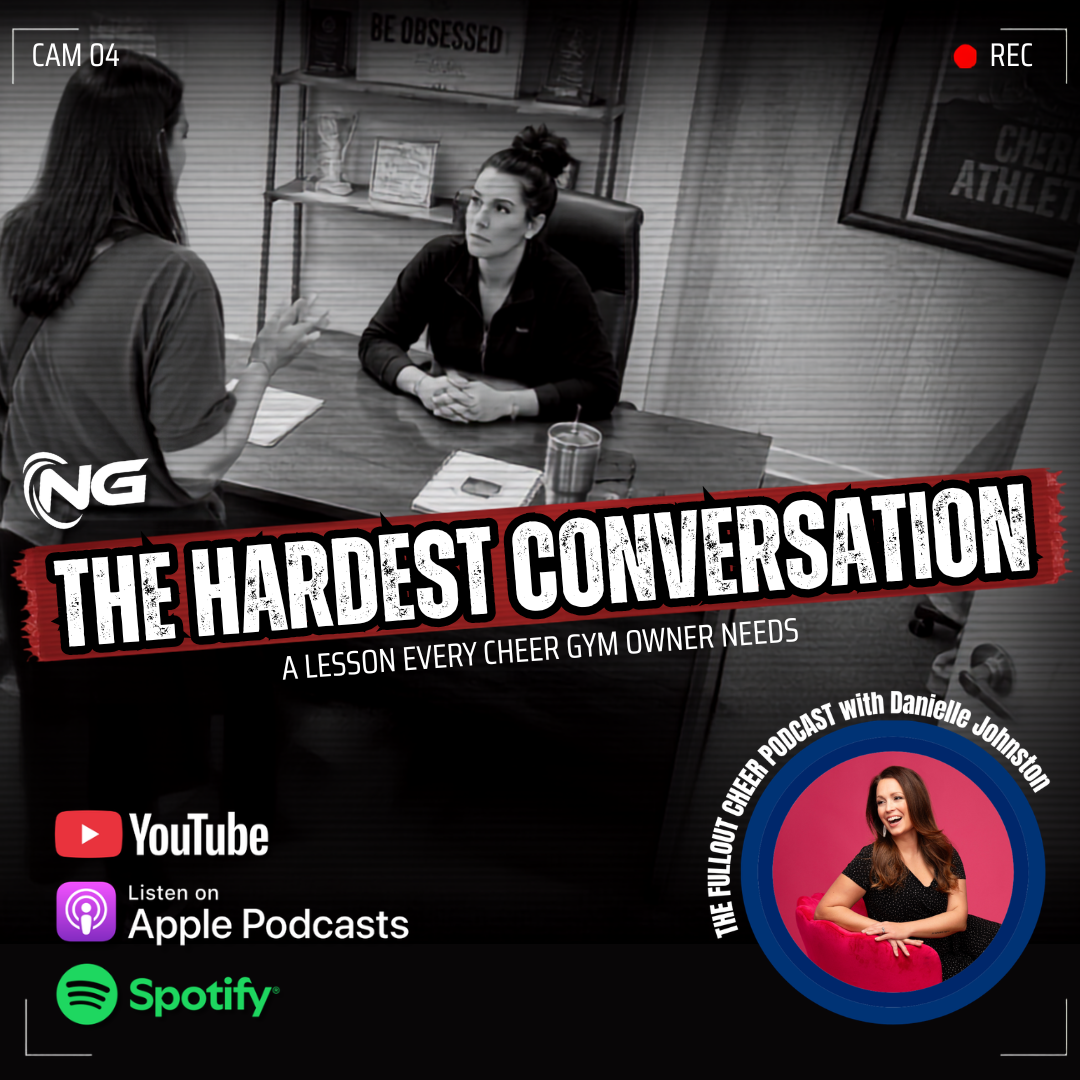
YouTube | Spotify | Apple Podcasts
Compassion and Boundaries: Lessons From My Hardest Parent Conversation in 15 Years
Have you ever set a boundary in your gym, only to have a parent in an unusual circumstance push right past it? A couple of weeks ago, I had the hardest parent conversation I’ve had in fifteen years of owning a gym, and on this episode I want to walk you through it — and talk about how I balanced compassion with boundaries.
Hey guys, and welcome to this episode of the Full Out Cheer Podcast. I’m Danielle, and I’m your host for today and every day. I thought my toughest parent conversation happened last November, but this one may have topped it, just in a different way. I want to protect this family’s privacy, since they’re not current customers anymore, but they were dealing with some real life circumstances behind the scenes — so if I sound a little vague at points, that’s why.
How It Started
I was at the gym on a Tuesday night, getting ready to coach my team, when I noticed a parent waiting at the front desk. She said she was waiting for Lexi, our client success manager, and something about her tone made me a little wary. I stepped away for a few minutes, and when I came back, she was in the office with Lexi.
Lexi is incredible at her job — genuinely compassionate, and skilled enough that she could teach a conference session on handling difficult parent situations. About the only real boundary she doesn’t cross without checking with me is telling someone they’re no longer welcome at the gym. Normally that’s not a split-second decision. This time, it was.
I checked in with my business partner, Angie, who explained: this was a recreational parent a few weeks into classes, frustrated by a handful of things that weren’t wrong with our program, just different from what she’d experienced at a previous gym. Things like not being able to self-select or drop classes in our registration system — restrictions we put in place because new families often misjudge their kids’ level. We keep a fully staffed front desk specifically so there’s always a real person available to help instead. None of it was wrong, just different, and I understood the friction if she was used to another gym’s setup.
When It Became Personal
I stepped into another part of the office to listen in — I’m the owner, so I get to do that — and a few things caught my attention fast. The moment that made me step in was when this parent told Lexi she didn’t like the face she was making, right after Lexi had calmly apologized and explained our policies. Lexi had been doing everything right. I don’t often say I can’t find room for us to improve in a situation like this, but here, I genuinely felt we’d been clear and fair.
The parent used a couple of cuss words, which I chalked up to her being upset in the moment. But when it turned into a personal attack, I stopped being calm even though Lexi stayed composed. I checked with Angie first — is this a parent we have a relationship with that makes this decision complicated? Angie told me the parent had called Lexi trash on the phone the day before. I hadn’t known that.
I went in, introduced myself as the owner, and joined the conversation. I acknowledged that she’d recently moved from another state as a military family and was used to a different gym’s systems, and let her know there were other options in town — a dance studio, our local youth center’s sports programs, a gymnastics facility. I offered a full refund for her three weeks in classes with both kids, which I thought was more than fair. She accepted the refund but kept pushing at smaller issues, and once you’ve offered a solution, continuing to look for something to complain about tells you where things are headed.
The Line We Wouldn’t Cross
I let her know we’d process the refund and felt like it was time to part ways professionally. I wasn’t comfortable with how she’d spoken to my staff, and I offered to help her find other programs for her kids. She left the office, and I sat for a minute to regulate myself before heading back out to coach.
Before I could get back to my team, she came storming back in and asked directly: are you telling us we can’t come back for any classes in the future? I told her that was correct — that our policies and what she was looking for likely weren’t going to align, and it would be best for everyone to part ways. She asked how I’d feel about a one-star review, and I told her honestly that she had every right to share her opinion if that’s how she felt.
She told me I sounded like a perfect ChatGPT response, which I actually took as a compliment — it meant I was staying emotionally regulated. She pushed back that we were the only cheer and tumbling option in town, and I reminded her again of the other choices nearby, which she said she wasn’t interested in.
That’s when she told me something very personal: she’d lost a child the year before. She was heartbroken, trying to be a good mom, and this — pushing back on a policy she didn’t like — wasn’t how she normally behaved.
Holding Both Compassion and Boundaries
I’d never handled a situation quite like this one, and it took me a minute to figure out how to respond. The easy answer would have been to just let her stay in classes. But that wouldn’t have protected my staff or the boundaries I need to maintain in my gym.
In the end, I told her that even though she wouldn’t be at the gym week to week, I’d be thinking of her — praying for her, honestly, because she was in a hard situation. I meant it, and I made sure my tone reflected that. She asked how I could feel that way and still tell her she couldn’t be part of the gym. My answer: I can hold empathy and compassion for you while still maintaining the boundaries my staff deserves. Those two things aren’t in conflict — they can both be true at once.
I ended up hugging her, after asking first, and we prayed together. It was a genuinely special moment, even in the middle of an incredibly hard conversation.
Seven Lessons From a Hard Conversation
Here’s what I took away from this, for any of you managing people or leading a gym.
First, sometimes we inherit emotional situations that have nothing to do with us. When someone comes at you with outsized anger over something small, ninety-nine percent of the time they’re carrying something else entirely, and whatever triggered it just happened to be your gym. Don’t rush to defend yourself — listen more than you think you need to, and stay kind regardless.
Second, know when to step in. Lexi could have handled this alone, and she would have been fine. But sometimes a change in who’s in the room is what helps someone regulate. Know where that line is for you as the owner.
Third, boundaries will often feel like punishment to the person on the receiving end, and that’s okay. This parent told me I was punishing her child. I told her the truth: no man is an island, and you can’t behave a certain way toward my staff and expect your child’s participation to be unaffected. Sometimes the kindest thing you can do is end a relationship — though I try to frame it as “not forever, just for now.” I’ve taken people back into our program years after a release, once circumstances changed.
Fourth, two things can be true at once. I had real compassion for this mom — being a military spouse with two young kids and a husband who works constantly is genuinely hard. That compassion didn’t erase what had happened with my staff. Explaining that both things can coexist is one of the harder parts of leading with boundaries.
Fifth, pain explains behavior — it doesn’t excuse it. Knowing her story afterward didn’t change what I’d witnessed beforehand. It’s fair to give a relationship time and revisit it later, without pretending the behavior didn’t happen.
Sixth, compassion isn’t conditional. The way she acted didn’t erase my compassion for what she was going through internally. Twenty-five-year-old me might have met her rudeness with rudeness. I don’t want to be that person, and I’ve grown past letting someone else’s behavior dictate mine.
Seventh, sometimes the answer still has to be no — even when you understand someone’s circumstances. My staff deserved time to process what happened before restarting that relationship under different terms. That doesn’t mean it’s forever; it means right now isn’t working.
What Happened After
She never left us a bad review. That night, I found her on Facebook and friended her — she friended me back — and I’ve spent time since then thinking about who in our gym community might be a good friend for her, someone going through something similar. One mom came to mind almost immediately, and when I mentioned connecting them, she said yes before I’d even finished asking.
At the end of the day, I don’t want to lie awake wondering if I handled something differently. I know there will be more hard conversations ahead where I’ll wish I’d said something differently — that’s part of running a gym. But I’m proud of how our team held both compassion and boundaries in this one.
If you’re a gym owner or manager looking for a community of people who actually get it, come join us in Cheer Gym Owners on Facebook, or check out the Next Gen Academy at nextgenowners.com — click book a call, and let’s chat about whether it’s a good fit. Thanks so much for joining me on this episode of the Full Out Cheer Podcast, and I’ll see you on the next one.
If you enjoyed this episode, you may also like How Smart Coaches Handle Emotional Cheer Parents