YouTube | Spotify | Apple Podcasts
Where Cheer Gym Owners Should and Shouldn’t Spend Marketing Dollars
In this solo episode, host Dan Cotton breaks down which marketing channels waste a cheer gym’s budget and which ones deliver real, measurable growth, from billboards and Google Ads to organic social, professional content, and Meta ads.
Too Little or Too Wrong
Welcome to the Cheer Biz Podcast. In this solo episode, host Dan Cotton tackles a topic he admits he has been returning to often lately: marketing. His reasoning is simple. Marketing is essential to any gym’s growth, and now more than ever is the time to be doing it right. Dan talks with gym owners who spend absolutely nothing on marketing, and with just as many who spend heavily on the wrong things. He has made those mistakes himself.
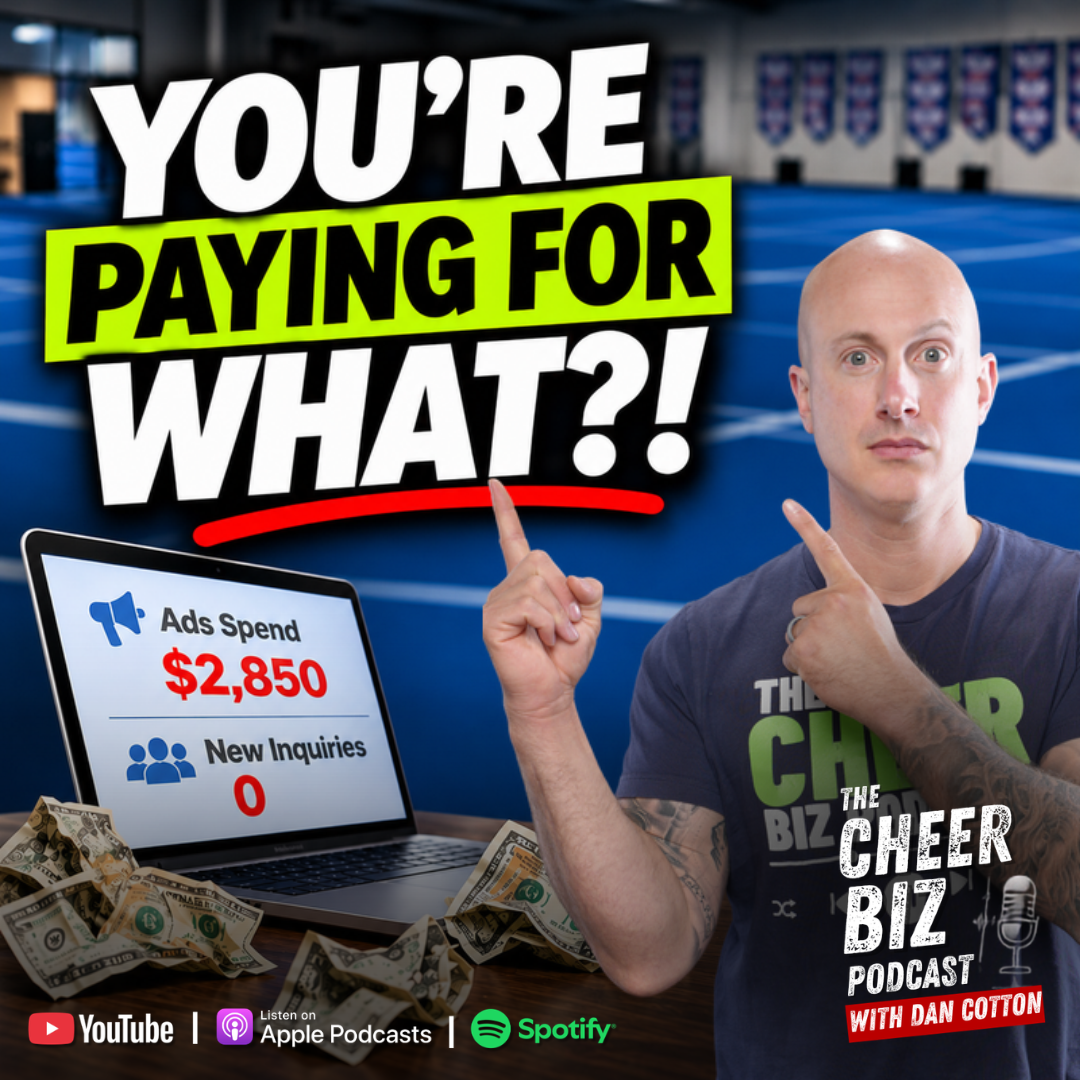
The pattern shows up at Cheer Biz Accelerator events, where gym owners submit pre-work detailing exactly what they spend on marketing. Across the industry, the average is less than $100 a month. Dan is blunt about it: at that level, the money is likely going down the drain, because $100 is not enough to stand out from the crowd. Yet he has also met owners spending $2,000 a month who still see no results. Today’s episode walks through what works, what doesn’t, and where he would put his dollars first.
Fix Your Foundation First
Before spending a single dollar on marketing, Dan says, a gym needs a way to capture contact information and follow up. That means a functional CRM, and he is careful to define what he means. Class management systems such as iClass Pro, Jackrabbit, or Fallout are great at what they do, but they are not what he is describing. He wants a customer relationship system that can send automated emails and text messages, embedded and working smoothly on a strong website.
Without those two pieces, paid marketing simply sends people into a black hole. Dan’s advice is to fix the CRM and the website first, because that is ultimately where marketing becomes valuable: in where you send people once you have their attention.
If You Can’t Measure It, Skip It
The first rule Dan applies to any marketing spend is that it must be measurable. He needs to know the return on every dollar, and if a channel can’t show that, he almost never invests in it. That rules out most traditional media: billboards, your business name on the back of a grocery cart, or a flyer tucked into a school program, handed out at an event, or placed on windshields.
There is a caveat. With a CRM and some UTM tracking, such as a unique QR code on each ad, an owner can see that a form submission came from a specific cart ad, flyer, or billboard. Dan won’t get deep into the technical setup, but he notes that owners with limited technical knowledge will have a harder time getting good results from these older formats. Radio is another one he avoids, since fewer people listen to it and it is hard to know whether a new lead heard about you on the air. His broader point is that those dollars are better spent elsewhere.
The Contrarian Take on Google Ads
Dan describes his second item as the contrarian one: Google Ads for roughly 90 percent of cheer gyms. He sees value for gyms in large, saturated cities that understand how to use the platform and target very specific keywords. His own example is birthday parties. In a city with 15 or more places to host one, a campaign can make his gym appear when someone searches for birthday parties near them, including in Google’s AI results.
For most gyms, though, the local market is too small to support it, and the result is a lot of spending for a relatively low return. Google also demands a high level of technical proficiency. Dan adds a warning about the companies that call promising to rank you at the top of Google. Those are a hard no. Outside of paid ads, rankings come down to SEO, and the most anyone can reasonably guarantee is the first page, when what you really want is the top three results, most of which are paid or sponsored. Even a gym promoting all-star cheerleading is better off skipping the ad, since it would show to many people who are not motivated buyers.
TV Commercials and Yelp
Television advertising is nuanced, but Dan generally steers owners away from it. A commercial on the local news is hard to track, and while it may build brand awareness, the expense usually isn’t justified when those dollars could reach high-intention buyers actively looking for a gym. There is one exception he describes. A gym he recently spoke with produces fresh commercials every month, and receives all of the B-roll from each shoot. That footage can be repurposed across other channels, which gives the spend real value. If a TV ad delivers that kind of material, Dan is open to it.
Yelp is another no. The company calls constantly, and Dan says they mostly reach him through Tori, who tells them he won’t be very nice to them. He has had bad experiences: false reviews that Yelp won’t remove, even for paying advertisers, and customer service that was less than optimal. In his experience, a top ranking on Yelp isn’t overly helpful, the cost is high, and the return is low. He applies the same skepticism to most companies that cold call with promises of creative advertising.
Start With Free Social Media
So where should the money go? Dan starts with what costs nothing: using your social media correctly to build your brand, raise awareness, and run strong campaigns. He suggests your following should be made up mostly of likely customers in your local market. Being nationally known has value for big programs whose athletes travel across the country, and it helps when families move to places like Texas or Florida and already know the names of programs such as Brandon All-Stars and Top Guns. For most gyms, though, being known locally matters far more.
Good free social media means posting regularly and often, and not turning your page into a billboard. Dan wants to see very little AI-generated content. AI can help clip videos together, clean up copy, or build carousels, but a feed full of AI flyers gets scrolled right past, and audiences are increasingly able to spot it. Graphics made with AI need refinement so they don’t come across as slop. The content that earns engagement is organic and real: more about who you are, more videos, more reels, and flyers that look like they were made from scratch.
Invest in Professional Photo and Video
If you are going to spend money, Dan’s next recommendation is to hire a professional photographer or videographer for high-quality content. Whether it costs two, three, or even $5,000, that investment can stretch a very long way, especially if you receive all of the B-roll rather than a single edited video. He would never work with a creator who wouldn’t hand over everything. With all the raw footage, you or an employee can use CapCut and AI tools to cut countless new pieces of content from one shoot.
Dan believes professional photography and videography belongs in every gym’s yearly budget so the content stays fresh, because that is what makes advertising take off. In his view, advertising without good creative is an error, and a plain graphic ad isn’t enough. That said, a lot can be done with an iPhone or a basic camera in the meantime.
Why Meta Ads Still Win
For paid marketing, Dan still points to Meta. He has gone back and forth on it, having watched it get worse over time, but it remains one of the best places to spend when done correctly. Organic content on platforms like TikTok is valuable too, but Meta ads still offer the best bang for the buck. He notes that Meta is hungry for creative. Content goes stale fast, so videos and photos should be refreshed weekly, or at least every other week, because new videos bring more traction and more opt-ins.
Budget matters as well. The era of spending $5 a day and getting decent results is over, and Dan says owners should expect to need around $10 to $15 a day. He also urges tracking real metrics rather than vanity metrics: not whether someone clicked, but whether they opted in, and whether those who opted in are genuine buyers rather than bots. For help with the technique, including using AI as a marketing expert, he points listeners to the Cheer Gym AI Lab on Skool.
Coming full circle, Dan repeats his central rule. If you cannot measure the results, don’t do it. Until the infrastructure for high-quality paid marketing is in place, owners are better off knocking on doors, doing grassroots outreach, and running referral campaigns within their gyms. Dan runs paid marketing for all three of his businesses and says the results can be insane when it is done correctly.
Where to Learn More
Dan wraps up by noting that marketing changes constantly because AI keeps reshaping how it works, so his advice is to start with the free options and avoid the distractions that waste money better used elsewhere. He also teased a Cheer Biz Accelerator event focused purely on marketing, which would suit academy members and brand-new marketers alike. Accelerator events are scheduled for Portland in January and Warrensburg in February, with another expected in Warrensburg in March and more dates to come.
Thank you for listening to the Cheer Biz Podcast. If you haven’t already, join the Cheer Gym Owners and All-Star Cheer Coaches and Owners groups on Facebook, and check out the Cheer Gym AI Lab on Skool.com for just $37 a month to learn how to use AI to take work off your plate. We’ll catch you on the next episode.
If you enjoyed this episode, you may also like “I Never Knew I Could Be “Marketing” And Still Staying Invisible”
YouTube | Spotify | Apple Podcasts