YouTube | Spotify | Apple Podcasts
From Worlds Champion to Weber State Standout and Coach
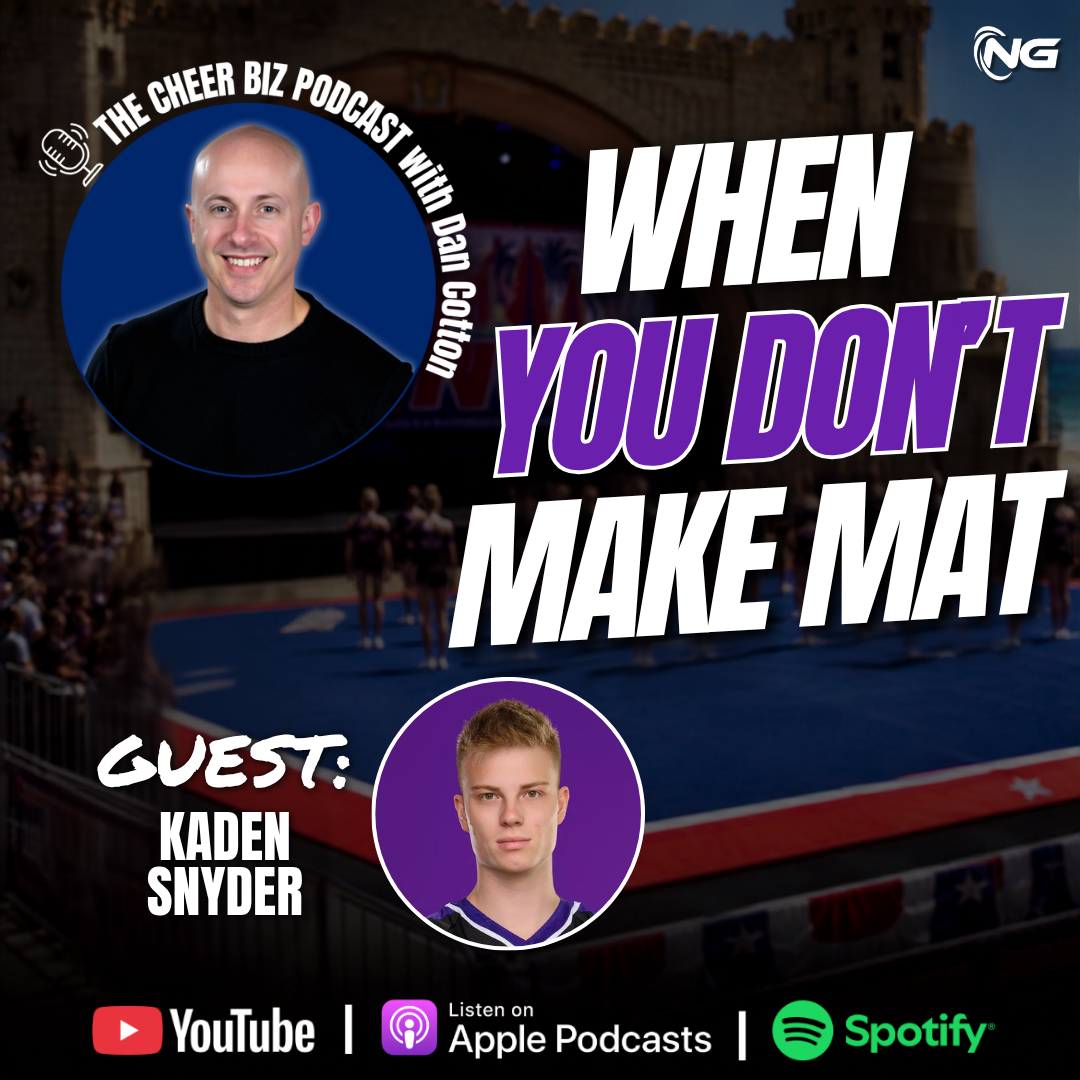
In this episode of the Cheer Biz Podcast, host Dan Cotton sits down with Kayden Snider, a fifth-year Weber State cheerleader and Northstar Elite coach, to talk about winning Worlds with Max All Stars, missing the mat during an injury-plagued season, and building a coaching career and business on the side.
Welcome back to another episode of the Cheer Biz Podcast. Host Dan Cotton is joined by Kayden Snider, a standout tumbler and fifth-year athlete at Weber State University, one of the top programs in collegiate cheerleading. Kayden’s path runs from a small gym in Lehi, Utah, through a Worlds championship with Max All Stars, into the pressure and polish of NCA-level college cheer, and now into a coaching career of his own. The conversation covers Kayden’s rise as a tumbler, the culture shift that turned Max into an industry powerhouse, the toll of a tough injury year, and the rapid-fire tumbling technique questions every gym owner and coach will want to hear.
Small Gym Roots and a Rapid Rise
Kayden’s cheer story started in Lehi, Utah, where he began at a small gym called UPA, Utah Peak Athletics, in 2013. He was 11 years old, and cheer wasn’t even his first sport of choice. He’d played football and soccer growing up, but his cousins cheered and eventually pulled him into the gym. A little bit of childhood gymnastics gave him a head start, but Kayden said nearly all of his tumbling technique came through cheer itself, particularly once he landed at Max All Stars in 2019.
At Max, Kayden trained five to six days a week, Sunday through Friday, often coaching in between his own tumbling sessions. He credits the coaching staff there for refining his technique and helping him develop the big, clean skills he’s become known for, including doubles and punch backs that go well beyond the basic tumbling passes most gyms see.
Dan, who has watched the industry for years, pointed out something notable about Max’s trajectory: the gym went from a relatively unknown program in the mid-2010s to one of the top five most influential names in all-star cheer. Kayden pointed to choreographer TJ Smith as the turning point. Smith joined Max and stayed, and Kayden said his mindset shift is a big part of why the team won Worlds in 2022. Kayden remembers Smith telling the team on the competition floor that they were going to pull through and win, even while they were sitting in second. They did, dethroning Brandon Senior Black that year, and Kayden said the feeling afterward was almost disorienting. He’d actually planned to leave for Brandon Senior Black that same season before deciding to stay and finish his super senior year with his own team.
Staying Put While Others Chase Titles
That decision opened up a broader conversation about a trend Dan sees across the industry: athletes jumping from gym to gym chasing a win, moving to Top Gun, California All Stars, or Cheer Athletics the moment their current team comes up short. Kayden was diplomatic about it, noting that all of those programs have great staff and great athletes, and that the sport’s overall growth means talent is simply more spread out than it used to be. For him personally, staying was easy. Weber State is only an hour from where he grew up, so once his all-star career ended, he was already home. He acknowledged that other athletes who grow quickly may naturally look for a bigger stage, and that’s simply part of how the sport is evolving.
That loyalty carried into his transition to Weber State, which Kayden called arguably the best program in collegiate cheerleading. He admitted that adjusting from a spring floor to a dead mat as a tumbler was a real hurdle, but once it clicked, he found he loved college cheer even more than all-star. Part of that ease came from familiarity. Several of his coaches at his very first gym had cheered at Weber themselves, so he’d known where he was headed for years.
Kayden described the Weber culture in simple terms: it’s family. The team keeps its head down, works hard, and tries to blow away the competition in Daytona every year, often without anyone having seen their routine beforehand. He pointed to Weber’s role in pushing the sport forward, including being among the first programs to put multiple men into pyramid sections, a trend that’s since spread across nearly every top-tier program. Being part of that kind of innovation, Kayden said, isn’t something he can fully put into words. It’s an experience shared only by the 50 to 65 athletes on the team in any given year.
The Hardest Season: Watching From the Sideline
The conversation then turned to a more personal and difficult topic: this past season, after three years on the mat, Kayden didn’t earn a spot on the floor. He was open about the reasons. A string of injuries made it harder to nail a standing tumbling pass, a one-to-full, in the middle of the routine, and that struggle became the deciding factor. Everything else, he said, including a new shoulder stunt element he’d never performed before, was coming together well. But dead-floor tumbling takes a toll on the body over four or five years, and he said he could feel himself working just to keep pace with the incoming freshmen.
Dan, who was in Daytona and saw Kayden emotional after both days of competition, asked what that experience was like. Kayden described the shift from coach, who’s used to standing at the front of the floor with no control once the routine starts, to athlete, watching his closest friends compete without him. That, more than anything, was what hurt. Getting through it meant leaning on a veteran mindset: showing up for his teammates regardless of whether he was on the floor, and leaning on teammates and mentors, including Dan himself, to help him regroup after a rough first day.
Looking back, Kayden said the experience reshaped how he thinks about his final year. Rather than viewing himself as just another athlete on the floor, he wants to be the best possible fifth-year veteran and leader for his team, on the mat or not.
Coaching the Next Generation
Beyond his own competition schedule, Kayden coaches Senior 5, Senior 3, Junior 2, and Youth 2 at Northstar Elite, on top of a full college course load and cheering himself. He runs tumbling privates every Sunday, often booking his day solid from morning to evening. Dan joked that between college, coaching four teams, and competing, Kayden clearly has plenty of free time.
Asked whether it’s a challenge to go from training among the best athletes in the sport to teaching a nine-year-old what pointing a toe even means, Kayden said no. He pointed to the technique he’s absorbed from his own tumbling coaches over the years, including Mike Citer and his former Max coach Julian, as the foundation he now passes down. His favorite thing to coach is fixing a broken full, helping an athlete who’s only getting halfway or three-quarters of the way around finally land it clean. He said watching that moment click for a young athlete, the same way it once clicked for him, is one of the best feelings in coaching.
Kayden also spoke to the real differences between tumbling on a spring floor and dead mat, something he navigates daily as both an athlete and a coach. He still tumbles on dead floor the way he would on spring floor, bounding through his passes, while some Weber teammates, like standout tumbler Jordan, have adapted to a flatter, more efficient dead-floor style. At heart, Kayden said, he’s still an all-star tumbler.
Rapid-Fire Tumbling Technique
Dan closed out the technical portion of the conversation with a fast round of coaching questions, and Kayden’s answers offered a quick technique cheat sheet for gym owners and coaches. On handstands, he teaches a neutral head position, not tucked and not thrown back. For spotting twisting skills, he’ll spot from either direction, giving athletes a bump, letting them initiate the spin, and helping them catch, rather than spinning them through it. His roundoff cue is “park the car in the garage,” with a straight lead hand and the trail hand turning over without opening at the elbow. For back handsprings, he prioritizes the arms over the jump, and teaches setting with the arms up by the ears rather than out front. Coming out of a roundoff, he teaches hands by the ears, not down at the hips.
On drop steps, Kayden said he’ll allow them for higher-level skills like a two-to-whip layout or a one delay, but for a standing full, his own progression went from a step to a hop to eventually neither, and that’s the same path he coaches his athletes through.
What’s Next for Kayden
With one final year of eligibility left at Weber, thanks to an extra year carried over from a previous season, Kayden is preparing to graduate with a degree in exercise and sports science, a fitting fit given his coaching career. He plans to keep working with Dream Camps and to keep building Curve AI, an online coaching venture he recently launched, with hopes of growing it into a bigger business over time.
Looking ahead at the sport as a whole, Kayden said his hope for the next five to ten years is for cheerleading to reach a bigger stage, whether that’s the Olympics or another major platform, once scoring and judging standards are further refined.
Dan thanked Kayden for making time on a day off to share his story. Listeners can find Kayden on social media at Kayden Snider 04. As always, Dan invites listeners to join the Cheer Gym Owners and All-Star Cheer Coaches and Owners groups on Facebook to keep the conversation going, and to catch the next episode of the Cheer Biz Podcast soon.
If you enjoyed this episode, you. may also like What Happens When Your Team Doesn’t Hit: Processing a Worlds Letdown
YouTube | Spotify | Apple Podcasts