YouTube | Spotify | Apple Podcasts
From Chucking Tricks to Pro Cheer: Ty on Miami Metal’s First Season
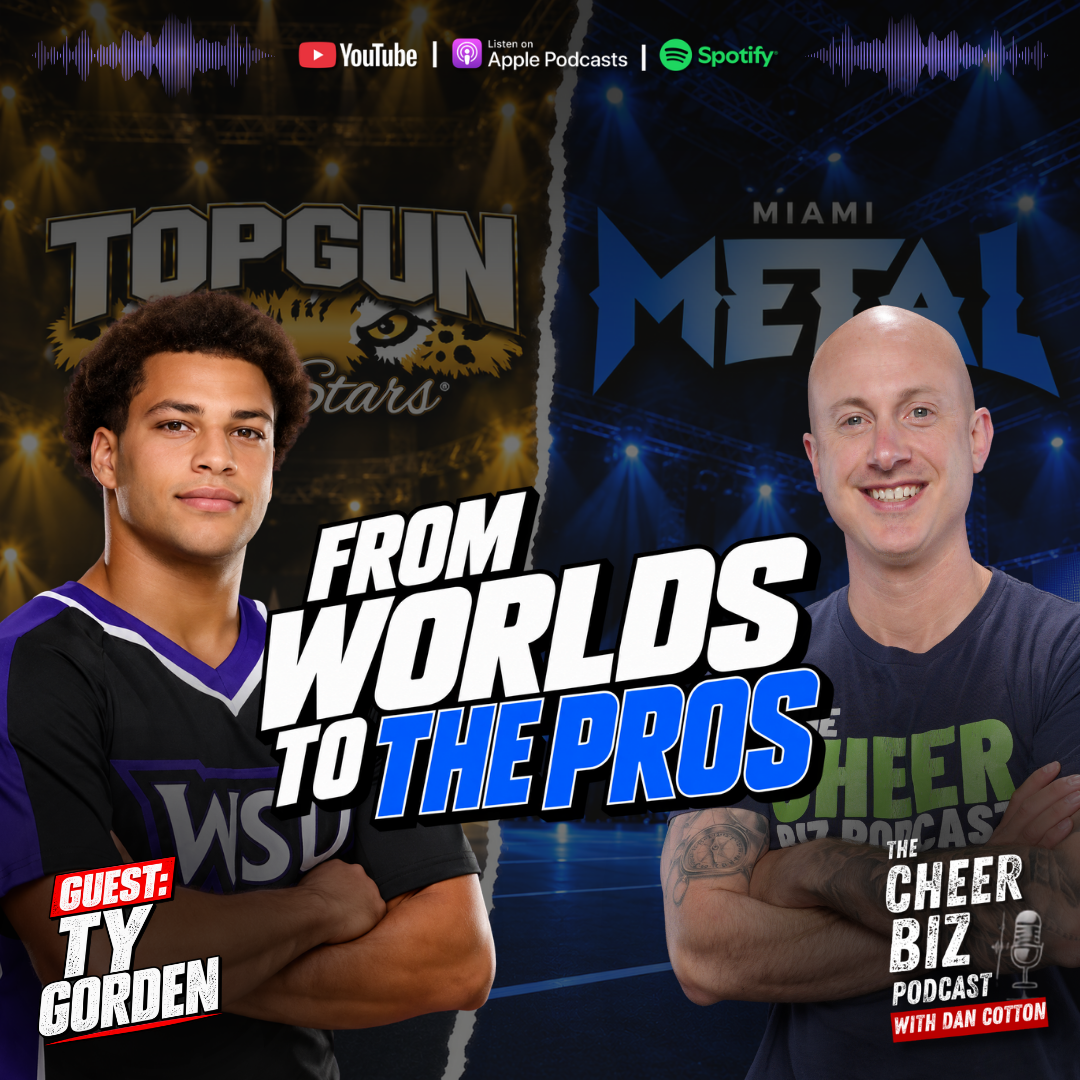
Top Gun Miami veteran and Miami Metal athlete Ty joins the Cheer Biz Podcast to share how a football and baseball kid became a world champion tumbler, what the first-ever Pro Cheer League season was really like, and the rule changes and big ideas he hopes shape its future.
Meet Ty: Top Gun to Pro Cheer
Welcome back to the Cheer Biz Podcast. I’m your host, Dan Cotton, and this week’s guest is someone I have been trying to sit down with for a couple of years. Ty is a longtime Top Gun Miami athlete who competed on some of the gym’s most extraordinary teams and is now part of Miami Metal, one of the first teams in the brand-new Pro Cheer League. Because the league is so new, Ty is the first person I’ve been able to interview who has actually competed in it, so we dug into everything from his path into the sport to the games, the scoring, and where he thinks pro cheer should go next.
Ty started his career at Top Gun in Miami, spending time on TGLC and later on Toxic. He explained that he is thrilled to be doing something new and pushing the sport in a different direction, and that he considers it very cool to be part of something this historic.
A Football Kid Finds Cheer
Nobody just walks into Top Gun Miami and lands on a top team, and Ty was no exception. His journey began at a small gym in Starke, Florida, where he cheered on a Senior 2 team before making the unusual jump straight to TGLC. His first year at Top Gun was spent as an alternate, which kept him in the mix with the team even if he wasn’t on the floor.
Before any of that, Ty was a football and baseball guy who never gave cheerleading a thought. That changed when he spotted the bay doors open at an open gym and noticed that what was happening inside didn’t look like sideline cheer at all. The gym’s owner was also a teacher at his school, and she had invited his brother to check it out after a pep rally. Ty tagged along, and that moment, he said, was literally the start of who he is today.
Asked, tongue firmly in cheek, whether it was the skills or the pretty girls that pulled him in, Ty admitted it was a bit of both. He was used to locker rooms full of boys, and walking into a room of girls throwing fulls he couldn’t do himself was a different world. Between the cool skills and the new environment, he decided to give it a try.
Learning Technique the Hard Way
Ty has always had a back handspring, but the road to a polished tumbling pass was anything but smooth. He couldn’t throw a back walkover to save his life until the teacher who is now his coach made him learn one. The standing tuck turned out to be the hardest skill he ever learned, since carrying a little extra weight made it difficult to pull his hips over.
His gym only went up to Level 3 at the time, so Ty spent his time on a tumble track before and after practice, simply chucking skills and trying to learn how to spin because he had seen his brother do it. Today he coaches tumbling and is known for clean technique, and he credits his brother for the shift. His brother was the technical one, with perfectly straight legs and precise form, while Ty was just a thrower. Hearing people call his brother’s tumbling clean, while no one said the same about his, pushed Ty to ask questions about pointing his toes and lifting his hips. He got tired of simply chucking and wanted people to say wow, and his brother became the coach who made that happen.
Worlds Titles and a Heartbreaking Year
When Dan first met Ty, he was a four-time undefeated world champion. After that run, Ty decided he wanted something different, nearly skipped cheering altogether, and instead joined Toxic. The team was undefeated and he felt on top of the world, sure he was about to go five for five.
Then things unraveled in the warm-up room. A teammate was hit in a basket, and when the team went back to warm up again, his base tore her Achilles. The room went silent, and Ty knew in that moment that the streak was probably about to end. Every year he has won Worlds, he said, he could feel the aura in the air, and that aura was gone. The team didn’t make finals, which leaves Ty with a running joke: every time he makes finals, he wins.
College Cheer at Weber State
Ty spent last year cheering collegiately at Weber State while also competing with Miami Metal. College cheer was a big change: dead mats, deep traditions, and a completely different culture. Having come from spring floor, where a bigger athlete like him could rely on angles to protect his body, he had to learn to dig and bound on a surface that doesn’t care who you are. It challenged him in ways he didn’t expect, and he has nothing but great things to say about the program.
His first collegiate year was spent as an alternate after he broke his toe right before Mat Trials. He wasn’t doing anything reckless, he insisted, just playing flag football with friends on a turf field without shoes, and his doctor said it would likely have happened either way. Ty is known for shaking off injuries, but he knew this one was different. He kept enjoying the traditions and the new side of cheerleading anyway.
Why Ty Joined the Pro Cheer League
For Ty, the biggest draw was simple: athletes finally get paid to do something they love. He remembered standing in line before full-outs at Top Gun, nervous and reminding each other that they pay to do this. Now there is a check on the table and real recognition. He also believes younger athletes finally have a professional league to look up to and push toward, and he wanted to be part of the first-ever teams and the history books. Miami Metal also plays in a place that is home to him and to Top Gun, which made it feel right to do it first and for his people.
Ty never actually tried out. Coach Victor simply texted to ask if he wanted to be part of it, and when Ty said absolutely, he was told he had made it. After watching clips of tryouts, with athletes throwing doubles and collegiate-level skills and even a high jump game, he could see the skills getting tougher and the grit required increasing. He expects everyone to have to try out again for the second season.
Inside the Games and the Schedule
The league’s events were a surprise even to the athletes. Ty admitted that hearing about a back tuck over a high jump bar made him wonder what the heck was going on, since cheerleading normally means tumbling into a double full, not clearing a bar. A flash pyramid, where teams sprint to a line and build a pyramid as fast as possible, meant figuring out how to train something nobody had ever practiced. Even so, he thought it looked a bit like the Olympics and appreciated that it got cheerleaders out of the box while still having cheer in it.
The first season featured five events. Miami Metal trained roughly once a month, with Saturday and Sunday practices running from 10 a.m. to 10 p.m., and about twice a month during competition season. Teams practiced the games, and athletes earned their spots by competing against each other, almost like the real thing. Ty himself competed in the Bullseye and the Flash Pyramid in addition to the routine.
Rule Changes Ty Wants to See
The Bullseye requires a pass with at least two and a half flips or spins, and Ty explained that the league already tightened the rules after teams began throwing a simple tuck at the end. He and Dan agreed that a pro league should demand a real pro-level skill at the end of the pass, at minimum a double. Ty also noted that a team needs at least one female athlete in the Bullseye, while the high jump event could be done by anyone. He gave a shout-out to a Kansas State athlete known as Squirrel, who competed in nearly everything and won one of the high jump events.
The biggest issue for Ty is overtime. Miami Metal was called for repeating the same pass in Houston, even though his pass and teammate Cory Little’s were technically different. In Nashville, Miami finished tied 73 to 73 and lost because the tie was broken by who had won the first quarter. He compared it to deciding a football game by who scored first and said he would love a tiebreaker where teams keep battling it out.
Dan raised a related concern for viewers: the difference between the winners’ and losers’ bracket games is hard to follow. In the first bracket, a winning team can gain three to four points, while a losing team can only gain one to two, and the two brackets play completely different games. Ty admitted he had never thought about it and said the point was a real light bulb moment. With the league expanding from four to six teams and events becoming head-to-head, he is very curious to see how the games and scoring will change.
Ty’s Dream: A Pro Cheer Draft
Asked what he would do as head of Pro Cheer for a day, Ty didn’t hesitate. He would add a combine and a draft. He described watching NBA draft nights, where athletes sit at home with their families after a lifetime of work and finally hear their name called, and said he sometimes tears up at the reactions. A cheerleader who could have that moment, walking across a stage, shaking hands with league leadership and holding up a Miami Metal shirt, would train harder than ever, he believes, because they would be chasing something big.
Dan agreed, joking that it beats a text message asking if you want to be on the team, and noted that such a draft isn’t unattainable within the next few years.
Final Thoughts and Friendly Ribbing
As the conversation wound down, Dan had one request after watching the final: less snorkeling every time the cameras cut to Miami Metal, and more of the metal hand signal. Ty promised to deliver. He also said the best part of the season was competing against friends from teams like Atlanta Air, Dallas Drive, and Golden State on one stage, and getting paid for it too.
Dan couldn’t resist closing with a bit of friendly rivalry. By Ty’s count, Miami Metal won three of the competitions to Dallas Drive’s two, and both of them felt that a final decided by what seemed like silly events didn’t truly crown the best team. Fans ask Ty about it all the time. Both agreed that a little drama and rivalry is good for the sport and for viewership.
Thanks for Listening
Thank you to Ty for sharing his time and his candid look inside the first season of the Pro Cheer League. We’re excited to see what Miami Metal has in store, and we hope to see Ty back on TV this season. If you enjoyed this episode, be sure to join the Cheer Biz Podcast Facebook groups to keep the conversation going with other gym owners and cheer professionals. Thanks for listening, and we’ll see you next time.
If you enjoyed this episode, you may also like “Pro Cheer Is Coming… But Will It Actually Change Anything?”