YouTube | Spotify | Apple Podcasts
How to Choose the Right Uniform Vendor for Your Cheer Gym
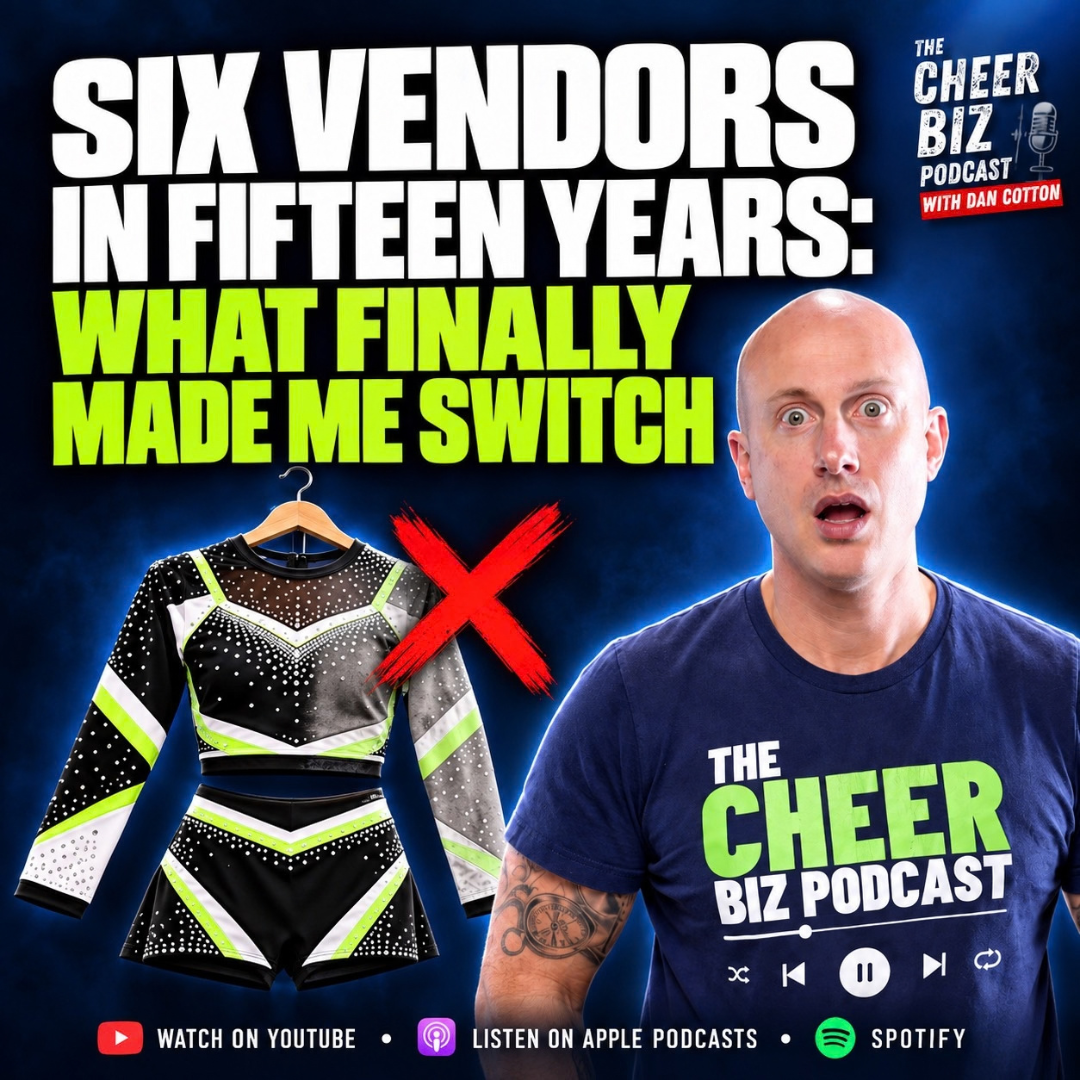
Cheer Biz Podcast host Dan Cotton shares the exact framework he has used across six uniform vendors in 15 years of gym ownership, plus when to start the process and whether AI belongs in your design phase.
Why Uniform Decisions Feel So Hard
Welcome to another episode of the Cheer Biz Podcast, hosted by Dan Cotton. In this episode, Dan tackles a question that keeps landing in front of gym owners: who should we order our uniforms from, how early should we start, and can we design them with AI?
The inspiration came straight from the community. Over the last three months, the Cheer Gym Owners and All-Star Cheer Coaches and Owners Facebook groups saw more than 20 questions about uniform providers. Dan noted that choosing a vendor is a challenging decision precisely because there are so many options, and so many of them are good.
He was clear that this episode will not tell listeners which vendor to use. Instead, he lays out the framework he personally uses to decide whether a vendor is the right fit for his program. Every gym has different priorities, and the right answer depends on where you want to take your uniform process.
Start With Design and Budget
The first thing to evaluate is whether you like a provider’s designs. Dan treats this as a starting filter rather than a formal part of the framework. Look at the vendors whose work has caught your eye, and go in with a general idea of what you want your uniform to look like.
From there, the first real number to set is your price per athlete. Dan described two approaches: decide on a budget and search for vendors that fit it, or start shopping and see what you find. He strongly recommends the first. When a vendor asks about your budget and you have not set one, they will design the best possible uniform for the highest possible profit margin. Without constraints, that is the direction the conversation will go.
Just as important is demanding transparent pricing. Ask what the garment costs, what shipping costs, whether there are add-ons, whether early payment is required to get a deal, and whether credit card processing fees apply. What you want is the all-in or landed price, meaning what it truly costs to have the uniform in your hands at your gym. Some vendors include shipping and fees in the quoted price and some do not, and Dan warned that skipping these questions can quickly leave you with an extra two to three thousand dollars on the bill, or even more depending on how many garments you order and how they ship.
Test the Quality Before You Buy
Quality is the next pillar, and Dan’s rule here is firm: if a provider will not send a demo garment or prototype, he goes the other direction. He will not buy from any company he cannot see a prototype from, especially a new one. Although he does not consider himself a pro shop garment expert, he has been in the industry long enough to know what to look for, including whether the stitching is single or double, how the fabric feels, and how the garment behaves when it is worn.
He shared a cautionary story from years ago. A prototype arrived in what was supposed to be black, and when the athlete put it on and the fabric stretched, the dye spread and the black shifted to an almost white shade. The result looked very odd, and that company did not get his business. He also advised checking whether any part of the garment is see-through, since a uniform that looks great on a mannequin or on paper may not look the same on a real body.
Dan also recommends washing the prototype about five times. Families typically wash a uniform six to eight times in a season, so the test should reflect reality. Skip the hot dryer, but otherwise treat it normally, then check whether the stones stay on, whether any dye bleeds into other areas, and whether the stitching holds. If a vendor says a garment can only be hand washed, that is a red flag. Some parents will not read the band post or emails, will throw it in the washing machine, and will be unhappy when a three-, four-, or five-hundred-dollar uniform is ruined.
Finally, put the prototype on an athlete who can stunt and tumble in it, not just a staff member who poses. Things look different in motion. Dan described a past uniform whose crop tops, because of how they were cut and sat on the rib cage, would not stay put for athletes with certain body shapes during tumbling. At showcase, some girls stopped mid back handspring to pull their tops down, and others tried taping them in place. The vendor remade the garments, and thankfully no one was truly exposed, but it was close, and it illustrates why fit and function must be tested in motion.
Turnaround Time and Real Guarantees
The third area to assess is turnaround time. Ask whether the vendor has a promised ship date, whether it is guaranteed, and what the recourse is if the uniforms are not in hand. Dan cautioned against accepting a verbal promise that the order will arrive before your showcase. Get it in writing, in a contract, along with the specific remedy, such as a set refund per garment if the deadline is missed.
It is equally important to understand your own part in the timeline. Will the vendor send a sizing kit? Do you have to take measurements and submit them through a spreadsheet? If the process is difficult and you end up submitting late, that can void the guarantee, so read the fine print carefully.
Dan also made a point that vendors may not love hearing: no single provider can handle the entire industry’s volume at once. If every gym bought from the same company, its systems would break, deadlines would be missed, and quality would likely suffer. That is part of why having many providers in the market is healthy, and why he encourages owners to compare several. Research other gyms’ actual delivery experiences as well, not just the dates a vendor promises. Dan has spoken with owners who were promised on-time delivery and received their uniforms three months late, and he factors that into his decisions.
How Vendors Handle Problems
No matter who you order from, Dan said, some uniforms will arrive wrong or not fit quite right. What matters is how the vendor responds. Do they fix the problem or blame you? Dan is willing to accept responsibility when the gym is at fault, but he looks for vendors who do not push blame onto the customer and then withhold service. He also asks how long a fix takes, since a replacement that arrives three or four months later is not much help.
Late orders deserve the same scrutiny. Many programs, Dan’s included, allow athletes to join after the summer is over, so you need to know what happens when a new athlete needs a uniform. Does the price go up or stay the same? Is there a minimum order quantity that would force you to order ten uniforms to get one?
Communication speed rounds out this category. If you email a question, do you get a reasonable response within 24 hours? Is text messaging available? Will you have a dedicated rep who is accessible and solves problems for you? These all affect how smooth the season will be.
DIY Versus Concierge Service
The last factor is your level of investment in the process. Dan described two formats. In the do-it-yourself model, you handle all communication, measurements, sizing, and design, and you hand out the uniforms, with the vendor only making the garments. In the done-for-you or concierge model, a rep may come in and size your athletes, act as your liaison, and manage the relationship with the maker, all in exchange for a fee.
Each has trade-offs. Going directly to a manufacturer, whether overseas or in the United States, can save money, but it often brings language barriers and time zone gaps, and no one takes ultimate responsibility if something goes wrong. If your gym does not have the staff infrastructure to manage ordering and measuring, Dan does not always recommend ordering from overseas, even though the savings are tempting.
A concierge-style company, by contrast, has its own logo on the product and a strong incentive to make sure everything leaving the door looks good. You may pay more per uniform, but you are likely to get better quality assurance and a better experience.
Dan knows this from experience. In 15 years of owning his gym, he has switched uniform vendors at least six times. He stayed with one vendor for a long time because their quality was fantastic, but his dollar did not stretch as far, so he moved to a provider that delivered more rhinestones and bling, which his customers wanted, without raising their costs. Later he switched again, and he has now been with his current company for quite a while. Every provider has pros and cons, and the framework helps you decide which aligns best with your program.
Should You Design Uniforms With AI?
One question from the Facebook groups asked whether it is okay to design uniforms with AI. Dan, who describes himself as an AI super user, has tried it, though he mostly uses AI for more complex tasks. His answer: it is fine for inspiration and ideas, but he would not rely on an AI-designed uniform.
AI does not necessarily know what fits a body well, how a garment must be constructed, or what is actually possible to manufacture. It may produce something that looks adorable, only for a uniform maker to say it cannot be done, such as placing a logo on mesh while keeping the mesh see-through. Bringing AI-generated concepts to your vendor as inspiration is perfectly fine, but understand that there is often a real reason uniforms are designed the way they are.
Dan added that a good provider will tell you when they could do what you ask but the quality will disappoint you, and will decline to make something that will turn out badly. He respects that far more than a vendor who does whatever you request even when it is a poor fit.
Start Earlier Than You Think
To recap, the framework asks whether you love the designs, what the price per athlete is, how good the quality is, how reliable the turnaround is, how the company handles problems, and how well it communicates, all weighed against how involved you want to be in the process.
On timing, Dan recorded this episode in October 2026 and advised that any gym looking for a 2027 provider should have its decision made no later than January 2027, and should already be in the design phase as early as possible. Designing, prototyping, shipping, testing, and iterating all take far longer than most owners expect, so start sooner rather than later.
Thank you for listening to this episode of the Cheer Biz Podcast. If you are a gym owner, register for a Cheer Biz Accelerator event, held in person at the hosts’ gyms, where the team will review your business and give you the guidance they would give themselves if they owned your gym. One more event is planned for 2026, at Dan’s gym, Oregon Dream Teams, in November with only four seats left, and two more are coming in early 2027 in Missouri and Oregon. And be sure to join the Cheer Gym Owners and All-Star Cheer Coaches and Owners Facebook groups to join the conversation. We will catch you on the next episode.