
YouTube | Spotify | Apple Podcasts
Why Cheer Gym Owners Are Burning Out Right Now
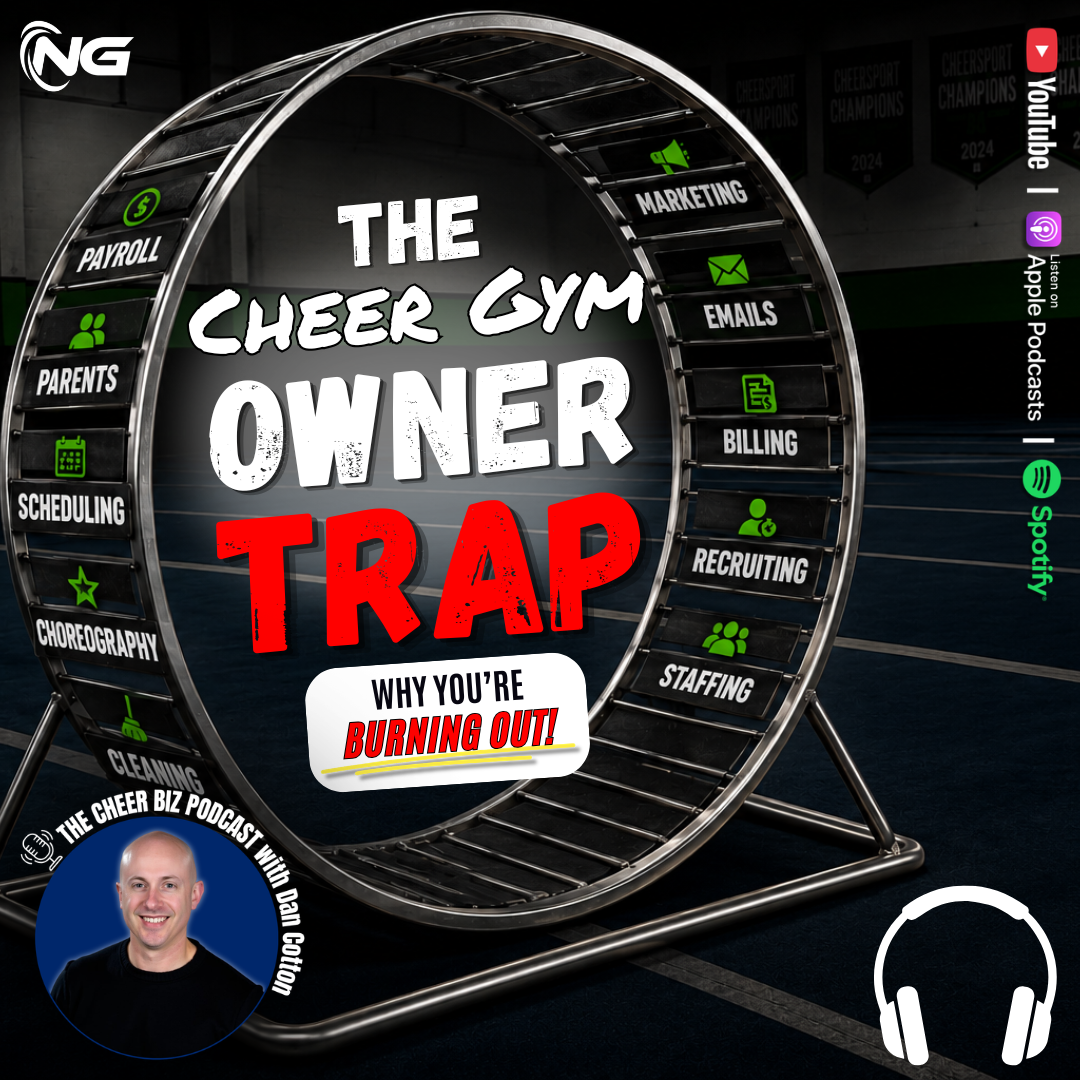
In this solo episode of the Cheer Biz Podcast, host Dan Cotton breaks down why gym owner burnout is on the rise across the cheer industry, drawing on his own experience and lessons from his new book, The Cheer Coach’s Handbook, to explain what’s driving it and how to fight back.
A Book Chapter That Hit Home
Dan Cotton opens this solo episode of the Cheer Biz Podcast by pointing back to a chapter he recently wrote in the newly released book, The Cheer Coach’s Handbook, on avoiding burnout. Since finishing that chapter, one group keeps standing out to him as most at risk right now: cheer gym owners themselves. This episode is his attempt to unpack exactly why that’s happening and what owners can do about it.
Before diving in, Dan shares a quick update from NextGen: the team’s Cheer Biz Accelerator event in Reno this August has officially sold out, with registration closed. The next opportunities to attend are coming up in Red Deer, Canada, followed by events in Missouri and Oregon. He encourages any gym owner interested in learning from his team to get registered for one of those remaining sessions, and points listeners to the Cheer Gym Owners and All-Star Cheer Coaches and Owners groups on Facebook to keep the conversation going between episodes.
Fresh Off the Stage in Nashville
Dan recently presented his Avoiding Burnout talk live at the NextGen conference in Nashville, which he calls one of his favorite conferences yet, a claim he admits he makes most years, but means every time. He felt the burnout presentation left a lot of attendees genuinely fired up to make changes, both within their gyms and within themselves. He also taught a session on using Claude, an AI tool, which generated a lot of enthusiasm and will be the subject of future content from his team. But burnout, not AI, is the focus of this episode, and Dan says it’s a problem he’s seeing more and more across the industry.
What Burned-Out Ownership Looks Like
Before getting into causes, Dan describes what burnout actually looks like in a gym owner. It’s the owner who has become detached, not fully engaged, not tracking what’s happening in the business, running on fumes, and quick to snap. Things in the gym start to slip, and that owner often can’t see that they themselves are a major part of the problem, because they’re no longer executing at the level they’re capable of.
Dan also notes that burnout tends to cluster around specific points in a gym owner’s career. One trigger is an unexpected drop in enrollment, often right after tryout season. Dan admits he felt this himself this year, after his gym saw one of its worst years for post-placement retention, with more families opting only for tumbling classes instead of continuing with a team. Beyond enrollment swings, he sees burnout cluster heavily around the three-to-five-year mark of gym ownership, once the initial excitement of the first two years wears off, and again around the ten-to-thirteen-year mark, when longer-term owners start to flame out.
Mistake One: Refusing to Delegate
The first major driver of burnout Dan identifies is an inability, or unwillingness, to delegate. Many owners convince themselves that the only way something gets done right is if they do it themselves. Dan is careful to note there’s a balance here. Some owners overcorrect in year one by handing out director titles to people who don’t yet know what they’re doing. But there’s a wide range of tasks that should be delegated from day one: taking out the garbage, vacuuming, setting up mats for class, pressing pro shop apparel, cleaning the gym, checking competition registrations, or even coaching a class or team. AI tools can help too. An email digest tool, for example, can take over sorting and organizing an inbox instead of an owner doing it manually.
Dan admits he’s personally guilty of the “it’s faster if I just do it myself” trap, even though he knows that investing a couple of hours to teach someone else pays off over the long run. He’s been working on this at his own gym, within NextGen, and now within Dream Camps, where he’s building out a team he can delegate to. As proof of progress, he notes that while recording this very episode, a camp is running at Lewis and Clark without him on-site, with his team fully in charge. He does add one caveat: delegation only works if it’s done properly. Simply assigning someone a title with no direction isn’t delegation, it’s abdication, and he plans to cover that distinction in a future episode.
Mistake Two: Rescuing Staff Constantly
The second major cause of burnout Dan describes is the habit of stepping in and rescuing staff the moment something becomes difficult, taking over a class because someone called in sick, or sitting in on a difficult parent meeting instead of letting a coach handle it. He notes there are legitimate exceptions, like a case where he intervened because a parent was too dysregulated to have a productive conversation with a coach. But constantly rescuing staff instead of letting them work through problems sends the message that they aren’t trusted or capable, and it robs them of the chance to grow. Owners, he says, need to let staff make mistakes, the same way a good coach lets an athlete fail and learn from a missed stunt correction rather than hovering over every rep. As long as safety isn’t at risk, most mistakes are simply part of the learning process, for staff and athletes alike.
Mistake Three: Execution Over Leadership
The third pattern Dan sees is owners who stay locked into execution, coaching classes, obsessing over score sheets, managing curriculum details, instead of stepping into the leadership role their position actually requires. He illustrates this with a story from earlier in the week: while driving a forklift at his gym, a staff member checked in on him mid-task, and Dan realized he simply needed a hat, water, and to hand off his phone entirely so he could focus. Because he’d built trust with that staff member over time, the handoff worked seamlessly, and problems got solved without him. The lesson, he says, is that owners who stay buried in execution eventually get overwhelmed by everything else competing for their attention. True leadership means meeting with people, coaching them up, and elevating the team, not just being the person constantly doing the work.
Mistake Four: Avoiding Discomfort
The final driver of burnout Dan identifies is avoidance, specifically avoiding the parts of the job that create discomfort, whether that’s reviewing the bank account, doing the books, or handling marketing and social media. Owners who avoid these tasks might feel temporary relief, but the stress doesn’t actually disappear. It lingers subconsciously and quietly compounds. Dan’s advice is to face those uncomfortable tasks head-on rather than let them pile up in the background. He references the idea of “eating the frog,” tackling the least appealing task first, though he says it’s less about the exact time of day and more about consistently blocking time for the thing you’d rather avoid and following through on it.
Delegate, Trust, Lead, Don’t Quit
Dan ties his four points together with a line borrowed from Dan Martell’s book Buy Back Your Time: “80% done right by someone else is a hundred percent freaking awesome.” Owners need to let people step up, allow staff room to make mistakes without rescuing them, focus on leadership rather than execution, and get uncomfortable tasks out of the way early so they stop draining energy in the background.
He closes with an encouragement for anyone currently feeling burned out: don’t quit. Dan’s view is that quitting is the only way to truly lose, and that pushing through the hard parts is what separates the owners who make it long-term from those who don’t. He encourages anyone struggling to reach out to NextGen for coaching support, even just to vent if that’s what’s needed in the moment, and reflects on how valuable it’s been for him personally to have people outside his own household, including his wife and fellow gym owner, to talk things through with.
Join the Conversation
Thanks for tuning in to this episode of the Cheer Biz Podcast. If you’re feeling burned out right now, know that you’re not alone, and that there’s a path forward. Reach out to the NextGen team if you need support, and don’t forget to join the conversation in the Cheer Gym Owners and All-Star Cheer Coaches and Owners groups on Facebook. And if the podcast helped you out this year, Dan would appreciate your vote for Best Podcast of 2025 during this year’s Cheer Awards. Thanks for listening, and we’ll catch you on the next episode.
If you enjoyed this episode, you may also like “My Lack of Delegation Was Killing Me”