
YouTube | Spotify | Apple Podcasts
The Emotional Stoplight: What Every Cheer Coach and Cheer Parent Needs to Know
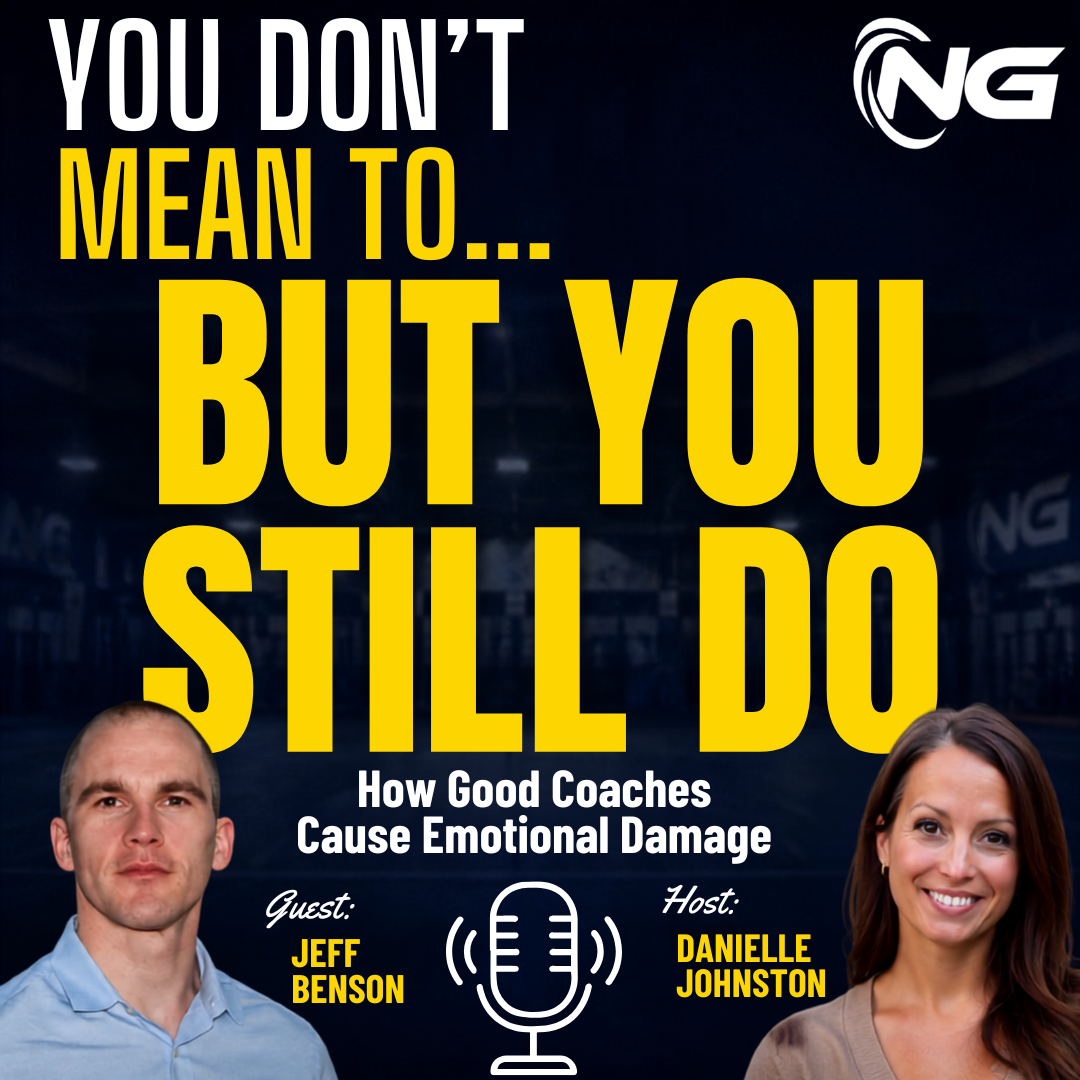
What does it actually mean to coach or parent with emotional intelligence in competitive cheer? This week I sat down with Jeff Benson — sports performance consultant, co-author of the Cheer Coach’s Handbook, and one of the most downloaded guests in Full Out Cheer history — to talk about toxic coaching, toxic parenting, and what it really takes to build resilient athletes. This conversation was one of my favorites, and I think you’re going to walk away with some serious tools.
Meet Jeff Benson
If you’re not familiar with Jeff, here’s his elevator pitch: he’s a sports performance consultant who works with competitive cheer athletes, coaches, and parents — all with the goal of helping athletes be the best people they can be through the sport of cheerleading. He helps them reach their goals on the mat and off.
I’ve personally used Jeff’s methods with my athletes over the years and seen outstanding results. His approach to building resilience and helping kids work through challenges — especially around tumbling — has been incredible. He’s also one of the contributors to the Cheer Coach’s Handbook, which is packed with worksheets and tools you can use directly with your staff.
When Does Fear Start? Understanding the Mental Shift in Young Athletes
One of the first things we talked about was when athletes start experiencing fear and self-doubt. A four or five year old doesn’t have the same mental hurdles as a twelve or thirteen year old — so what changes?
Jeff explained that it often correlates with rapid growth spurts, when the body changes quickly. But there’s also a developmental shift that happens around ages 11 to 12, when kids move from black-and-white thinking to more abstract thinking. That’s when fear starts becoming the dominant force. For many of Jeff’s clients, that fear starts even earlier, around nine years old.
I’ve seen this firsthand. Kids who got skills very young and never thought twice about them will suddenly stop and go, “Wait — what I do is actually dangerous.” Jeff put it perfectly: they realize what they’re doing is scary, and they just never recognized that before. That’s why I always talk to parents about pacing skill progression with emotional and mental maturity — not just physical ability. Just because an athlete can do a skill doesn’t mean they’re ready to handle the pressure of doing it on cue, every time, in front of a crowd.
The Emotional Stoplight: A Framework Every Coach Should Know
Jeff introduced a framework he uses called the emotional stoplight, and honestly, it’s one of the most practical tools I’ve heard for coaches and parents alike.
Green light means go — you’re feeling happy, confident, and joyful. Yellow light is that cautious middle zone: frustration, confusion, uncertainty. You have to make a choice about how to respond. And red light is rage, anger, panic, or overwhelm. When we’re in red light, Jeff says, chances are we’re letting our ego drive the car.
The key insight is that nobody’s stoplight looks the same. What sends one person to red might barely move the needle for someone else. The goal isn’t to stay permanently in green — a healthy person moves up and down the scale throughout the day. The problem comes when we’re stuck in red without realizing it, especially when we’re coaching.
Jeff shared a story about a moment coaching a high school athlete in the gymnastics gym. The athlete kept insisting his whip double was terrible, even when the video evidence showed otherwise. Jeff could feel his frustration rising — he was heading toward red — and he knew it because he recognized the physical sensations in his body. He used a tool (the video review) and eventually caught himself going fully red when the kid pushed back. His ego had taken over. He paused, switched activities to emotionally regulate, and then came back to address the moment with his athletes. His takeaway? As coaches, we have to be willing to own our slip-ups and then work to do better.
What Toxic Coaching Actually Does to Athletes
When a coach’s sense of worth is tied to how their athletes perform, it stamps something damaging into every kid in that room: I am only worthy when I get things fast. I am only valuable when I’m perfect. Kids inherently want to please the adults in their lives — so when a coach’s love and approval are tied to performance, kids don’t just feel pressure. They start to believe their worth as a person is conditional.
And here’s the part that surprised even me: even the “favorites” in a toxic coaching environment are being harmed. If you’re the kid who isn’t on the receiving end of the negative behavior, you’re still watching. You’re still learning. The message seeps in either way.
From a physiological standpoint, Jeff explained that kids in a toxic environment are in a high sympathetic nervous system state for the entire duration of practice. The sympathetic nervous system is what activates when we feel stress, fear, or pressure. Healthy humans move in and out of that state throughout the day. But when kids are in it constantly — never allowed to downshift — it has real physical consequences, including a compromised immune system.
I want to be really clear about something Jeff said, because I feel it too: the vast majority of coaches who act in these ways are not doing it intentionally. It’s often an unconscious drive, and many of them genuinely want to be better. The fact that our toxic coaching episode was one of our most downloaded says a lot. Coaches are listening. They want to grow.
So maybe instead of calling someone “toxic,” the more useful definition is this: a coach who recognizes they’re acting outside their values and isn’t doing anything to change it. The behavior is the problem — not the person.
The Mama Bear Trap: How Over-Protecting Hurts Kids
We also talked a lot about toxic parenting, and Jeff made a point I think every parent needs to hear: 99.9% of parents want what’s best for their kids. The problem is that wanting what’s best and acting in ways that are aligned with that goal are two very different things.
When parents step in to fix every struggle, manage every coach interaction, and shield their kids from every difficult emotion, they’re actually stealing something from their child. They’re stealing the ability to self-regulate. They’re stealing confidence. And they’re sending a powerful unconscious message: these feelings are so big and scary that even adults can’t handle them, so you definitely shouldn’t have to feel them.
Jeff put it bluntly: whatever we as parents don’t heal in ourselves, our kids are going to have to heal in themselves. A lot of us didn’t grow up with parents who knew how to handle big emotions, so we don’t know how to handle our kids’ big emotions either. That cycle continues until someone breaks it.
And here’s the part that stung a little: he said that both extremes — the over-protective parent and the pressure-filled, perfection-demanding parent — produce the same result. A kid who looks tough on the outside but is emotionally fragile on the inside. A Cadbury egg. Soft and gooey in the middle, unable to emotionally regulate when things get hard.
Having Hard Conversations: Tools That Actually Work
We spent a good chunk of the conversation on practical tools for when things get hard — for parents approaching coaches, for coaches managing their own emotions, and for everyone in between.
Jeff’s framework for parents: keep yourself at green light, or no higher than yellow, before approaching a coach. Use facts, not stories. My child came home crying is a fact. The coach hates my kid is a story. Ask questions: Help me understand… What can I do to support… How can I better help? Those are the conversations that actually move things forward.
I mentioned something I’ve used in my own parent interactions: taking notes during the conversation. It keeps me from interjecting prematurely, gives me something physical to focus on when I feel myself heading toward yellow, and helps me filter what actually needs to be addressed versus what I can let go.
We also talked about using tools like ChatGPT to draft emails when you’re feeling angry. Jeff’s take: it can be a useful bridge, but you have to actually read it, and you shouldn’t rely on it so heavily that you lose your ability to have hard conversations in person. If you outsource every difficult communication, you’re not building the skill set you need — and neither are your kids if they’re watching you do it.
For coaches, Jeff’s advice is simple: learn to sit with discomfort instead of rushing to fix or react. The dead air in a tense moment is often more valuable than a fast response. Respond in a way that’s aligned with your values, not in a way that’s driven by the story in your head.
Choosing the Right Gym: Champion-Minded Culture vs. the Status Gym
I asked Jeff a question I know a lot of cheer parents wrestle with: if your child could level up by leaving a gym with great culture for a gym with higher-level skills and more prestige, what would you do?
He didn’t give me an easy answer, but his real one was this: it depends on what you truly want your child to get out of this experience. And the more you understand about emotional development, the more you realize the culture might matter more than the level.
Jeff defines a champion-minded culture as the intersection of high challenge and high relationship. It’s not a gym where your kid is comfortable all the time — he actually wants kids to be frustrated, disappointed, and challenged. That’s how they build the tools to handle hard things. But the challenge has to exist within a relationship of trust, where coaches and parents are working as a team rather than on separate islands.
What worries Jeff about status-driven gyms is the burnout he sees. Kids who chase the name on their chest, who have their identity wrapped up in being elite, who by fourteen have walked away from the sport entirely. As a parent, he said, knowing the value of sports in a teenager’s life — that’s a heartbreaking outcome.
My own answer to this question has changed a lot as I’ve gotten older. At 25 I would’ve said go for the challenge and figure out the culture piece later. Now, with three adult kids and one 16-year-old still in the gym, I feel the shortness of this time deeply. The mental skills — resilience, emotional regulation, how to handle hard things — those are what they’re going to carry into the rest of their lives.
Cheer Celebrity Culture: A Real Concern
We touched briefly on cheer celebrity culture — the social media influencer side of the sport — and both of us agree it’s something to take seriously.
Jeff’s concern is that adolescents are wired to seek status and respect. Celebrity culture feeds that need in a way that feels satisfying on the surface but can be really harmful underneath. What your kid sees online is a curated version of someone else’s life. The pressure those “celebrity” athletes feel, the crash that comes after a fall at a major competition — none of that makes it into the highlights reel.
His advice for parents: you’re probably not going to stop your kid from engaging with cheer celebrity culture entirely, so use it as a teaching tool instead. Ask questions. Talk about what’s curated and what’s real. Help them develop a growth mindset when they’re comparing themselves to what they see online.
As a coach, I’ve been intentional about not putting anyone on a pedestal inside our gym walls. People are human. They will inevitably disappoint you. And when your whole identity is tied to someone else’s highlight reel, you’re setting yourself up for a rough landing.
The Triad: Parents, Coaches, and Athletes Working Together
Jeff keeps coming back to what he calls the triad: parent, coach, and athlete. When all three are aligned around the same values and working in partnership, that’s where the real magic happens.
One of my favorite things he said was this: find a gym that cares enough to help you parent. That’s a green flag. A gym where the coaches will sit in the room with you and your child, invite the athlete to be part of the conversation, and help everyone navigate the hard moments together.
He also talked about progressive exposure for helping quieter kids build the ability to advocate for themselves. You don’t have to expect a seven-year-old to have a full conversation about their feelings with their coach. But can she sit in the room while you talk, so the coach can look at her directly and ask, “Did your mom explain that the way you’re feeling?” Those small ladder steps are how you build kids who can eventually speak up for themselves — which is a life skill that matters a lot more than any tumbling pass.
I always encourage parents: coach your kid to come to me directly. About half the time when a parent tells me their child has a concern, the child never actually follows up with me. And that’s often because by the time they think it through, they’ve filtered it and decided it’s not that important. That’s actually healthy. We all have to learn which battles are worth having, and how to have them. You can’t be your kid’s advocate in every professional setting for the rest of their life.
Final Thoughts
Cheerleading is, by nature, a perfection-based and comparison-heavy sport. There’s an objective score sheet, but we all know we’re comparing from the moment we step into the gym. What Jeff argues — and what I genuinely believe — is that if you can lead with intention inside that environment, you’re equipping your athletes with something invaluable. The ability to handle comparison. The tools to deal with pressure and imperfection. A growth mindset that will serve them long after they’ve taken their last competitive bow.
If today’s episode resonated with you, I’d highly encourage you to pick up the Cheer Coach’s Handbook. Jeff’s chapter is full of worksheets and practical tools you can use directly with your staff and athletes. And as always, thanks for listening to Full Out Cheer. We’ll see you next week.