
YouTube | Spotify | Apple Podcasts
Redefining “Toxic”: What Cheer Parents and Coaches Really Owe Each Other
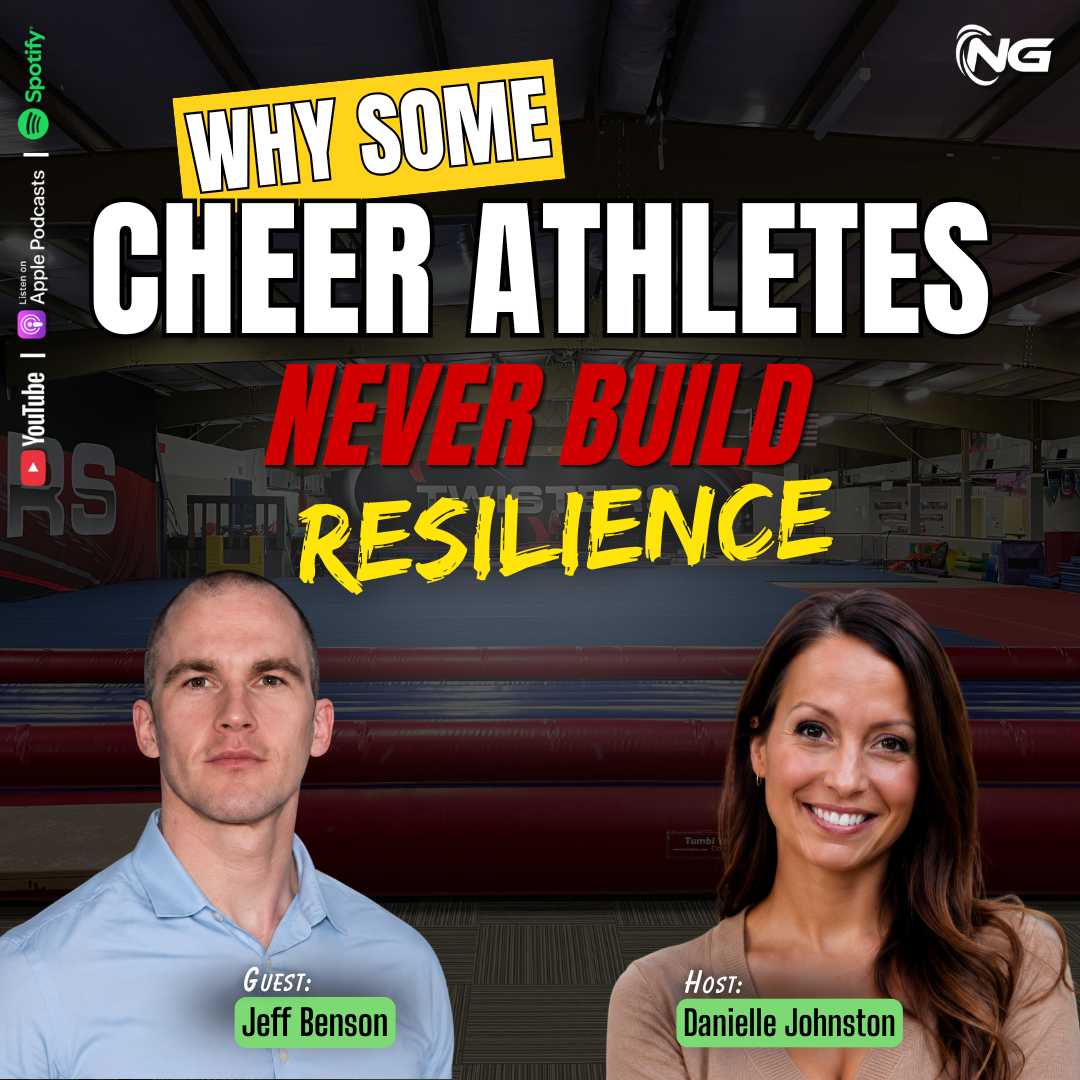
A while back on the podcast, I sat down with Jeff Benson of Mind Body Cheer, a sports performance consultant who spends his days helping gyms build what he calls a “champion-minded culture.” We got into one of those conversations that starts in one place and ends up somewhere much bigger — about what “toxic” really means, why we react the way we do under pressure, and how parents, coaches, and athletes can actually work as a team instead of against each other. Here’s the heart of what we talked about.
What Does “Toxic” Actually Mean for Parents?
We’d already spent part of the episode talking about toxic coaching, so I wanted to turn the question around: what does toxic parenting look like? My instinct was that it comes down to the same thing as toxic coaching — being self-serving. But with parents, I don’t think it’s intentional. Most parents are so used to knowing what’s best for their kids that when they land in a competitive environment like a cheer gym, that instinct can tip into pushing for the next skill, the next level, the next spot on the mat — without meaning to make it about themselves.
Jeff put a number on it that stuck with me: he’d say 99.9% of parents want what’s best for their kid. That part is almost never in question. The problem is that wanting what’s best and acting in ways that are aligned with that goal are two different things. We all have unconscious stories running in the background that drive our behavior in ways we don’t always notice — and that gap between intention and action is where things go sideways.
Facts vs. Stories: Why We React the Way We Do
Jeff shared an example that hit home for a lot of cheer parents: your daughter comes home crying because she got pulled from a spot in the routine, and suddenly you’re doing the math on how much you’re paying every year for this. It feels logical. It feels like facts. But as Jeff pointed out, if we truly want to shift the culture in this sport, we have to start giving each other grace — and recognize that the meaning we make of a situation is usually just a story, not the actual facts.
He described a mental trick he uses: imagine you’re a lawyer in a courtroom, and ask yourself whether the things you’re about to say are facts that couldn’t be questioned by the other side. “My kid came home crying” is a fact. “I don’t love how this feels” is a fact. But the story we build on top of those facts — that the coach doesn’t care, that our kid is being mistreated — is where we get into trouble.
This is also where a tool like ChatGPT can actually help. I’ve told parents at my gym: if you’re feeling heated, write the scathing email — just don’t send it. Run it through a tool that can help you reframe what you want to say in a way that’s still honest but more productive. Jeff’s caveat is a good one, though: AI can’t know your full values or goals, and if you lean on it for every hard conversation, you never build the in-person skills to navigate those moments live. It’s a bridge, not a replacement.
Mirror Neurons: When Our Kids’ Emotions Become Our Own
One of the most interesting things Jeff brought up was mirror neurons — the reason we start to feel what the people around us are feeling. When a parent reaches out feeling yellow, orange, or full panic-red about something happening with their child, that energy is contagious. The more a parent revs up needing to solve the problem right now, the more Jeff notices his own reaction ramping up too.
And it works the same way with our own kids. When they start ramping up emotionally, we start ramping up right along with them — and it doesn’t even have to match. Their sadness can trigger our anger. Jeff was honest that his own default setting, when he’s not at his best, is to want to tell an overinvolved parent to back off and let their kid struggle — which he’s the first to admit isn’t his best self talking.
The Urge to Fix — and Why We Should Sit With It Instead
This led to one of the more vulnerable parts of our conversation. Jeff talked about how, when a parent asks him how to keep their kid happy and confident, his instinct is to feel like it’s his job to fix it — and if he can’t, he must not be doing his job well. He generalized that pattern beyond cheer entirely: whenever we feel a compulsive need to fix things for other people, it’s almost always tied to a belief that if we can’t fix it, we’re not worthy or valuable.
His reframe: our job isn’t to fix. Our job is to sit with. And the better we get at emotionally regulating ourselves, the easier that becomes — whether we’re a parent, a coach, or an athlete trying to support someone else.
Mama Bear Parenting and the Cost of Rescuing Our Kids
I wanted to put this in plain terms, so I asked Jeff: what does “mama bear” behavior actually do to a kid? Not as a judgment — I’m a mom, and I know this comes from a place of protection, not malice. But what happens when we step in and solve our kids’ problems for them, over and over?
Jeff didn’t soften this one: when we let our own stories drive us to save our kids from every struggle, we steal their ability to self-regulate. We steal their confidence. And we send an unspoken message that their big emotions are too scary for even an adult to handle, so obviously they shouldn’t have to feel them either.
He went further, calling out his own generation of parents — including himself and me — for raising what he called a “soft generation.” And it’s not just about being permissive. He pointed out that being overly hard on our kids can create the same outcome from the opposite direction: kids who look tough on the outside but are just as emotionally unequipped underneath. Like a Cadbury egg — hard shell, soft and gooey inside. Most of us parent this way because our own parents loved us dearly but didn’t have the tools to help us deal with big feelings, so we had to raise ourselves emotionally. Whatever we don’t heal in ourselves, our kids end up having to heal in themselves.
Teaching Kids to Speak Up for Themselves
As a coach, I see this play out constantly: a parent tells me their daughter felt a certain way in practice, and my first move is always to want the athlete to tell me that herself. Here’s the thing — about half the time, that conversation never actually happens between the athlete and me. Kids filter what they say, just like adults do, and sometimes mom is simply the safe person they vent to. That’s not a bad thing; it’s part of learning where your own filter is.
Jeff calls his approach to building that skill “ladder stepping” or progressive exposure. A seven-year-old can’t have a full, nuanced conversation about her hurt feelings — but she can sit in the room while her mom talks it through with the coach, and nod yes or no when asked, “Is that how it felt?” Those small steps build toward a kid who can eventually speak up for herself.
There’s a bonus benefit, too: when the athlete is in the room, it creates accountability on both sides. The parent can’t quietly project their own agenda, because the kid might say, “That’s not what I meant.” And the coach is accountable as well — the athlete can confirm or correct what actually happened. Everyone does better when all three parties are part of the conversation.
Green Flags: Finding a Gym That Partners With You
Jeff calls it the triad: parent, coach, athlete. His advice for parents is to find a gym that holds the same values you do — one that will help you walk into an uncomfortable conversation instead of leaving you to have it alone. A gym that says, in effect, “I know this is scary for you as a parent. Let me help you come into the room, because I love your child and I value you.”
That kind of partnership, Jeff said, is the real ticket to a champion-minded culture. We raise resilient, confident kids together — not on our own separate islands.
Should You Ever Leave for a “Better” Gym?
I put Jeff on the spot with a question I know a lot of parents wrestle with: if your athlete could level up by leaving a program with this kind of culture for one that’s more of an unknown, is it worth the risk? He laughed and refused to answer in the abstract — fair, since every situation is different — but he walked through how he’d actually think it through for his own daughter.
His honest reaction, if he just went with instinct, would be to chase the higher level and the bigger skill set. But if he slowed down, he’d ask what he really wants his child to get out of the experience for the money he’s spending. A shot at Worlds and some challenging coaching sounds great — but it might also come with more comparison and a more hands-off, drop-your-kid-off kind of culture. Meanwhile, staying somewhere she may not be showcased as the star can still mean she’s being worked hard and well, in partnership with parents who are trusted to challenge her in the right ways.
His real point: a champion-minded gym isn’t one where your kid is comfortable all the time. He said flat out that he wants his own daughter to be frustrated, disappointed, and stuck in a yellow-light headspace a good chunk of the time — because that’s where growth actually happens.
What a Champion-Minded Culture Actually Looks Like
This is the part Jeff cares most about getting precise, because he believes so much of our disagreement in this sport comes down to people using the same words to mean different things. Toxic, growth mindset, mental block — we all define them differently in our heads, and we rarely check whether we’re even talking about the same thing.
His definition of champion-minded: the intersection of high challenge and high relationship. A gym that’s all relationship and no challenge isn’t pushing your kid. A gym that’s all challenge and no relationship is just toxic pressure. And challenge doesn’t only mean physical — it’s mental and emotional too. Can a gym challenge a kid in all three ways at once? That’s the real test.
The Danger of Cheer “Celebrity” Culture
I asked Jeff a question that’s been on my mind for a while: does cheer’s growing “celebrity culture” make him nervous? His answer was immediate — terrifying, in his words. He understands the pull completely: adolescence is already full of wanting to feel valued and respected, so chasing status makes sense developmentally. But he’s seen too many kids chase that status-and-respect gym experience, burn out within a year or two, and be completely disengaged from the sport by fourteen.
I feel the same way, for a related reason. When we put anyone on a pedestal, they’re still human, and they will inevitably disappoint the people looking up to them. That’s a hard landing for a young athlete’s mental health.
Jeff’s suggestion isn’t to pretend celebrity culture doesn’t exist — our kids are going to encounter it regardless. Instead, use it as a growth-mindset teaching tool. Ask your kid to imagine the pressure behind those polished posts, and remind them that what they’re seeing online is almost always a curated version of someone else’s worst and best days.
Leading With Intention
As we wrapped up, Jeff made a point I think is worth sitting with: cheerleading is, by nature, a perfection-based, comparison-heavy sport. That’s baked into a judged score sheet and impossible to fully avoid. But if a coach can lead with intention — building a genuinely challenging, growth-minded environment while also equipping kids with the tools to handle comparison and the drive for perfection — that combination becomes an invaluable resource for a world that’s still largely running on fixed mindset.
It’s a theme I keep coming back to on this podcast: when we coach with intention, we see fewer issues with things like mental blocks and athlete insecurity, because we’re helping shape how our kids’ brains handle pressure long after they’ve left the gym.
If this conversation resonated with you, Jeff’s book, the Cheer Coach’s Handbook, digs into all of this in more depth — including discussion questions at the end of every chapter and worksheets you can use with your own staff to build resilience in your athletes. Thanks for listening, and I’ll catch you next week on the Full Out Cheer Podcast.