
YouTube | Spotify | Apple Podcasts
Why Hit Zero Is Quietly Hurting Cheerleading
In this solo episode of the Cheer Biz Podcast, host Dan Cotton makes the case that the sport’s obsession with hitting zero deductions is doing more harm than good, and lays out why he believes it’s time for gyms to rethink how they define success.
A Bold Claim, Years in the Making
Dan Cotton opens this episode of the Cheer Biz Podcast with a claim he doesn’t make lightly: when the cheerleading industry looks back on the last twenty-five years, he believes that validating the concept of “hit zero”, and building so much of the sport’s culture around it, will stand out as one of its biggest mistakes. Dan is upfront that this is his opinion rather than a data-backed conclusion, but it’s one he’s arrived at after years of coaching, and more recently, after a conversation with another gym owner that crystallized his thinking. He wanted to lay out the full case for listeners, along with what he thinks gyms should do about it.
Hitting Zero Doesn’t Mean Winning
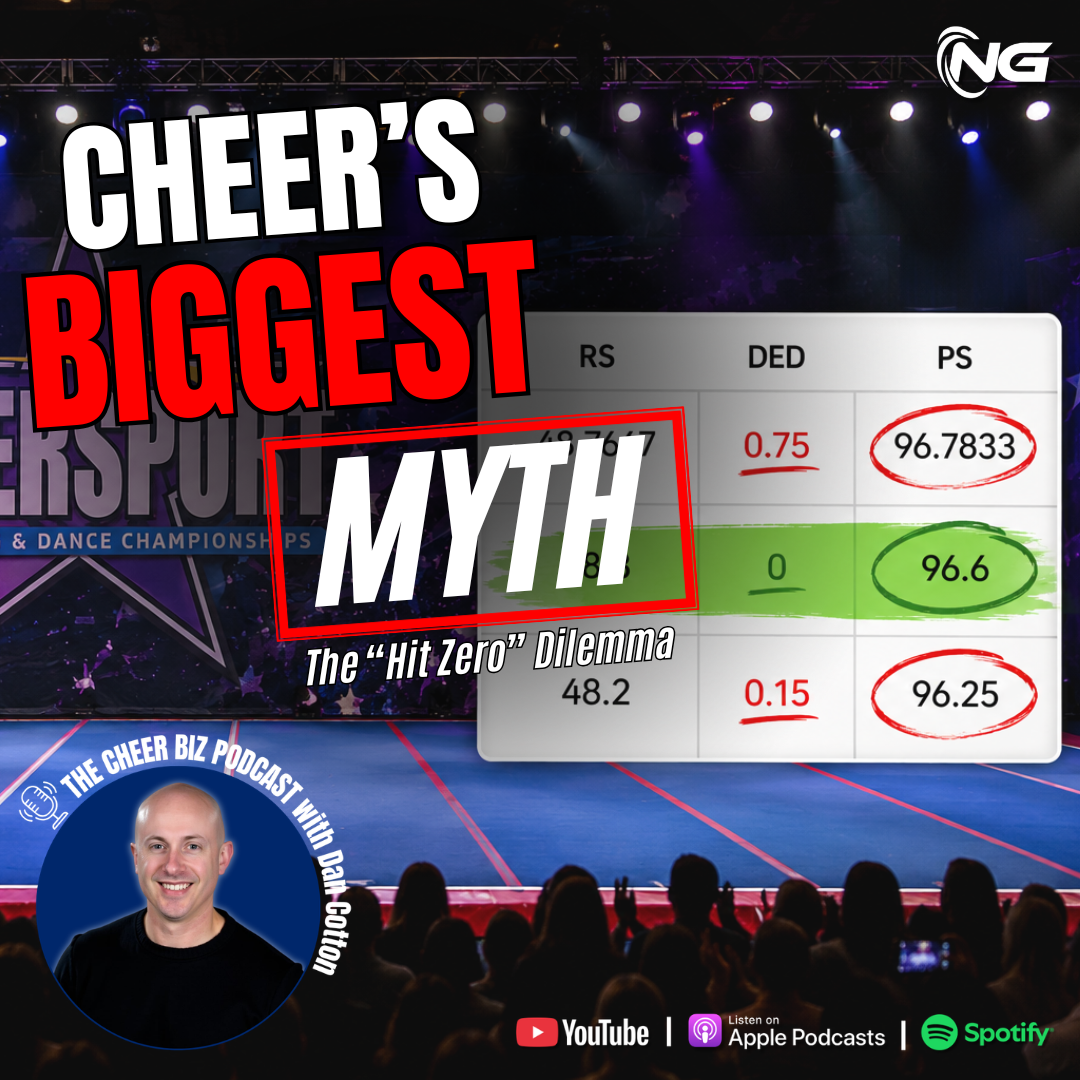
Dan’s first point is that hitting zero, meaning a routine performed with no deductions, doesn’t actually determine who wins. Gyms drill the phrase into athletes constantly, he says, calling it maybe the most repeated phrase in the industry. But a team can hit zero and still lose to a team that had deductions, or every team in a division can hit zero and someone will still finish last. Hitting zero simply means there were no execution errors; it says nothing about whether the skills performed were difficult enough to win. Dan offers a deliberately extreme example: a senior, medium, all-girl Level 4 team could hit zero on a Level 3 routine and still get beaten badly, because they weren’t throwing skills at the appropriate level.
The bigger problem, Dan says, is that parents and athletes often don’t grasp this nuance, even when gyms try to explain it. A team can walk off the mat having hit zero and still lose, leaving everyone confused about how that’s possible. The reverse is true too: a team can miss part of their routine and still win, because their execution was stronger elsewhere, their deduction was minor, or a competitor lost points to something even more costly than a deduction. Dan points to the scoring mechanics on the United score sheet, where an omission, like an athlete turning their hips at the bottom of a dip and not getting credit for a full-up, or a base falling out of stunt range and scoring a 3.5 or 4 instead of a 4 or 5, can cost a full point or more, compared to a deduction that might only cost 0.25 to 0.75 of a point. Losing a skill entirely can be far more damaging than a clean deduction, which is exactly the kind of nuance that gets lost when hit zero becomes the only story a gym tells its athletes.
The Devastating Moment of a Deduction
The second problem Dan raises is emotional. When hitting zero becomes the focus, a single deduction partway through a routine can become a devastating moment for an athlete, even though there’s still more routine left to perform. He describes watching an athlete touch down and seeing their face drain in real time.
Dan shares a personal story to illustrate the point. His Level 4 team, the reigning D2 Summit champions from the year before, competed at D1 Summit and decided to come out strong with six standing back handspring flips in the tumbling section, skills the team had hit all season without ever dropping one in competition. On the floor at Summit, his daughter’s stunt group, which he describes as exceptionally strong, dropped their skill. He recalls watching their faces and knowing instantly that they understood what it likely meant for their chances of reaching finals. What made him proudest, he says, was watching the team, including his own daughter, a self-described perfectionist, rally and make the rest of the routine look outstanding rather than unraveling. As both a parent and a coach, he was proud of how the team responded, even though the deduction still stung.
Dan connects this to a broader pattern he sees across the sport: flyers scanning the room mid-routine to see if anyone else dropped, or bases glancing over their shoulders at a group that looked shaky in warm-ups. That hyper-awareness of the zero pulls focus away from execution and adds a layer of anxiety he believes doesn’t need to be there.
A Coach’s Own Anxiety at the Mat
Dan doesn’t exempt himself from this dynamic. He jokes that he’ll probably die one day in the warm-up room, because from the moment warm-ups end to the moment his team’s music starts, he’s in a state of pure anxiety. He reminds listeners that anxiety and excitement register as the same chemical reaction in the brain. He’s genuinely excited, but also genuinely anxious, because at that point there’s nothing left for him to control. He describes it as prayers, hopes, dreams, and deep breathing, hoping his athletes can perform to their potential without the added dread of not hitting zero and feeling like failures regardless of how well they actually performed.
He points back to that same Level 4 team’s Summit routine as an example: aside from the one dropped skill, he considers it the best routine they ran all season, the cleanest, most exceptional performance of the year, with a stunt execution score that was nearly perfect. But because of that single deduction, the team walked away feeling like they had done something wrong, when in Dan’s eyes they had turned in one of their finest performances.
Every Other Sport Allows for Errors
Dan’s broader argument is that cheerleading is unusual among precision- and judgment-based sports in demanding perfection as the standard. He points to figure skating, gymnastics, and diving, sports built around flawless execution, and notes that none of them center their culture around a hit zero concept the way cheer does. Skaters fall. Gymnasts have deductions. Divers miss entries. Those sports treat errors as part of competition without building an entire emotional framework around the absence of them.
He extends the comparison beyond judged sports: a football team doesn’t score on every drive, a soccer team turns the ball over constantly even at the World Cup level, and hockey players take penalties and lose the puck. Errors are simply part of every sport, except that in cheerleading, the cultural expectation is perfection at all times. Dan doesn’t think that expectation is healthy for the kids competing under it.
A Possible Driver of Mental Blocks
The most serious concern Dan raises is a possible connection between the hit-zero culture and the rise in mental blocks he’s observed while traveling the country to teach. He’s clear that this is an opinion rather than something he has data to prove, but based on what he’s seen over the last five years, mental blocks have become far more widespread than they used to be, when he might have encountered them in only a handful of athletes at a time.
Dan’s theory is that the pressure to be perfect, reinforced constantly by the hit-zero mindset, hits perfectionist-minded athletes especially hard, building anxiety around the idea that a single mistake doesn’t just affect them, it affects the whole team. That kind of pressure can trigger a fight-flight-freeze response, and when an athlete freezes, it reinforces a belief that they’ve failed, which can spiral into a much deeper mental block.
Rethinking What Gyms Celebrate
Dan doesn’t expect hit zero to disappear from the sport entirely, and he isn’t arguing that deductions shouldn’t exist. He thinks they’re a necessary part of scoring. His recommendation is narrower: gyms should move away from making hit zero the centerpiece of how they talk to athletes. He still plans to celebrate it in small ways, handing out buttons and acknowledging the accomplishment, but he’d like to see gyms de-emphasize it as the primary marker of a successful routine. Instead, he wants his athletes to know that what matters most to him is whether they gave their best effort, regardless of what the judges’ score sheet ultimately says. He encourages other coaches and gym owners to take an honest look at how much they reinforce hit zero in their own programs and to gradually shift the focus toward other markers of success and growth.
Join the Conversation
Thanks for listening to this episode of the Cheer Biz Podcast. If Dan’s take on hit zero got you thinking about how your own gym talks about success, head over to the Cheer Gym Owners and All-Star Cheer Coaches and Owners groups on Facebook to keep the conversation going. And if you’re ready to take a deeper look at how to grow your gym, check out one of the upcoming Cheer Biz Accelerator events. There are three more with open spots in 2026 before the series moves into its 2027 season. Ready to get started right away? Book a call with the NextGen sales team to get signed up for the academy.