
YouTube | Spotify | Apple Podcasts
Three Lies Cheer Gym Owners Tell Themselves And How To Stop
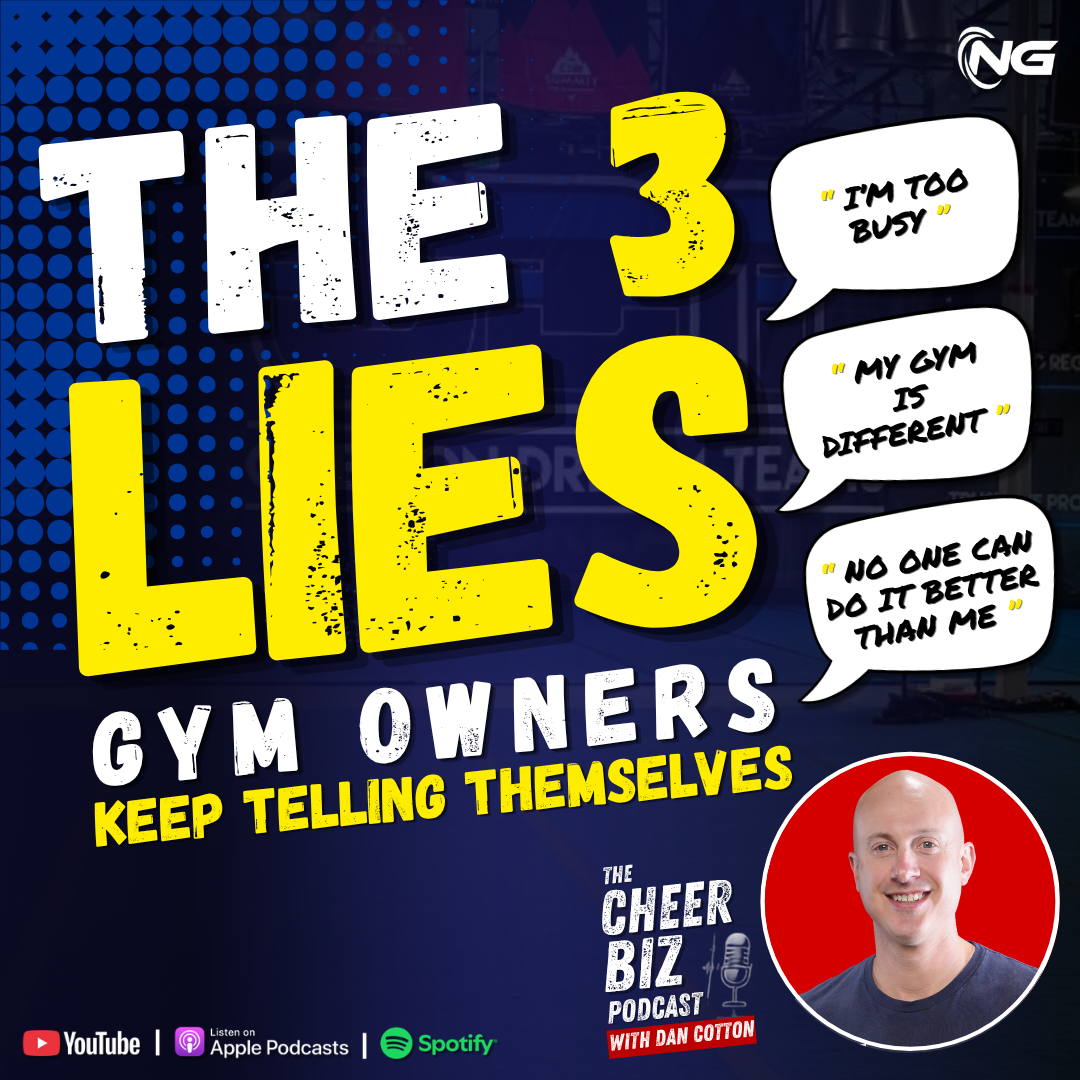
Dan Cotton, host of the Cheer Biz Podcast, breaks down the three most common lies gym owners tell themselves about being too busy, being too different, and being too indispensable — and explains why letting go of them may be the fastest path to real growth.
Confronting the Lies We Tell Ourselves
Welcome back to another episode of the Cheer Biz Podcast. Host Dan Cotton opens this solo episode with a question every gym owner has asked themselves at some point: how many times have you said, “when things slow down, I’ll fix that”? According to Dan, that promise is just one of several lies gym owners routinely tell themselves, and this episode is dedicated to naming three of the biggest ones, explaining how they quietly hold owners back, and offering a clear path to doing something about it.
Before diving in, Dan reminded listeners to join two active communities: Cheer Gym Owners and All-Star Cheer Coaches and Owners, both on Facebook, where gym owners regularly swap ideas about running their businesses and staying current on everything happening with NextGen and the Academy. He also pointed listeners toward the upcoming Cheer Biz Accelerator events, small-group intensive sessions happening in Missouri and Oregon later this year, designed to take a deep dive into a gym owner’s business and help them grow it.
Dan explained that not all self-talk is harmful. Telling yourself “it’s going to get better” or “I’m capable of this” can be the kind of healthy lie that pushes you to get up and do the hard thing, whether that’s posting a video on YouTube or walking into a difficult parent meeting. But there’s another category of lie, the kind gym owners tell themselves not to motivate action but to excuse inaction. Those are the lies worth examining, and Dan walked through three of the most common ones.
The ‘I’m Too Busy’ Excuse
The first lie, and one Dan admits he’s told himself plenty of times, is “I’m too busy.” It’s an easy excuse to reach for, but Dan pushed back on the premise itself: are gym owners really too busy, or are they simply not using their time effectively? He noted that whenever he sits down with a gym owner who insists they’re too busy and actually runs a time audit on their day, the answer is usually the same. They are busy. They’re active from morning to night. But they’re busy doing the wrong things: chasing distractions, putting out fires, or handling tasks that could easily be delegated to someone else or set aside for a little while.
To make the point concrete, Dan walked through his own day: meeting a contractor at his old house, a call on the drive home, an all-staff meeting for NextGen followed by management and owner’s meetings, work on apps he’s building for NextGen, billing for Dream Camps, and remotely resolving a couple of challenges at the Florida camp. He prepped for his NextGen coaching calls, took a short break to assemble fitness equipment at his new house, grabbed a quick lunch and shower, worked on a survey, took another meeting en route to the gym, recorded this podcast, built a practice plan with his co-coaches between recordings, and headed straight to coach his level four team afterward, with more work waiting that evening. Notably, he barely touched Facebook and only glanced at Instagram during lunch. Everyone has the same number of hours in a day; the difference is how deliberately those hours get used.
Track Your Time to Find the Truth
Dan offered a practical tool for anyone who suspects they might be falling into the busy-but-not-productive trap: the time audit. The method is simple. Set a timer to go off every 15 minutes. When it rings, write down everything you did during that stretch, then reset the timer and keep going. It’s tedious by design. Dan noted that the act of having to write things down actually changes behavior in real time, because most people don’t want to admit they checked email, scrolled Facebook, browsed Instagram, sent a text, and looked at a competitor’s website all within a single 15-minute block. The embarrassment alone tends to sharpen focus, and over time the exercise reveals exactly where the hours are really going.
The bigger insight, Dan said, is that most gym owners aren’t actually as busy as they feel. And when they are genuinely busy, it’s often with tasks that aren’t moving the business forward. He also addressed the common refrain of “I’m too busy for X right now, but I’ll get to it when things slow down.” His answer was blunt: things are never going to slow down. Learning to do the hard, important things while you’re busy is what separates owners who make lasting progress from those who keep waiting for a calm moment that never arrives. If you can only tackle big priorities when things are quiet, you’ll never stick with them long term, because busy season always comes back around.
The Myth That Your Gym Is Different
The second lie Dan tackled is one he’s touched on in past episodes: “my gym is different.” He was quick to acknowledge there’s truth buried in it. Every gym does have its own rent, space, staff costs, payroll rules, and state-specific legal requirements, and those genuinely can’t be copied and pasted from one business to another. But Dan drew a hard line between those legitimate differences and the excuse gym owners lean on to avoid trying something new. At the end of the day, every gym is teaching cheerleading, and the fundamentals that make a gym successful work in the vast majority of cases, regardless of location or size.
He pointed to a common mistake he sees constantly: gym owners trying to plug and play the exact pricing structure or employee handbook from another successful gym owner, without accounting for the fact that laws and market conditions differ by state. That kind of direct copying doesn’t work, and it’s genuinely a case where the differences matter. But Dan was careful to separate that from the far more common situation, where an owner declares “that won’t work here” about something that has nothing to do with their gym’s actual unique circumstances and everything to do with reluctance to change.
What Actually Works Everywhere
Dan ran through a list of things that do transfer across gyms almost universally, regardless of location, size, or clientele. Marketing tactics that convert tend to convert broadly. Monthly recurring billing works. Investing in class management software works. Having a professional website works, even though owners sometimes convince themselves their parents need something custom or unique. He also flagged the practice of not letting coaches keep 100 percent of private lesson revenue as something that works well operationally, even if it’s not universally popular with staff at first.
The resistance to these changes, Dan noted, often has less to do with whether they’ll work and more to do with the fact that people generally dislike change. When an owner introduces something more efficient, the initial reaction from staff or parents is frequently negative, but that reaction tends to fade once people adjust and see the benefit. Dan’s broader recommendation was to work with someone experienced, a trained coach or gym owner who understands implementation, when rolling out new systems. Too often, owners modify a proven system to “fit their gym better,” not realizing the piece they changed is the piece that drives the results, then blame the system when it doesn’t work as expected.
Dan used a tumbling analogy to drive the point home: a back handspring can be executed with different styles, a deep sit or a shallow one, more emphasis on the jump or on the arm throw, but every single one still requires getting the arms overhead into a handstand position off the ground. There’s no version of the skill that skips that fundamental. In the same way, a gym can have its own flavor and personality, but the fundamentals of good business still apply. Your gym is different, Dan said, but it’s not a unicorn, and good business is simply good business.
No One Can Do It Better Than Me? Think Again
The third lie is a familiar one for owners who struggle to delegate, or who tried delegating once and got burned: “no one can do it better than me.” Dan called this one out directly as a cop-out. He acknowledged that no one is going to care about the business the way the owner does, because for the owner, the gym is their creation, their baby, something they’ll never fully separate from unless they sell it or shut it down. Staff can care a lot, but they’re never going to care at that exact same level, and that’s simply the nature of ownership.
But caring the most and being the best at every task are two different things, and Dan pushed back hard on the idea that no one else could ever outperform an owner in a given area. He was candid that plenty of people out there could probably run his own business better than he does, even without his depth of institutional knowledge. There are people who can coach better, manage staff better, handle social media better, manage billables better, and sell better, and Dan admitted there are people who can out-sell him too, despite considering himself a strong salesperson. The real issue, he said, usually isn’t that no one can do it better. It’s that no one in your current circle can do it better, or that you’re using the fear of imperfect execution as a reason not to hand anything off at all.
Embracing the 80 Percent Rule
To help reframe delegation, Dan leaned on a line from entrepreneur Dan Martell: “80 percent done by someone else is 100 percent freaking awesome.” Even if a delegated task only gets done to 80 percent of the owner’s own standard, that’s still 80 percent of the work off the owner’s plate. Sometimes the person you delegate to will exceed expectations. Other times you’ll need to carry it that final 20 percent yourself. Either way, it’s a far better outcome than trying to hold onto everything personally because no one else could possibly meet the bar.
The through-line across all three lies, Dan said, is the cost of believing them. Owners who convince themselves they’re too busy, that their gym is too different, or that no one else can do the job as well as they can will not grow as fast as they’re capable of growing. They’ll stay stuck doing things the way they’ve always done them instead of adopting approaches that are proven to work across the industry.
Naming Your Lie and Moving Forward
Dan closed the episode with a direct challenge to listeners: identify which of these lies you tell yourself most often, name it out loud, and deliberately act against it the next time you catch yourself reaching for it. If the excuse is “no one can do it better than me,” the response should be to find or train someone who can. Dan pointed to his own experience as a tumbling coach as proof this is possible, noting that he never landed a full-and-a-half through to double himself, yet he’s able to teach the skill to others and is actively training people to surpass him. If the excuse is “my gym is different,” the challenge is to separate the things that are truly unique to your business from the things that are simply uncomfortable to change. And if the excuse is “I’m too busy,” the answer is to stop waiting for things to slow down, because they won’t, and to start doing the hard things now.
Dan thanked listeners for tuning in to this shorter episode and encouraged everyone to keep the conversation going in the Cheer Gym Owners and All-Star Cheer Coaches and Owners Facebook groups. For gym owners ready to dig deeper into their own businesses with hands-on guidance, registration is open for the upcoming Cheer Biz Accelerator events in Missouri and Oregon later this year. As always, he’ll be back with the next episode of the Cheer Biz Podcast soon.
If you enjoyed this episode, you may also like “Breaking the “That Won’t Work Here” Myth“