
YouTube | Spotify | Apple Podcasts
Working With Family in Your Cheer Gym: A Real Framework for Making It Work
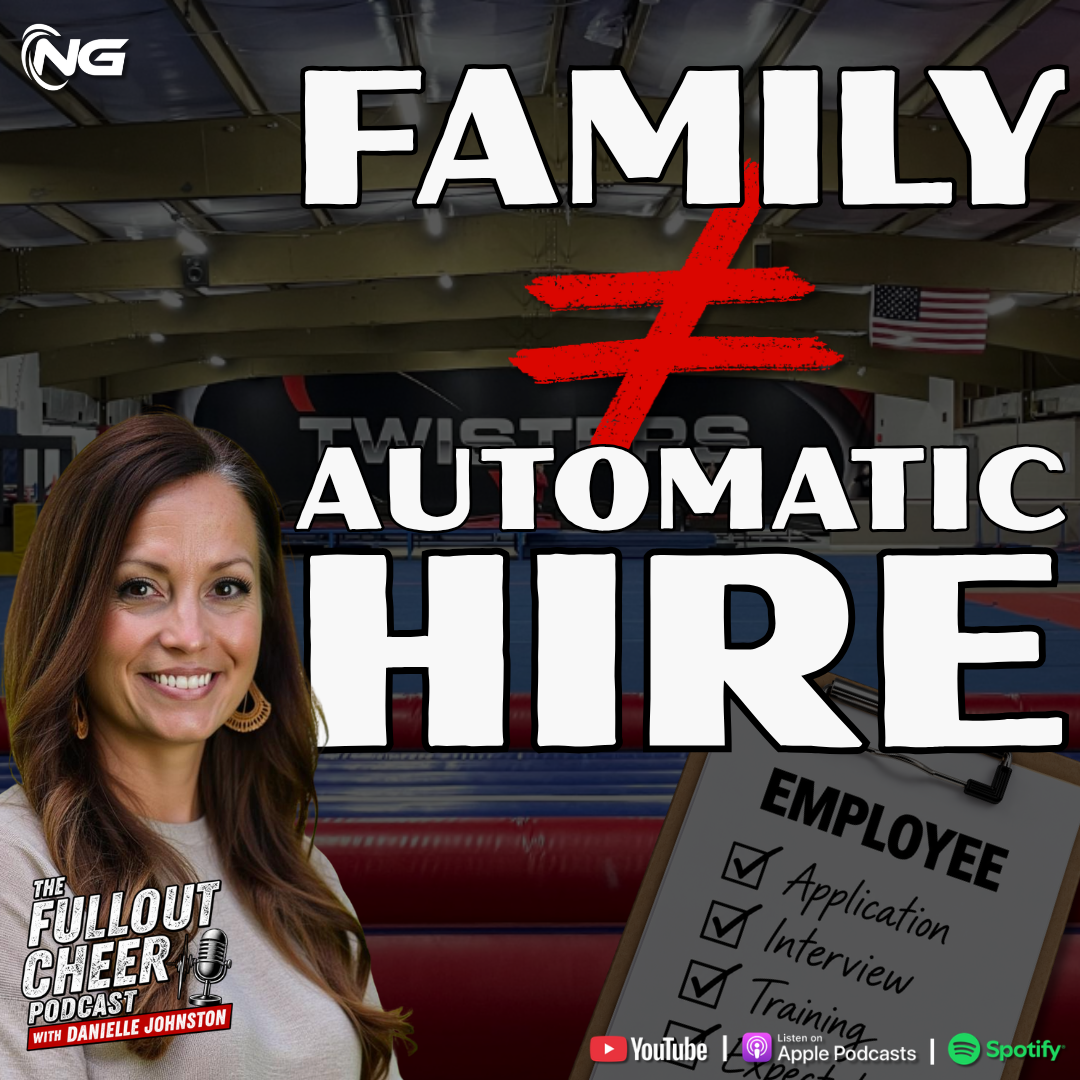
Working with family is one of the hardest things you will ever do in your cheer gym — and boy, have I done it. In this episode of the Full Out Cheer Podcast, we’re talking about what it really takes to work alongside the people you love, whether that’s a spouse who co-owns the business with you, kids who coach or work the front desk, a sister who helps out, or a mother-in-law who answers the phones. I’ve been there and done it all, and today we’re covering every challenge that comes along with keeping it in the family.
My Gym Has Been a Family Business From Day One
I’m Danielle, and I own a gym in Warrensburg, Missouri — a small town about as close to the dead center of the state as you can get. My gym opened about fifteen years ago, and from day one I’ve owned it with my family. My husband and I run it together with another couple, and when we first started, our kids were too young to actually work there. That was fifteen years ago, though, and today both my daughter and my business partner’s daughter work at the gym.
My mother-in-law used to work the front desk. My sister-in-law used to handle cleaning and sanitizing at the end of the night. My business partner’s husband works in the gym too, along with both of her kids, and her mother-in-law is actually our kids’ camp director. So if we’re talking about what it’s like to run a family business, I’ve been on every end of that spectrum — and it’s something almost every one of my coaching clients deals with as well: a spouse, a sister, a cousin, someone who works in the gym alongside them.
It can become a huge point of contention if you don’t have the right systems and structure in place. My daughter is sixteen and a junior in high school, and we’re actually planning a college visit near one of my next-gen coaching clients this month. I joked with my husband, Justin, about how cool it would be if she could pick up some hours at that gym — she’s grown up in this world and can do just about anything, from coaching to front desk. Justin laughed and pointed out that if she worked there, his one call a week with that client would turn into two, because now one of them would have to be about staffing. It was a funny moment, but it got me thinking about how casually we sometimes treat our own family members as staff — joking about what a great employee they’d make — without acknowledging that family has also produced some of the most challenging relationships and toughest employment situations in my gym’s history.
So here’s what I want to walk you through: how to work effectively with family. And if you’re a gym owner who doesn’t currently have any family on staff, stay with me anyway — because one day a coach’s spouse, sibling, or child may apply, and you’ll need the exact same structure in place for them. We once had a manager whose husband applied to coach our ninja program, and if you run a ninja program, you know you can’t turn away someone who’d be a great coach just because of who they’re related to. You need these systems ready before that moment arrives.
Your Family Isn’t the Problem — Your Structure Is
Here’s the first thing I need you to hear: your family is not the problem. The structure of your employment processes is the problem. I’ve talked to so many gym owners, myself included, who’ve said things like, “Oh, she’s just here to help when we need her,” or “I’m not really tracking her hours,” or “She’s fine not getting paid right now because she loves me.” That kind of thinking feels harmless until you need to correct a family member’s work and suddenly feel like you can’t, because you’re afraid of offending them.
When we first opened the gym, my mother-in-law worked the front desk. We didn’t have much of a budget for staff, so we paid her a little, gave her a computer and a cash box, and called it good. At the end of the night I’d find pages of handwritten notes — beautiful cursive, almost like calligraphy, because that’s her generation — but notes like “Elena bought a bag of chips for this amount of dollars.” It’s incredibly hard to run a business on notes like that when someone isn’t comfortable with a register or a computer. Eventually I couldn’t keep her at the front desk anymore. People loved her, she was wonderful with families, but she simply couldn’t do what the role required.
Our head coach, Samantha, had a similar experience before she joined our team — her grandmother worked the front desk mostly to stay busy and stay involved, not because she was sending email automations or updating the website. That’s the real challenge: we want to give the people we love a position that makes sense for them, but that position often comes with zero structure. Which means, more often than not, you’ve simply got the wrong person in the role — and all that missing structure becomes more work for you down the line.
Treat Family Like Any Other Applicant
That lack of structure with my mother-in-law was, thankfully, always meant to be part-time and temporary. But it came back to bite us later, when our own kids started coaching and we hadn’t built the same systems for them. So here’s the rule: treat your family like actual staff members. Yes, that means they undergo an interview. They submit a resume. They go through the exact same training as everyone else. Even if nothing else changes, this alone will minimize resentment from the rest of your staff.
It’s easy to see family through rose-colored glasses in both directions — we assume our sister will be great because she also grew up in the cheer world, or she’s amazing at her own social media, so we hire her without weighing her against other candidates who might genuinely be a better fit. When your staff sees someone come in who’s less qualified, or who is qualified but isn’t held to the same process, it breeds resentment fast.
So yes, all of my kids have had to submit an application and resume to work at the gym. They’ve all interviewed with someone other than me. They’ve all done job shadowing — their first several shifts are spent simply observing coaches, taking notes, and asking questions afterward. They’ve all been trained on hands-on spotting from scratch. My business partner’s daughter is naturally gifted — she was spotting standing tucks in high school — and we still taught her how to teach cartwheels and handstands from the ground up, the same as we would anyone walking in the door. If we’d assumed she already knew those things because of her talent, it would be no different than letting an experienced outside coach skip our training because they’d coached a team to Worlds. It doesn’t matter what you’ve done elsewhere — everyone trains on how we spot, how we communicate, and how we coach with empathy and respect here. Don’t let family bypass the system just because you already trust their experience; it will create animosity among your staff every time.
Give Every Family Member a Clear Role
If your plan is that your sister will “help out” — a little front desk, a little office work, pressing some pro shop t-shirts, taking some social media photos — you’re setting yourself up for frustration. You’ll get annoyed when she hasn’t posted in a month, when she’s unavailable the day shirts need pressing, when the office is a mess. But here’s the truth: any other staff member in that situation would have received a job description, a position agreement, or a clearly defined task list. If none of your staff have that, even the ones doing great work, you’re going to hit a wall eventually — a moment where you’re frustrated with someone for not meeting expectations you never actually gave them.
Every family member needs a role, and that role needs to be clearly outlined: what are the key performance indicators, what’s the expectation, how will they be evaluated, and what does accountability look like when they don’t meet it? Treat family exactly like you’d treat any other employee here.
The one caveat is spouses running the business together — that’s really a topic for its own episode. There are elements of clear roles and accountability that absolutely apply to a marriage running a business, but there’s also a different dynamic at play. You each bring strengths to different areas, and sometimes it makes sense to maintain those lanes and sometimes it doesn’t. A family member who works for you doesn’t carry the same level of mutual obligation you have with a business partner or spouse.
Keep Your Employee Relationship Separate From Your Family Relationship
This one’s crucial: don’t let the Thanksgiving table become a staff meeting. Don’t call your sister at 10:30 at night to complain about a billing error. Treat your family members with the same respect you’d give any other employee — if you’d wait until the next day, or their next shift, to raise an issue with a regular staff member, extend your family the same courtesy.
As much as we talk about burnout in this industry, family members are often the ones who burn out fastest, precisely because we tend to skip the boundaries we’d naturally keep with everyone else. Late-night calls, not-so-kind text messages the moment something goes wrong — those are the exact things that drive burnout, and we assume family won’t quit because they love us. But burnout doesn’t care how much someone loves you. It can push anyone to walk away, and that kind of fallout can strain the family relationship right along with the business one.
This extends to the owners themselves, too. My husband Justin and I have had to set real boundaries — I’m a morning person who wants to talk business first thing, coffee in hand; he’s wide awake late at night scrolling the news. So we don’t talk business before 9 a.m. or after 9 p.m. If something comes up outside that window, it goes in an email or a note for the next day. The same boundary applies with my daughter. If she comes home at 10 p.m. after a rough shift, my patience is already thin, and that’s not the moment to hash out a work problem — even though it might be exactly the moment she needs to vent. I’ve had to learn to ask myself: is she talking to me right now as her mom, just venting? Or is she telling me because she wants me, as her boss, to fix something? Those are two very different conversations, and figuring out which one you’re in — and honoring people’s off hours — is a boundary you’d maintain with any employee.
Don’t Let Family Skip Training or Everyday Accountability
Family members should be expected at every training session, checking email the way any other staff member would, and following the same systems — down to clocking in and out, and submitting time-off requests. My own daughter has forgotten to put in requests for high school cheer conflicts in our clock-in system before. Luckily, my business partner is the one who has that conversation with her, since that’s an easier dynamic than me correcting my own kid. But the expectation doesn’t bend: my kids have had CPR training, attended every staff meeting, and are held to the same clock-in standards as anyone else. I coach a junior team with my business partner’s daughter, Cadence, who’s now a college cheerleader, and there are plenty of shifts where I’ve looked over and said, “Please clock in” — not because I wouldn’t say that to any other coach, but because I say it to every coach. As the boss, it’s my job to hold everyone to the same standard, family included.
Keep Personal Conflict Out of the Gym
What happens when you’re in the middle of a conflict outside the gym and then have to work side by side that same day? For me, it’s happened more times than I can count. Justin and I will be at each other’s throats one minute and walking into a business meeting together the next. If you’ve ever parented a teenager, you know there are days you’ve done nothing wrong and they’re still furious with you — maybe you said no to a Saturday night plan, and now you have to coach together the next day anyway.
I actually coached my daughter on a mini team a couple of years ago, when she was fourteen. There were practices where she’d been grounded hours earlier, or said something disrespectful that I’d had to address right before we walked into the gym. What made it work was a conversation we had ahead of time: I know you’re not happy with me right now, but once we clock in, I’m your coach and you’re my athlete — or my coach and my employee — and we keep it professional while we’re here. She was genuinely good at that. I don’t think all of my kids would have been — some of them are more emotional and less able to compartmentalize, and I don’t think I could have coached side by side with all of them the way I did with her. Honestly, keeping the gym relationship professional sometimes even eased the tension once we got home and went back to being mother and daughter.
If you have a family member who truly can’t shift between those roles, it’s worth seriously questioning whether they should be an employee at all — because everyone on your staff needs to be able to set aside what’s happening outside the gym to focus once they’re in it. I’ll be the first to admit I’m not naturally great at this myself; it’s something I’ve had to work on for years.
Hold Family Accountable Just Like Everyone Else
Mats not put away, trash not taken out, showing up late, missed deadlines, going straight to the owner instead of their manager, getting a favorable schedule that conveniently skips birthday parties, speaking disrespectfully to you — these are the things we let slide with family that we’d never let slide with anyone else. It’s especially tricky in situations like mine, where the last thing you want as a daughter-in-law is to upset your mother-in-law or create tension in your marriage by correcting her. But at the end of the day, I confronted the same situations with her that I would have confronted with any employee, because she was ultimately an employee, and holding her accountable was my job.
If you have a family member you haven’t been holding accountable, that’s a hard conversation you’ll need to have — something like: I know we haven’t always seen eye to eye on this, and I know I’ve let some things slide in the past, but for the good of the business, which we both want to succeed, I need you to fall in line the same way I’d ask any other employee to. And in return, I’ll extend you the same boundaries and respect I give everyone else.
Don’t Create a Job Just Because Someone Needs One
This is probably where I struggle the most personally, because I have so much compassion for people that when someone wants to work at the gym, my instinct is to say yes and build them a role on the spot. But it matters whether they actually have the skills the position requires. Are you hiring someone for social media who took a three-year break from it because they hated it? Someone with zero marketing experience who can’t tell a good photo from a bad one? Someone who doesn’t know the difference between tumbling and gymnastics? Hiring someone who doesn’t understand your business because they need a paycheck puts you in a genuinely hard position.
To be clear, I’m not saying every hire needs to already know everything about cheerleading. When we opened our gym, Justin knew absolutely nothing about the sport. That didn’t make him a bad owner, but he had to be willing to learn his boundaries fast — like not spotting kids himself, and not telling a team they looked great if they were dropping everything. We also own a rental property company, and that’s my blind spot: I don’t enjoy contracts, I don’t enjoy the legal side, I don’t enjoy clearing out apartments after a move-out. If I tried to override Justin’s decisions in that business, I’d actually undercut the good work he’s doing there. The lesson is the same either way — don’t create positions for people who aren’t qualified for them, and be honest about whether you’d create this role at all if this particular person didn’t need a job. Do you actually have the budget for it, or are you stretching your gym thin to help someone out? Do that too many times, and eventually your gym will be the one that needs the help, with no one left to give it.
A Simple Framework for Hiring a Family Member
Before you bring any family member onto your staff, walk through these five things:
First, provide clarity on the role. What will they actually be doing, and is it something they’re suited for? You don’t need someone to already know how to work a cheer gym front desk, but they should have solid customer service skills, basic administrative ability, and comfort with technology.
Second, decide their authority in advance. Are they a regular staff member, or are they coming in with management responsibility — and if the latter, do they actually have the skills to manage?
Third, define accountability. Who evaluates their performance? If you have a business partner or a true management structure in place, let that person hold the family member accountable rather than doing it yourself. When my daughter Addy started, we made it clear from day one: her manager is her boss, and if she needs something, she goes to that person first. I’m her mom — my role is to listen when she vents at home. Every so often I’ll hear something that makes me think, I should actually fix that at the gym, but we keep those two roles clearly separate.
Fourth, set boundaries — and then honor them. The fastest way to upset a family member isn’t setting a boundary; it’s agreeing on one and then breaking it yourself. Justin and I have both been guilty of this.
Fifth, decide your exit plan in advance. Are you at peace with this person eventually leaving the business? Will there be tension at the next family dinner if they decide the gym isn’t for them anymore? And on the flip side, as the employee, what happens if it doesn’t work out? These conversations are different with family than with a typical employee, because you don’t stop sitting across from them at Thanksgiving just because they’ve left the gym.
Working With Family Doesn’t Have to Be a Mistake
Working with family doesn’t have to be a mistake — in fact, it’s been one of the sweetest parts of building this business. My business partner Angie’s kids feel like my own, especially her daughter, whom I’ve coached through the years and now coach alongside. That closeness creates its own blurry boundaries I have to catch myself on, but it’s also genuinely rewarding. I coach with a gym about two hours from mine, and one of the most committed, trustworthy people there — someone I trust fully as their business coach — is the owner’s family member. That relationship didn’t happen by accident; it’s been built and improved over years by putting real structure in place.
Love and loyalty can’t replace job descriptions, key performance indicators, and accountability — that’s exactly where the line gets blurry. If you love someone, you still hold them accountable on the business side. We talk often about what makes a good employee and a good coach, but with family there’s a third layer: what makes a good family member, too. The goal was never to remove the relationship from the business — it’s to build enough structure that both can thrive. If a family relationship in your gym isn’t working well right now, it is absolutely possible to move it from “we can’t work together” to “this is working pretty well for us.” It just takes both people committing to clear accountability and real boundaries. Put enough structure around it, and nine times out of ten, working with your family will work for you.
If you enjoyed this episode of the Full Out Cheer Podcast, go back and check out some of our older episodes — there’s a lot of good content in there I don’t want you to miss. Also head over and listen to the CheerBiz Podcast from my good friend and NextGen business partner, Dan, who tells it like it is in excellent episodes twice a week. And if you’re exploring how to use AI to automate parts of your cheer gym and make your life easier, check out Cheer Gym Lab AI on Skool, where we teach gym owners how to put AI to work as, quite honestly, the cheapest employee you’ll ever have at thirty-seven dollars a month.