YouTube | Spotify | Apple Podcasts
Five Growth Killers Every Cheer Gym Owner Must Avoid
Dan Cotton, host of the Cheer Biz Podcast, flips the script and walks through five habits he’d adopt if his goal were to stop his gym from growing altogether — and what owners should do instead.
Treat Every Post Like You’re Famous
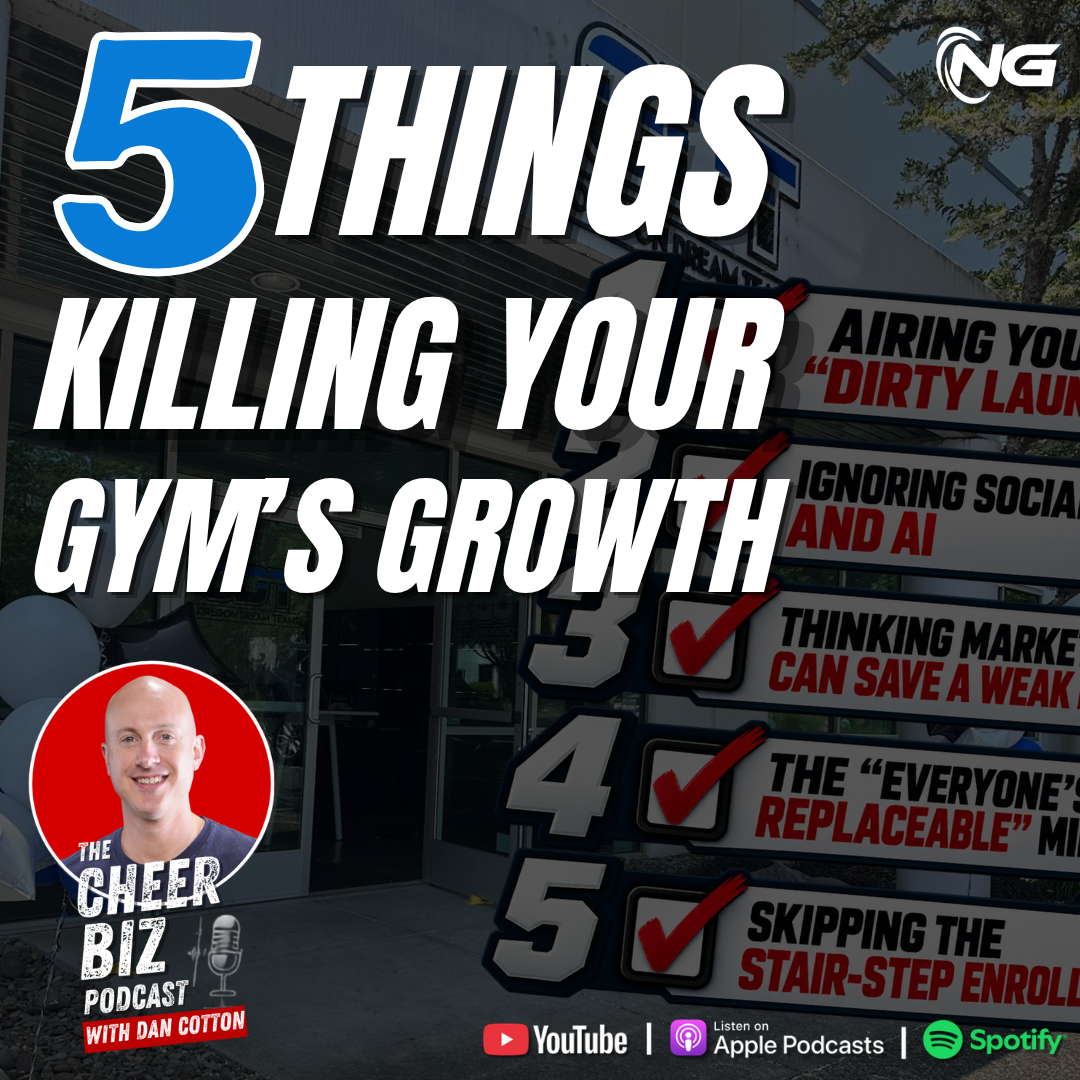
In this episode of the Cheer Biz Podcast, host Dan Cotton took an unusual approach: rather than laying out what gym owners should do to grow, he walked through five things he would do on purpose if his goal were to stop his business from growing altogether. These are mistakes he has made himself and watched other owners repeat again and again across the cheerleading industry. Before getting into the list, Dan reminded listeners to join the Cheer Gym Owners and All-Star Cheer Coaches and Owners groups on Facebook, and pointed anyone serious about scaling their gym toward the next Cheer Biz Accelerator event. One spot remains in 2026, with the November event, and new sessions are already being planned for January and February of 2027.
The first growth killer, Dan said, is airing dirty laundry all over the internet. His advice is to operate like a celebrity, whether or not it feels natural, because a single post, comment, or offhand remark can shape how an entire community perceives a gym. He pushed back gently on the popular idea that there’s no such thing as bad press, agreeing there’s a kernel of truth to it, but noting that the rule doesn’t hold up the same way for a small, local brick-and-mortar business. A national brand can afford to polarize and still find its tribe, Dan explained, but a gym pulling from a limited local market doesn’t have that luxury — one bad impression can sour an already small pool of prospective families.
Dan applied the same caution to himself, noting that even on the podcast he’s selective about what he shares, choosing to keep some stories private rather than broadcasting every struggle or mistake publicly. He extended the warning to political posting in particular, pointing out that in an increasingly polarized climate, sharing strong opinions online can quietly push potential clients away. None of this means gym owners can’t speak freely, Dan clarified — only that freedom of speech doesn’t erase the consequences that can follow it, and staying strategic about what gets said in public is worth the discipline it takes.
Don’t Sit Out the Social Media Era
The second mistake Dan would make on purpose is refusing to use social media or emerging technology. Rejecting platforms like TikTok, Instagram, or Facebook out of principle, he said, cuts off one of the easiest and most direct ways to reach new clients. Dan noted that the landscape has shifted from a plain, old-fashioned social media era into what he called a social influence era, where audiences want to get to know the people behind a business, not just see it advertised. Owners who are uncomfortable in front of a camera, he suggested, should either push through that discomfort or find someone on their team who’s a natural fit for the role, since visibility is what gives a gym the velocity to get its message out.
Dan extended the same logic to artificial intelligence. He pointed listeners to the AI Cheer Lab, a program he’s running through Skool.com dedicated to teaching gym owners how to apply AI inside their businesses, and mentioned that his next episode would dive deeper into the topic. Dan called himself a committed advocate for the technology and warned that owners who ignore it, or only use it at a surface level, are handing a real advantage to competitors who learn to combine AI with their marketing and day-to-day operations. Skipping it entirely, he said, won’t just stall growth — over time it can send a business backward relative to gyms that adapt.
A Great Product Beats Great Marketing
Dan’s third growth killer might surprise regular listeners: focusing only on marketing and never on the product itself. He acknowledged that he talks constantly about promotion, pricing, and getting a gym’s name out into the community, but stressed that none of it matters if the underlying product isn’t strong. A gym can market aggressively and still shrink if it’s losing two athletes for every one it enrolls, since eventually there simply won’t be enough people left to train.
The fix, Dan explained, is making sure the actual experience families and athletes have at the gym lives up to what the marketing promises. When there’s a mismatch between the message and the reality on the mat, new customers churn quickly and the business sees no lasting gain from its marketing spend. Marketing should be what draws people in, he said, but a great product, well delivered, is what keeps them enrolled long-term.
Never Tell Customers They’re Replaceable
The fourth habit Dan would use to sabotage his own business is letting customers know they’re replaceable — a mindset he said is common among all-star cheer coaches. He referenced the “bye Felicia” attitude that was popular several years ago, where coaches would shrug off an athlete’s frustration with a reminder that plenty of others were waiting to take their spot. That approach, Dan said, sends families a clear message that they aren’t valued, and in a market where cheer gyms are increasingly plentiful and families are willing to drive further for a program they enjoy, that message pushes people right out the door.
Dan drew a comparison to his years with the Beaverton Police Department, where he learned that even veteran sergeants who retired were genuinely missed, even though the department kept functioning without them. The difference with a cheer gym, he pointed out, is that the people walking away aren’t employees filling a role — they’re customers, and treating them as disposable all but guarantees they’ll find a gym that won’t. He gave a concrete example: an athlete who loses a skill like a round-off double back handspring mid-season needs support, not a reminder that they’re replaceable. Sustainable growth, Dan said, requires adding new families to the top of the funnel faster than a gym loses them from the bottom, and a replaceable-customer culture works directly against that.
Build a Stair-Step Path to Elite
The fifth and final growth killer is having no stair-step enrollment path into a gym’s programs. Dan explained that a low-barrier entry point needs to exist before a family is ever asked to commit to a competitive team — something like a trial class or a short series of discounted trial classes that lead into a standard class membership, which then steps up into a novice or prep program, and eventually into an elite, all-star level. Building that ladder intentionally, he said, gives far more families a reason to take the first step, even though not everyone will eventually climb all the way to an elite program.
Dan spoke from experience here. When his own gym first opened, the only options were full all-star cheerleading or five-dollar drop-in tumbling classes that, by his own admission, lost money outright. There was nothing connecting the two, and growth suffered as a result — families went from a five-dollar drop-in or a private lesson straight to signing up for elite travel competitive cheer, with no middle ground. It wasn’t until the gym built out a proper class program that enrollment on the all-star side began to climb, giving families a natural, gradual path from a first tumbling class all the way up to a competitive team.
Turn These Mistakes Into Momentum
Dan closed the episode by reminding listeners that growing a gym is essentially the inverse of these five habits: stay disciplined about what gets posted online, embrace social media and AI rather than avoid them, invest as much in the product as in the marketing, make every customer feel valued rather than replaceable, and build a clear stair-step path from a first class to an elite team. He thanked everyone for tuning in and encouraged listeners ready to put these lessons into practice to join the Cheer Gym Owners and All-Star Cheer Coaches and Owners groups on Facebook, explore the AI Cheer Lab on Skool.com, and watch for the next round of Cheer Biz Accelerator events launching in January and February of 2027.