Menu
Our Services
Next Gen Academy
Conferences
Sponsors
Cheer Biz Accelerator
Our Products
Connect 3
Training Packets
New Gym Course
Our Podcast
Our Blog
About Us
About our Staff
Preferred Partners
Contact Us
Available Positions
Too Busy to Browse?
BOOK A CALL
0
No products in cart
Menu
Our Services
Next Gen Academy
Conferences
Sponsors
Cheer Biz Accelerator
Our Products
Connect 3
Training Packets
New Gym Course
Our Podcast
Our Blog
About Us
About our Staff
Preferred Partners
Contact Us
Available Positions
Too Busy to Browse?
Posts tagged with: spectator fees
Tag: spectator fees
spectator fees
+
All Star Cheerleading
,
Athletes
,
Blogs
,
Communication
,
Events
,
Parents
,
Podcast
,
Staff
,
Uncategorized
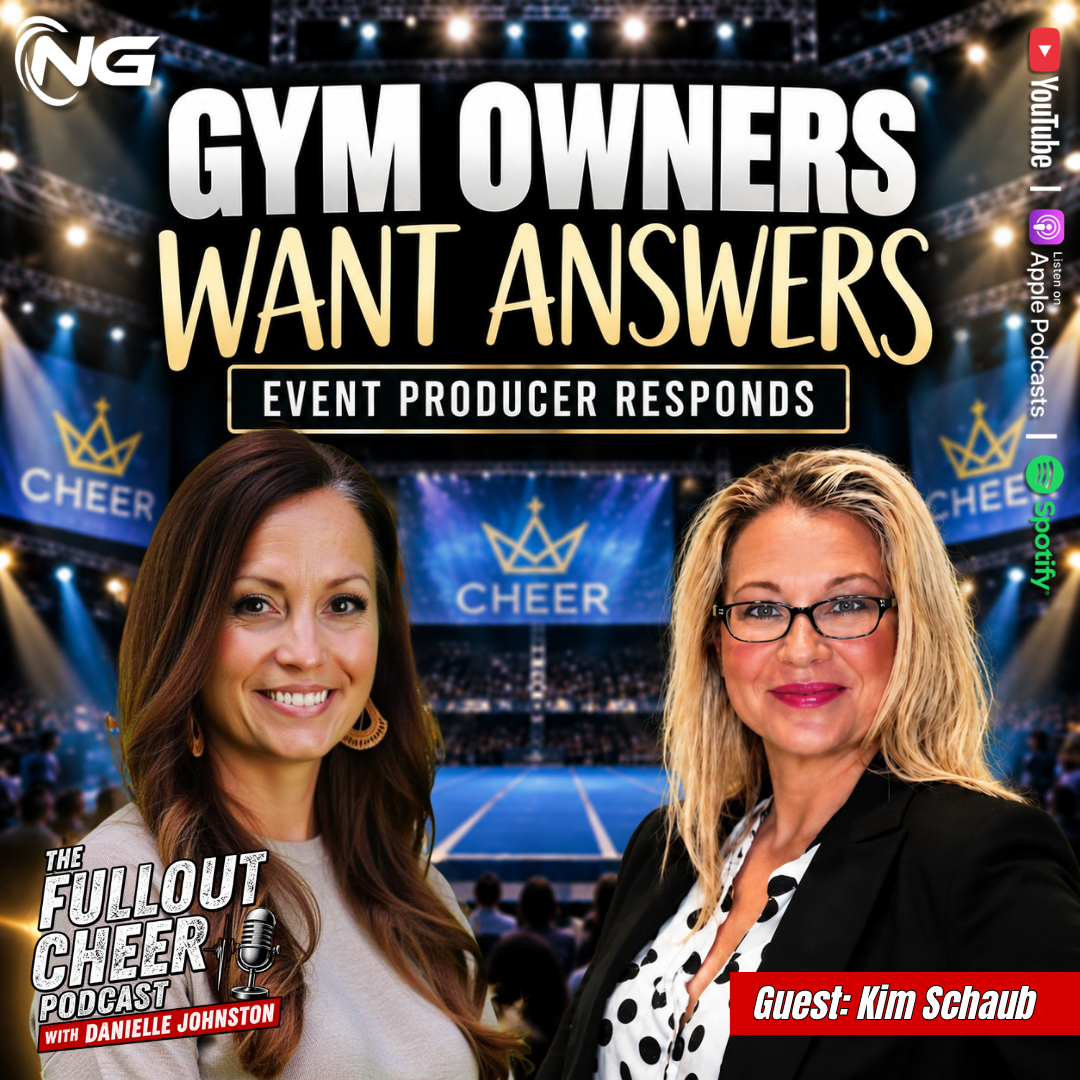
5 Things That Drive Gym Owners Crazy (And What Your Event Producer Wants You to Know) Meta Description: Event producer Kim Schaub joins the Fullout Cheer Podcast to explain competition fees, tiny divisions, cancellations, bad venues, and confusing scores. SEO Tags: Fullout Cheer Podcast, cheer competition fees, event producer, all-star cheer, gym owner tips, spectator fees, cheer scoring, competition cancellations, MCDA, cheer event planning I’ve talked to a lot of gym owners on this podcast, and there are a handful of complaints about event producers that come up again and again. So I brought on the person best equipped to answer them: Kim Schaub, who’s been producing cheer events for 22 years. I asked her about five things that drive gym owners crazy, and she gave me the real, behind-the-scenes reasons why they happen. Welcome back to the Fullout Cheer Podcast. I’m Danielle, and this one is packed with insight from the other side of the registration table. Why Aren’t Competition Fees Always Listed Up Front? This conversation actually started last winter, when a gym owner posted online, frustrated that competition fees weren’t listed on an event site. I wanted to get Kim’s take, because as a gym owner, I actually prefer when fees are posted. I have no problem explaining to parents what a coaches’ fee covers, so I get a little annoyed when I have to go digging for the number. Kim’s perspective, though, comes from running a one-woman show. She still handles most of her own registration and sales, and her personal cell phone is listed right on the website. Twenty-two years in, she simply can’t handle the call volume if every fee question comes to her directly. So the fees are posted. But she also takes every single call, because parents will see a number, assume their gym is overcharging, and never stop to think about what actually goes into it: coaches who have to drive or fly in, hotel stays, meals, and the fact that many coaches are essentially volunteering their weekend. As Kim put it, you can’t expect someone to do all that for free. At minimum, you owe them a hot dog. For me, the bigger issue is transparency. Early on, when parents pushed back on fees, it genuinely scared me, and I’d just say, “it’s part of the fees, take it or leave it.” I never went home feeling good about that answer. Over time I learned that transparency is what lets me sleep at night. Now I tell parents exactly why the numbers are what they are: we’re taking a certain number of coaches, they’re staying in hotels because we don’t live near the venue, we’re covering their gas and food because that’s what good employers do for the people they depend on. Nobody wants a hangry coach walking into warm-ups with your kids. The same logic applies on the choreography and training side. If you’re not telling parents what’s included in a professional fee, coaches’ fees, choreography, music, and they hear later that a coach paid for their own hotel or never got fed, parents are going to start wondering where their tuition is actually going. Being upfront about what you’re paying for and why is what keeps that trust intact. Kim’s bottom line: reading is fundamental. The information is on the website. If a parent calls her number instead of clicking into the event details, that’s part of the equation too. Between AI tools that can pull up total costs in seconds and event pages that spell out every fee, there’s less excuse than ever for gyms not to educate their families up front. The Problem With Divisions That Are Too Small The second complaint: registering for an event and finding out your division barely exists. Using her company, MCDA, as an example, Kim explained that she runs five different scoring systems just to accommodate every program’s needs, rec teams, Waikata teams, open score sheet teams, United score sheet teams, programs chasing Open Championships bids, and programs loyal to United because they want the detailed feedback ahead of Summit. Multiply all of those variables together, and sometimes a division that looks full on paper only has one or two teams on each score sheet, which means no real competition. Kim shared a wild example: two teams in the same division, one on the open score sheet and one on United, with no other competitors. The United team barely changed their routine because they figured, why bother, and still won a paid bid over the team that had prepared to actually compete. Kim’s staff reviewed the scores three times because it seemed so strange, but that’s what happens when score sheet differences fragment an already small division. From the gym owner side, my advice is to build relationships early. I ask around in local Facebook groups to find out where other programs are competing before I lock in a schedule, because having real competition matters. I don’t mind facing the same rival gym at every single event of the season. In fact, it gets my kids fired up. Get past the ego of not wanting to be “friends” with a competing gym, and build a network so you actually know where everyone’s going to be. If you truly can’t build competition in your division, especially common in dance, shift the goal. Instead of chasing a placement you already know is out of reach, set an internal target: a perfect score in baskets, a perfect score in jumps, hitting above a certain number. When a team hits that goal, it can feel like winning the whole competition, because they’re still competing against something. Kim pushed back gently here too: sometimes small divisions happen because gyms pull their teams once they see who else is registered, worried parents will bail if the competition looks unwinnable. She gets it, but at some point everyone has to actually compete. And that competitive struggle isn’t purely negative. Losing teaches lessons that winning never will. If kids only ever learn to win, that mindset tends to follow them into adulthood, quitting the first job that gets hard instead of pushing through. Kim also remembered a mini team I once brought to one of her events as a true learning-year squad, kids who couldn’t count eight the whole routine and couldn’t hear or see me from the floor. If the goal had been winning, I would have lost every one of those twelve kids. Because the goal was set correctly, as a learning year, I lost zero. Parents who are new to competition can be completely overwhelmed, and setting the right expectations up front makes all the difference. What’s Really Behind Spectator Fees Spectator fees are an easy target, and Kim, self-described as someone who still clips coupons for everything, walked through exactly where that money goes. A venue that used to cost $2,000 might now run $2,500. Coaches want new photo backdrops, so that’s another cost. Labor now has to go through union channels, and in some states that’s $90 an hour with an eight-hour minimum, even if you only need staff for four hours. A full elevated stage can run into the tens of thousands of dollars. Security has become standard where it wasn’t before. Judges, especially seasoned ones, are expensive to fly in and house, partly because local judges usually have coaching ties to teams in the area and can’t be used. Even the food adds up in ways people don’t expect. A $25 plate of pasta becomes $50 once service fees and gratuity are added, and if you want a separate salad plate, that’s counted separately too. Box lunches that feel outrageous to complain about, sandwich, pasta salad, cookie, apple, actually run around $40 each once catering markups are factored in. And details most people never think about, like the LED walls that let people in the back actually see the floor, or jugs of water for the warm-up room, or a single ten-foot section of pipe and drape, come with real, sometimes shocking, price tags. Kim’s now the proud owner of her own pipe and drape after getting burned once. There’s also a practical reason some events still run as cash-only: credit card processing fees can add eight to ten dollars per ticket, and that eats directly into what actually reaches the bank versus what gets absorbed by fees. As a gym owner, my job is to translate all of that for parents. I do look at spectator fees when picking competitions, but it can’t be the only factor. A $15 spectator fee three hours away that requires an overnight stay might cost more overall than a $30 fee at a local event. I factor those trade-offs into my budget every season, and I lean on producers like Kim to help me plan around it. Kim was also candid about taking feedback seriously, even when it stings in the moment. She’s made real changes, more LED walls, better food planning, because gym owners spoke up. The best feedback isn’t delivered in the heat of the moment; it’s the kind that comes after someone’s had time to process it and can explain clearly what needs to change. One piece of parent feedback even led Kim to completely overhaul her awards for novice teams after realizing ribbon-only novice athletes felt overlooked next to medal-winning elite siblings. The next season, every novice athlete got an oversized medal. If costs are becoming out of reach for your families, there are real levers to pull. Cut back on the number of competitions you attend, ten or twelve events a season is a lot, and trimming two can save real money while giving families a break. Consider one-day events instead of two-day events, which saves on coaches’ fees, spectator fees, and parking all at once. Skip season passes if there’s any chance of a cancellation, since a canceled event means losing that money outright. Look for multi-event discounts instead, and if your event producer accepts checks, paying that way can help you avoid credit card processing fees and late charges altogether. Why Events Get Canceled Cancellations are frustrating for gym owners, but Kim traced a lot of them back to timing. Gyms often want next year’s schedule as early as February, but many events aren’t actually under contract yet at that point, since contracts require deposits, and not every producer can front all of that money that early in the year. A schedule gets published as a placeholder, registration opens later, and if it turns out there isn’t enough demand or a contract never solidifies, the event gets pulled. Kim’s take: nothing should be posted publicly until there’s a signed contract behind it, ideally no earlier than May. Sometimes cancellations come from conflicts outside anyone’s control. Kim described planning an end-of-season event at SeaWorld Orlando, fully contracted, with registration already coming in, only to discover another cheer event had booked the same venue two days before hers. Rather than run two competing events back to back, she canceled hers, months in advance, and personally called other event producers in the area to help every registered gym find a new event. No tickets or park passes had been purchased yet, so the impact was minimal, and everyone was accommodated. From the gym owner side, I understand the instinct to want a locked schedule as early as possible. Parents are planning around it, weddings, travel, summer camps. But I’ve learned to build in some flexibility. I publish a schedule in February, but I’m upfront with parents that things may still shift until around June, when contracts and long-term plans are more solid. Kim’s advice mirrors that: when an event does get canceled, there’s almost always another one nearby. She keeps relationships with other producers specifically so she can point gyms toward an alternative and get them a comparable price. When the Venue Isn’t Ideal The last common frustration: venues that just don’t work, no parking, packed hallways, no food available, or a space that feels run-down for the price of admission. Kim has made just about every venue mistake there is, sometimes twice. She’s run events at soccer fields with barely any parking, and she’s run out of food entirely because she underestimated attendance. Now, 22 years in, she deliberately overestimates concession needs and builds in solutions like free shuttle service from overflow parking lots, lessons learned the hard way. Her advice for gym owners who think they’ve seen it all: come shadow an event producer for a day. You’ll walk it, literally, tens of thousands of steps, and see how many contingency plans are running at once, a backup plan for the backup plan. Kim’s done every job in the business, from loading trucks to judging routines back when scoring was done on paper, and that range of experience is exactly what lets her problem-solve in real time when a venue isn’t cooperating. It’s a reminder that after fifteen or twenty years of owning a gym, or producing events, you start to feel like you’ve seen everything, and then something new happens anyway. Kim’s own start was completely unplanned. She had a small rec team with nowhere to compete, no real information available, and figured it out by making phone calls and friends along the way. She’s the first to say it: nobody who owns a gym or runs events today actually had it all figured out from day one. Everyone falls into it and learns as they go. Bonus: Making Sense of Scoring Swings One topic kept coming up throughout the conversation: scoring. Kim was clear that she stays out of it entirely and leaves it to the judges, but she offered some useful context for why scores can swing so much from event to event. A 99 in November, for example, usually isn’t realistic. If a team is scoring that high that early, there’s nothing left to work toward for the rest of the season. Newer judging panels tend to score higher because they’re still learning the nuances, while seasoned judges, who get the harder assignments precisely because of their experience, tend to score lower and give more detailed, useful feedback, even when the number itself looks less exciting. It’s worth watching your routine back before reacting to a score. Coaches naturally fixate on the one moment they’re worried about, a shaky tuck, a kid without the endurance for the full routine, two athletes whose toe touches nearly collide. That focus means something happening on the other side of the formation, like a stunt that barely held, can get missed entirely. Judges don’t know where a coach’s attention was; they’re simply watching the whole picture. Virtual judging panels, which can pause, rewind, and zoom in, tend to score more critically because they catch details a live judge in real time might miss. Score sheet differences matter here too. On an open score sheet, a bobble counts as a fall. On a United score sheet, it doesn’t. That distinction trips up coaches and parents every single season, and it’s an argument that comes up constantly. Kim’s advice: don’t take a scoring disagreement personally, and don’t hold onto the frustration. Emotions run high in the moment, but producers and judges aren’t trying to work against any team. Take a breath, rewatch the routine, and use the feedback to get better before the next event. This conversation could easily have gone another three hours. If you found this helpful, come hang out with us on Facebook: Cheer Gym Owners for gym owners, and All-Star Cheer Coaches and Owners for anyone who’s also getting on the mat to coach. Thanks so much for listening, and we’ll catch you on the next episode of the Fullout Cheer Podcast.
YouTube | Spotify | Apple Podcasts 5 Things That Drive Gym Owners Crazy (And What Your Event Producer Wants You to Know) I’ve talked to a lot of gym owners on this podcast, and there are a handful of complaints...
Read More
September 24, 2026
<br />
x
Active Campaign Bootcamp Registration
×
Pause Academy Membership
×
Switch Academy Plan
×
Cancel Your Academy Membership
×
×
×
Beta Test Group
×
Connect 3
×
Impact: 3 Subscription
×
Done-For-You Hoppy Easter
×
Done-For-You Ninja Summer Camp
×
Budgeting Webinar
×
Register for Louisville
×