https://podcasts.apple.com/us/podcast/the-fullout-cheer-podcast/id1763244914?i=1000771122031
https://open.spotify.com/episode/5UBVj00nFi0wrN8DxYQXTW?si=QXrETaI6Ttya30hrkvtUHQ
The Hard Truth About Accountability
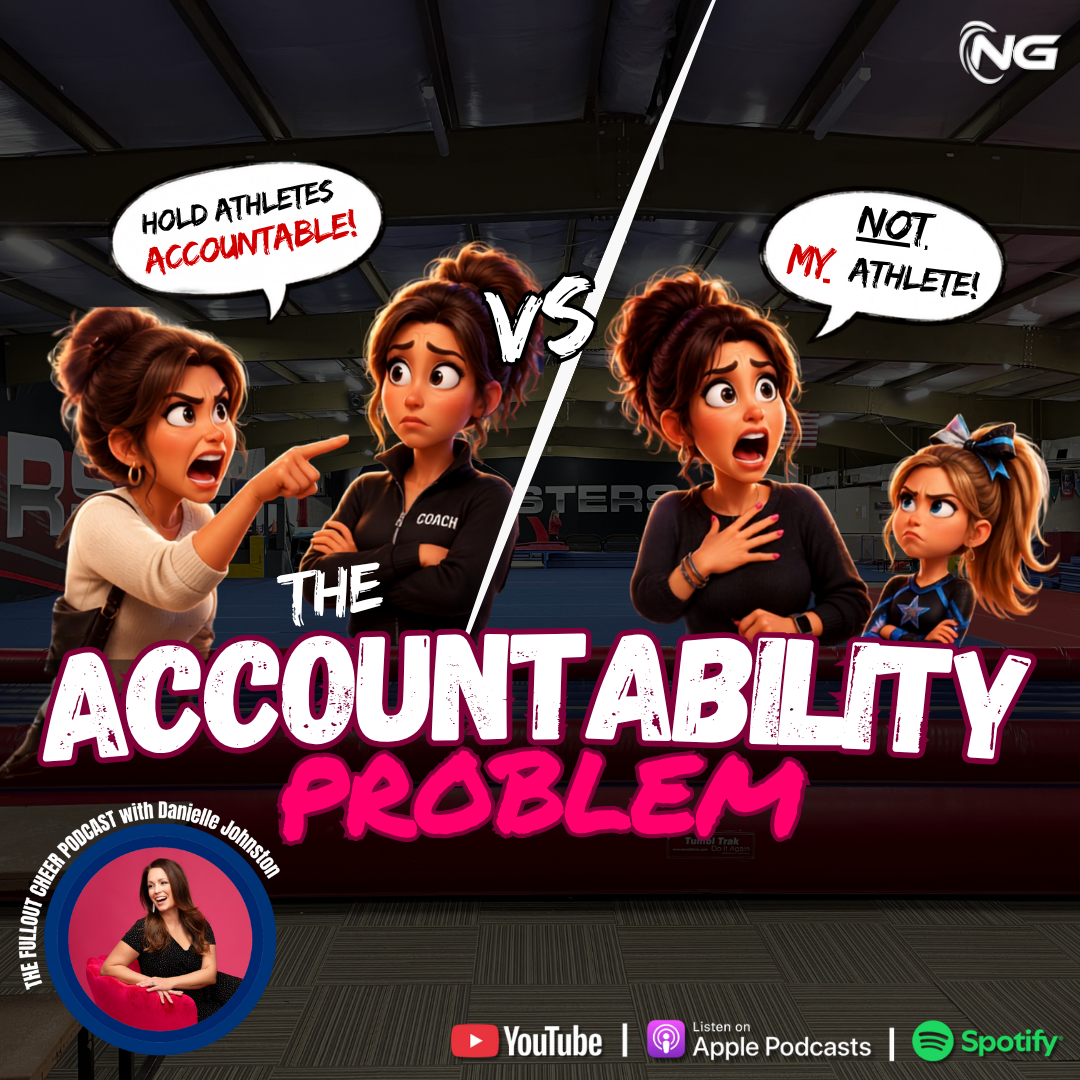
Parents want gym owners and coaches to keep athletes and their parents accountable. Everybody wants kids who are gonna show up to practice in their practice wear on time. But what happens when you’re the one that didn’t show up on time? Does that accountability feel as good as it sounded back in February?
Hi. Welcome to this episode of the Full Out To Your Podcast.
I’m Danielle, and I’m your host for today. Today, we are gonna be talking about accountability. Because when we talk about it at this time of the season, in May, it sounds really good.
Like, we are going to hold people accountable for being at practices on time, wearing their practice wear, having their hair up the way it’s supposed to be, being on time to competitions. Like, we’re gonna hold people accountable for all those things. But then, as a gym owner or coach, when you have to actually start holding people accountable, it seems like it backfires on us a little bit.
That’s what we’re gonna talk about today on the Full Out To Your Podcast. Guys, welcome. If you have not been here before, I’m Danielle, and I am the host.
I am excited to be with you guys. If you’re watching on YouTube, you might see that I have my book here on display, the Cheer Gym Owner’s Handbook. But I have it because there’s one more I am waiting to put in my hand that is coming in the mail literally any day.
I’ve just been waiting. That is our new book that we released this week, the Cheer Coach’s Handbook. The Cheer Coach’s Handbook is the number one tool that you need to use to train your staff this year.
So, it has six easily implementable chapters, things like how to be a good coach and how to be a good employee, because one without the other doesn’t really make you that great of a staff member at a gym. Things like what does everybody do in the gym and why is it important the person who is, you know, vacuuming mats versus the front desk versus the person who’s doing social media and how do all those roles play together for the gym. We have a chapter on mental health training for your athletes, how to make them resilient and growth-minded written by Jeff Benson.
And then Dan Cotton wrote some great chapters about athlete safety, coaches’ burnout, and some of the things that are just so important in our industry, like building a competitive spirit in your athletes. So, here’s my recommendation for this book. There are discussion questions at the end of every chapter and there are free downloadable worksheets on our website that you can access when you purchase the book.
So, here’s what I recommend for every gym owner and coach who is gonna be listening. Coaches, talk to your owners. Owners, make a plan for staff training this year.
In my gym, we are gonna take this book and we are gonna do one chapter every other month. We’re gonna facilitate using the discussion questions and have our staff complete the worksheets because doing the work is totally different than just reading about what work you should be doing. Our goal is to change the staff culture in gyms in 2026 to make your life, owners, easier and to make coaches’ lives a better experience when they’re at work.
In the end, it actually makes it a great experience for everybody. Your athletes and the gym parents have a strong, positive culture and a staff who loves doing their jobs. So, make sure by the time this podcast releases, you’ll be able to head over to Amazon and look for the Cheer Coaches Handbook by Dan Cotton, Danielle Johnson, me, and Jeff Benson.
Okay, guys, let’s go ahead and get into what we’ve got going today. So, at this point in my gym, we did our tryouts pretty quickly. We do them pretty quickly after All-Star World.
So, we come back and we take about a week off and then we start quickly into the tryout process because I think it is really valuable to get a break. But I like to have that break after we’ve already formed teams for the next season. I’ve learned that if we take that break before tryouts, a lot of our athletes spend that break work, work, work, work, trying to get the skills or trying to perfect the skills before tryouts.
The thing is, any skills you get in those two weeks before tryouts are kind of sketchy skills anyway for me to be putting in a routine. I want you to have skills that you are confidently doing and that we have consistently seen for the past couple of months at least. For me, it doesn’t make a lot of sense to have that break in between.
What we do is we come back, we have our week off, we do our banquet, we get into tryouts right away, and then we take another week off right after tryouts. Why? Because your schedule just changed. So for most of my gym parents, your practice may have been Sunday and Tuesday.
Well, now we’re on summer schedule and it’s Monday and Wednesday, right? And so it gives them a week or two to just sort of figure out what is the schedule gonna look like in relation to siblings and work and all the other life obligations that they have. Couple weeks into our new season, I do something that I call All-Star 101. This is a presentation in my gym that is mandatory for all parents to attend.
This year, I did break it up by elite families and then our prep and novice families. I went in NG Engine, we created a tag for all of our elite families and everybody as they attended, we untagged them so that we knew at the end of it who didn’t arrive that night. And I get it, like I’ve got nurses that work at night, I’ve got a dad who had already committed that night to like mowing the lawn at the church.
Like there are life obligations that just happen. And so I record that session or this year I will rerecord the session because we had a little recording snafu and we put that on an unlisted YouTube link, put it on our website embedded and then we have a form on our website that they just complete that says, if you weren’t at All-Star 101 in person, please make sure that you complete the form that tells us that you have completed this presentation and onboarding for the new season. Now, All-Star 101 changes up every couple of years because as we learn more about the things that our gym parents need, I modify the presentation.
So here’s what I did this year. I do Coffee and Conversations and if you’ve listened to this podcast for a while, you heard me talk about them back in like February and March and they’re essentially feedback sessions that I do with all of our parents on each of the teams. And as we do them, we’re asking questions about the season and just getting their feedback on anything we can do to make their season go smoother in future years, make it easier on our new parents, less taxing for our veteran parents and just to overall create an experience that can be repeated year after year without the burnout.
So I take really good notes on those and then I usually use AI to give me like, what are my top action items that I need to do moving forward? Well, this year, I took the notes from 2024, 25 and 26 and I put those into AI and I said, if I were to do an All-Star 101 presentation at the beginning of the season, which of these things that you’re finding like concerns or problem areas that were surfaced in these notes, which of these could I fix by educating parents on it at the beginning of the season? And it was super great actually. It gave me some really good points, pain points that we had seen in previous years that now I’m able to speak to those at the beginning of the season and by having that level of accountability, when I’m talking tags, if you’re not super familiar with that, it’s essentially like as the parents who couldn’t be at the presentation complete that form, it will untag them. So I always have a list of like, who has not yet completed it and I can just send a quick email or text message to those people.
So number one, it gives accountability to parents that they completed this onboarding for the new season. Number two, it’s an education session, whether you’ve been with me for one year or 15 years, it’s an education session where we talk about, you know, the things we expect within the gym. So I brought this up, I actually had a slide, most of my parents know that I do this podcast and so I actually had a slide at the end that said, don’t make it on the podcast this year, I prefer to get my content from Crazy Moms of Cheer and about half the room laughed because they knew about this podcast and the other half were like, what are you talking about? So anyway, if you are one of the coaches and you saw me post that in the coaches group, I absolutely did say it.
One of the things we talked about though, that I just felt was something that coaches needed to hear and be able to share with their parents because I feel like sometimes I say things that you guys wish you could tell your parents. Now, maybe I just let the elephant out of the room or whatever that phrase is, maybe I just said it and you were like, shut up Danielle, we’re supposed to be like silently sharing these. But at the end of the day, I have noticed that everyone wants someone to be held accountable.
But when that person is the one that’s held accountable, it doesn’t feel so good. So let’s talk about it. A couple examples of this are when you have parents who say we never miss but, we’re gonna have to miss this practice because of this.
Another one is when you have parents that say, if you look at my record from the past year, we never miss, but we need to miss now because of this. And are there legitimate reasons to miss practice? Of course, I had a girl miss a very mandatory practice because she had a funeral. Completely makes sense.
There are definitely exceptions to the rule. I think you don’t know what those exceptions are until you come across them. So you might say that you have a very firm black and white rule.
You don’t really know that you’re in the gray until that thing comes up. What about we only have one practice tank top and it was in the laundry? Like all of a sudden, everyone, you know, last night even when I was doing this All-Star 101, I was explaining the importance and using a John Wooden quote about the importance of details and you know, the measure of success based off of the little things that we do. And there were parents like nodding.
And my hope is that those aren’t the same people that will then say, well, her practice tank top was in the laundry, so sorry, she’s wearing a pink t-shirt, right? I’m hoping they’re not the same people that are gonna say, yeah, we didn’t have time to stop home in between school and work and coming here, so sorry, she’s wearing a pink t-shirt. Or she was at her dad’s and we totally forgot to bring that one over with us. Like my hope is that that discussion on accountability and I recommend gym owners and coaches have this in your gym.
My hope is that that discussion on accountability helps people to think, okay, I’ve got to plan ahead. I have to think ahead of what do we have coming up in the next couple of weeks? Maybe I wanna buy an extra practice tank top and have her keep it in her locker. Maybe I need as soon as she’s done with practice, I need to have her go literally put that thing in the washing machine so that I can wash it and it’s ready for the next day.
So I think that pointing out what it looks like to be held accountable and what it looks like when we want accountability but we don’t want it to be us, I think those things help. Those are all fair. There’s always going to be reasons that people miss the mark and sometimes it’s totally okay when those happen, but we want to minimize those so that we’re creating a greater positive impact on the majority.
I talked about that at my presentation last night. I said, you know, the purpose of accountability is that the majority are well-represented and there is a positive outcome for the majority. When we don’t have accountability, you know, this person doesn’t show up on time and this person doesn’t show up at all and this person’s not in practice wear.
And now we have all these small things that sort of add up to like really ineffective practices. And so hopefully if you can have these kinds of conversations with your parents before it becomes a problem, you can help them understand that, you know, the reason we have attendance issues isn’t later in the season, isn’t because the same people over and over and over, maybe, but that in 15 years, I’ve had that issue like once, right? Usually it’s one person here and one person here who never misses and one person here who never misses and one person who has perfect attendance all year but they have to miss now. And so it’s those issues that contribute to what I had last year, which was nine weeks before showcase, I hadn’t had a single full practice with my youth two team.
So, you know, hopefully you have those that you can talk about now and you have those opportunities you’ve created with your parents. Now, what I talk about in All-Star 101, probably long enough for an episode of its own. But I do wanna continue talking about accountability and why it is actually so important.
It’s hard, I felt like it was a little bit hard to talk about accountability in the summer because I do want these kids to have a summer. They need to have breaks, but we also need to have some structure to the breaks. If the break is just like, hey, she’s not gonna be there tonight.
Well, that’s really kind of a negative experience for people, why? I have coaches who write lesson plans about a week in advance. I approve lesson plans, I review them, I look at the stunt progressions that they’re doing week after week after week. Last year, when I coached a youth two, our first practice was literally just cleaning up smushes and preps.
And even though some of them had been level two, some had been level one, even I had coached them before. You still have to clean them up when your stunt groups shift and readjust a little bit. I spent my first practice cleaning up preps and cradles and stuff like that.
I spent my second practice working on extensions. From there, we progressed. It was like, clean up the prep, clean up the extensions, now do a quarter up to extension, now do a press from prep to extension to make sure, or twisting press to extension, to make sure that they can do it that way if we needed to.
Now go to your half up to extension. And from there, we’re certainly not gonna try and quarter cradle right away. So if you’re not taking them through those progressional steps, and you’re just saying, well, you’re a level two team, I expect you to now be able to do it, like you’re gonna take longer and you’re going to miss a lot of the technique things along the way.
And so what we find is that parents don’t understand that progression. Parents don’t realize that like week one needs to look like this, week two needs to look like this, week three needs to look like this. And by the way, if you don’t have one of your flyers in a back spot from a different group and you can’t easily switch people out, you just missed week three progression.
And that’s kind of a problem. And so people have vacations and I want them to have those in the summer. My gosh, I want to be on one right now as we speak.
But the way that we work those summer practices so that it works and it makes sense and it’s a benefit for everybody is that we have that list in advance of who is not going to be at what practice. At our welcome night, we had everybody write those down. I actually have a really wonderful thing we started today.
In fact, we have a form now that will reside. It’ll link on our weekly emails. It will reside on our website.
And it’s basically for absences. If your absence is within seven days, the coach gets a text message. If your absence is more than seven days, our front desk just gets an email that they need to put that absence on the calendar.
Because I want the coach to get that text message because they may have already written the lesson plan or have their progressional plan for the week. And so we have that going intentionally. And now I can also look back at it and see if we have a true attendance issue, right? Did somebody take off six weeks in the summer because they had, I’m gonna sound really Missouri right now, but they were showing their cows one week and they had a barrel racing competition the next week.
And then they went to a country music concert. That’s all very Missouri. These are all things that are very normal around here.
People go show animals all the time. So did they miss a whole bunch of practices and now it’s gonna be a little bit tough to get their stunt group in the right position for the fall? I know I sound like, man, summer is supposed to be chill. It’s supposed to be our time of not being in the grind, but it’s kind of interesting, right? I feel like we’re, by the time this episode comes out, it’s going to be June.
I am gonna be about three and a half weeks before we go to Dream Camp. I am gonna provide Dream Camps a list of the skills that I want each team working on at each of the stations. From there, I’ve got about a week or two before I really need to make decisions on what elite skills are going to go in our routines so that our choreographers have some time in advance to like prep through what these routines can look like.
Do some choreographers come in and they’re just like, I’m just gonna make your routine? Yes, I don’t prefer that because I feel like we have certain skills that they lead to better progressions. And so I prefer to do certain skills every year and certain levels. You know, at level one, if you do a switch up, though I like, we can all fight about the connection and I’m with you.
But like, if we do a switch up at level one, it’s gonna be easier to do a switch up at two. Then it’s going to be easier to do the switch up at three and ideally easier at four. Like those are just the things.
So I will probably always have a switch up in my routine every year. And I have those kinds of things that are just our gym, like this is what we do because I like how it progressionally moves. And so, you know, those are the things that I want choreographers to put in our routines.
And I wanna be very specific that I want those. So the things that parents don’t see is the amount of time and effort that coaches are putting into their preparation for practice. Great coaches are putting time into thought, into progressions, and they’re trying to use their time wisely.
If we have practices where I’m gonna be missing three or four kids, those are probably the practices that I’m gonna get some of that extra tumbling work in. We might be working more jumps. We might be doing a little bit more with flexibility on those practices because those are things that individuals can kind of do homework or get private lessons and really not be too far behind on.
So in that All-Star 101 presentation that I do, I educate parents on the standard for the season. I explain what it looks like to have a full team at practice versus having a couple of people gone, but finding it out at the last minute. So how this plays in to accountability is that by educating the parents on the why, why it’s important that we know in advance when kids are gonna be gone, why it’s important that the kids are wearing their practice wear, why it’s important that they’re on time.
I did have a girl yesterday and her teenage sister brings her, so we’ve got some grace there, but we do practices during the day in the summer for one practice a week and her practice started at noon and she walked in and it was noon. The clock literally said 12 o’clock, but we were already halfway through our jumping jacks because we start the second that clock turns 12 o’clock. So it was a good conversation with parents to say, hey, listen, if you show up on time, you’re already late.
When it comes to athletes, we also need to hold our athletes accountable. So I’ve been talking a lot about parents or things that parents have control over, right, as far as attendance. We also need to hold our athletes accountable.
I had a conversation with my senior four team yesterday. We had only had a couple of practices, I think two team tumbling classes, and honestly, the majority of them worked really hard, but I wanted to continue explaining why it was important that they were working hard and what that looks like right now. Cause sometimes teenagers can see like five feet in front of them.
And if you coach like a mini or youth team, it’s even shorter. And so I explained to them, I’m like, good job working hard yesterday. I like that because in February, when your parents and I sit down and we talk about how you’ve progressed this season, I wanna be able to tell them that your back handspring or your tuck or your layout or whatever has progressed so much, check out where she’s at now.
Do I think that you will get a new skill? Yes, I do. If you’re working hard, but I also know that sometimes it can take a whole season to perfect a skill enough to be ready to move on. I wanna be able to tell your parents, imagine how much she can progress through the remainder of the season when she’s already come this far.
We also had a conversation about, we’re doing this fitness program with all of my elite teams this year with a local fitness trainer. It’s called Swag. They go in, they do plyo, agility and endurance training.
And I think it will just honestly keep them in better shape throughout the summer. So it’s part of our practices, but it’s over at their facility. And my intention is that they stay in really good shape in the summer so that we don’t have the injuries that we’ve tended to see in the November, December timeframe, right? Because we’re already strong, we’re already using those muscles.
We’re not pushing all of a sudden in August for like a push, push, push, push when we’ve been just kind of chilling all summer. However, Swag has a specific dress code because it’s often for football players and track players and stuff like that. And one of the things is the length of the shorts and they don’t allow crop tops or sports bras.
You have to be covered in the midriff. It’s just their policy. And I can respect the policy of another program.
It’s honestly up to them. We’re going to them. So we’re gonna follow their rules.
And I heard some of my athletes were not thrilled about this. And so I sat down and I had a conversation with them and I said, first of all, we’re gonna wear what they require us to wear because it is their program. We are part of their program.
They’re not doing us a service. We are paying to be part of what they offer. And I wanna make sure we’re getting the full benefits of it which means I don’t want you to have to stop what you’re doing to pull your shorts down or to, you know, re-secure your sports bra when you’re in the middle of running sprints or something like that.
I wanna make sure that you are following their dress code as they require. I also had a conversation with them where I said, please do not reinforce the stereotype that cheerleaders are not athletes. You’re gonna go in there and it is going to be extremely hard.
And I want you to be tough and I want you to work hard. Now, do I think that some of the stuff they’re gonna do there is harder than what we do at a cheer practice, 100%. And I know that because my daughter did swag to prepare for the soccer season.
It’s hard. I was sitting outside in the car while my daughter was in there and there were boys coming out to throw up in the grass. I think that they may go a little bit lighter on our cheerleaders but my intention is that we end the summer with the people at swag saying, those kids are in such good shape.
Cheerleading is a real sport. So I had that conversation with my athletes to set the expectation early so that then we can maintain accountability throughout the summer. Some athletes are not going to do it for themselves.
I will tell you that. In probably like 2013, 2014, I coached this kid and she was a little thing, I can’t remember, a tiny or a mini. And when we would ask her to work on her back walkovers at home, she just wouldn’t do it.
It’s not that she didn’t love tumbling or love cheerleading. She just didn’t have that extra little motivation to do it at home without her mom. Like, come on, you need to do this.
One day I thought, maybe she won’t hold herself accountable or have that self-discipline for herself but maybe she’ll do it for others. And so I was doing a private lesson with her and I explained, I said, you know, I really want to put, this was 2013 when like full team tumbling made a difference. Anyway, so I said, I really want to put all the back walkovers in the routine.
Keep in mind, this was also 2013 when competing like a newish walkover was like kind of okay still. And I told her, I said, I want to have full team back walkovers. And it’s just a couple of you guys that are still working on these.
I know that you are not necessarily excited to work on it for yourself but will you work on it for your teammates? Because if you get it, all of your team benefits from it. And for whatever reason, that was what motivated that athlete. It wasn’t doing it for herself, it was doing it for others.
So I learned in that moment that kids just sometimes need to be held accountable to others because sometimes that self-discipline just isn’t there for them. I want to note, you know, accountability is not a lack of compassion and that’s really hard sometimes. It’s hard because sometimes you have to say to someone, I understand why you missed but I still have to acknowledge that you missed.
Those two things can absolutely exist together. I think a lot of times and I literally had this issue last season with a parent who was really angry with me. I felt like I wish I could have said that clearly at the time.
You know, I have compassion for the reason you’re missing. I have compassion for the circumstances that this mandatory practice puts you in. However, I also have to hold you accountable to attend this practice.
Now in that circumstance, I don’t know if it would have made sense but I did say something like that similar to a parent last night and I think that it helped us both realize those two things can exist. Like I can still have that compassion for the situation that you’re in while also holding you accountable. So like when it comes to things like work emergencies or school demands, especially when it comes to school sports or illnesses or rides, like we can hold people accountable but we also have to collectively make sure they understand that there’s a level of compassion especially when you’re talking about like parents with work.
Like I understand that it is hard to get out of work and sometimes the boss calls you in. We just need to have that backup plan and that’s how we can both demonstrate compassion and hold people accountable. I had an athlete last year who was a junior in high school and I gave my teams these workouts and they were expected to do, I think it was three workouts a week.
They had to do a time-lapse video. They had to send it to me. I had a little thing on my phone.
I’m gonna be honest, it was exhausting. It was a lot of work but I feel like it kept my level three team in shape over the summer. Well, one of these athletes worked and she was trying to basically work a full-time job that summer.
It was her last kind of summer at home before she graduated and she ended up working one day at a daycare. She worked 6 a.m. to 6 p.m. and she didn’t turn in her time-lapse video that night and I remember talking to her and I’m like, hey, I didn’t receive that video and she’s like, yeah, I worked 6 a.m. to 6 p.m., sorry and I ended up having to say to her, okay, I get that but you understand what you committed to. Like that still left you from 6 p.m. to 10 p.m. and she’s like, I was exhausted.
I’m like, I get that. Did you hang out on TikTok that night? She’s like, no, I went and hung out with my boyfriend. I’m like, okay, I asked you to do a 20-minute workout.
This is like adulting. Like this is what adults do. We get done with a 12-hour shift and we still have to go take care of kids and do laundry and do these other things.
I asked you for a 20-minute workout and you committed to it and so I expect you to do that and in the event that for whatever reason you couldn’t do it, I don’t wanna have to come to you. I want you to come to me and be proactive about that. Understand that you’re being held accountable and be proactive about that accountability.
So it was a really good lesson for her and I think you can hold kids accountable almost at any age, right? Like at any age, you have to do what you say you’re gonna do and if there’s some extenuating circumstance, I wanna know about it before whatever it is was due. It’s very similar to the attendance dilemma that I talked to you about in the beginning of this. Like if I know that you’re gonna be gone a week in advance, I can better prepare for things but if you forget to tell me until that day or you make a last-minute impulsive decision that day, like now we’ve impacted several people negatively.
You know, compassion happens when people are willing to explain circumstances. It doesn’t necessarily mean that it’s always going to be a free pass. It also doesn’t mean that they have to go into detail.
There are some personal family circumstances that you have to accept coaches and owners that people are not going to be willing to tell you and they shouldn’t have to. But to be willing to say we’ve got some stuff going on at home right now is really important. You need to be able to have both compassion and accountability.
There’s kind of a hidden cost. So when we don’t have that accountability, you know, athletes learn things like, somebody else will fix it for me. Somebody else is gonna explain it for me.
I’m gonna get a free pass on this. You know, somebody else will handle the difficult conversation. And over time, those standards actually do change.
When we tell people we’re gonna hold them accountable for things and then we don’t, the standard literally just changes in our gym. At the beginning of this, I talked about how parents need to be held accountable. And a lot of times, you know, when you hear parents are talking negatively or something, I think a lot of times we’re like, let’s let it slide.
Let’s deal with it next week. Let’s, you know, let this one play out and see how it goes. And I think we have to be really cautious of that.
Because again, if your culture in your gym is that we are gonna be positive people, we are gonna demonstrate what we want our kids’ characteristics to be like and what character we’re teaching the athletes, then we also have to be held to that standard. I think you also have to hold the parents accountable for the things they say they’re gonna do. For most of you guys, you are literally at the beginning of your season.
And I’m here to tell you, you need to hold people accountable for paying on time every time right from the beginning. So our season basically released May 6th and we go to camp in June and the payments for camp were expected by May 15th. And I kept a list of everybody who had paid and it helps me see right at the beginning, do I have someone that I think is going to potentially, I’m gonna have to be on top of their payments all year or do we have people who are pretty on top of them right from the beginning? But I can tell you, you know, anybody whose payments weren’t in on time definitely heard from me right away.
And we held them accountable for making sure that they had payments ready to go on a particular date. When you don’t hold parents accountable, they learn that you aren’t always gonna do what you say you’re gonna do. And eventually that strikes a chord with the parents who are responsible and who are following the policies.
And what you find is that people start looking at other options because strict seems appealing at that point. The idea that somebody is going to have a black and white rule seems really appealing when people don’t think that you will hold your gym members accountable. You know, life doesn’t work that way.
Employers won’t work that way where they let you slide all the time and college coaches won’t work that way. And so our goal is to teach our athletes responsibility and to teach our parents that we’re going to hold everyone in the gym accountable. But I do need to say this to our coaches and owners.
You are also expected to be accountable. In one of the last episodes, Dan and I talked about coaches who lose their temper. Coaches, you are accountable for so much.
You need to be on time. You need to be prepared for practice. You need to be there to give your athletes a hundred percent every practice.
I don’t care if this is the team that you really preferred not to coach this season. I don’t care if you preferred to coach seniors and you got put with tinies. I don’t care if you prefer to coach at 7 p.m. and you got put on a 4 p.m. practice.
I really don’t care. It is your responsibility to be accountable for those things that you agreed to and said you were going to do. Gym owners, you have a big level of accountability.
And the hardest part is that sometimes people won’t call you out on it. You need to be accountable to your athletes to make the right decisions and do the right thing. You need to be accountable to parents to make sure people are paying on time because when one person doesn’t pay on time, everybody else is financing that bill.
You need to be accountable to your coaches to do what you say you’re going to do. If you tell them you’re gonna help them with writing a lesson plan or giving them a certain part of the gym for a portion of practice or adding a second coach onto the team, you have to be accountable to those people. And gym owners, the hardest part is unless you’re part of like a business coaching program.
You know, I’ve got clients who are held accountable to me because we have to-do lists and I’m like, well, did you do this? Why not? But 99% of gym owners don’t sign up for something like that. And if you don’t, then you are the only person you are accountable to. And that can be a hard life.
Most people do much better when they have some oversight, right? Somebody else who is coming to them saying, why didn’t you finish that this week? If a coach or owner drops the ball, own it. Parents, if you found yourself misspeaking in the lobby and already starting to go negative, you know that that’s not the culture in the gym and that’s not what the gym owner is trying to build, own it. Athletes, if you are late to practice, I don’t wanna hear excuses, own it.
There are always reasons that are legitimate, but in the moment, own it and commit to doing better. The healthiest gyms are the ones where everybody is accountable. Okay, you guys.
So one thing I’ve learned after years of owning a gym is that accountability is not so easy when it’s tested. But when you are accountable and when you are held accountable for things and hold others accountable, your gym has so much opportunity to grow both in culture and in actual enrollments. So guys, if you liked this episode of the Full Out Cheer Podcast, make sure that you check out our book, Cheer Coach’s Handbook.
Make sure that you head over to our website, cheerbizaccelerator.com. We’ve got an event coming up at my gym this fall. We’ve got an event at Dan’s gym. I’m gonna be at Shelly’s gym in Five Star Athletics in Reno in August.
And I would love to talk to you guys and learn all about your gyms and help you to build and grow your own programs. All right, guys, with that, thank you so much for joining me and I’ll see you on the next episode.