
YouTube | Spotify | Apple Podcasts
Dan Cotton’s 10 Hot Takes on Running a Cheer Gym
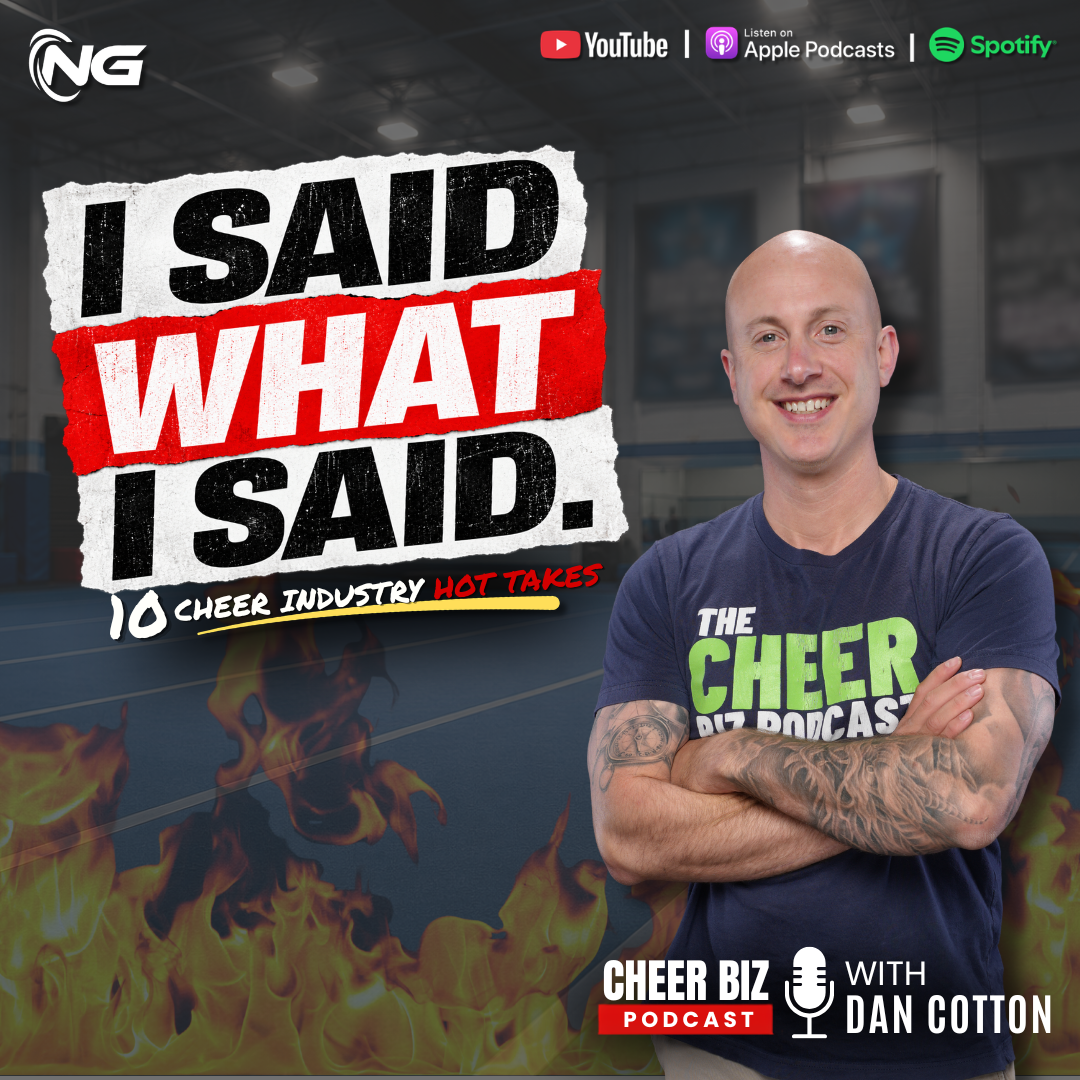
Fresh off a summer of travel, camps, and choreography work, Cheer Biz Podcast host Dan Cotton returns to the studio with ten unfiltered opinions on pay, parents, AI, staff training, and what’s really holding gym owners back.
Back From the Road, Ready to Talk
Dan Cotton opened this solo episode of the Cheer Biz Podcast fresh off nearly three months of travel. Since leaving his studio on June 5th, he had spent the summer running camps, choreographing, teaching, and instructing gyms around the country, with only a handful of days actually spent at home. Along the way, he attended the Cheer Biz Nashville conference in June and stayed active in the Cheer Gym Owners and All-Star Cheer Coaches and Owners Facebook groups, watching trends and conversations unfold in real time across the industry.
That mix of hands-on work and constant industry observation gave Dan plenty of material. He used the episode to run through ten hot takes, some new and some recurring themes he felt were worth revisiting, covering everything from how gyms pay for private lessons to how owners should think about accountability when things go wrong.
Rethinking What Private Lessons Are Worth
Dan’s first hot take grew out of conversations with a Dream Camp staff member and a gym owner client who was restructuring her business this summer: private lessons, as most coaches run them, are easier to teach than a class, and pay should reflect that. Managing ten kids in a tumbling class, he argued, is inherently more demanding than working with one athlete at a time.
His issue isn’t with private lessons themselves, but with how most coaches approach them. In his experience traveling and working alongside coaches, most private lessons amount to a scaled-down class: the athlete shows up, the coach picks a skill to work on, such as a back handspring or the connection out of a round-off, and runs through it. What Dan rarely sees is the kind of premium service that would justify premium pay, things like a documented lesson plan, video tracking shared with parents, or structured conditioning built around the session.
Dan does think clients should pay more for a private lesson. He simply believes it shouldn’t be billed directly through the instructor unless that coach operates as their own independent business. In his own gym, coaches who teach private lessons during normal business hours are paid their standard rate and can offer semi-private sessions. Coaches who work more than 15 hours a week can take on private lessons outside business hours, but only if they carry their own LLC, insurance, and an indemnification agreement with the gym. Most of his staff choose not to bother, he noted, because they’re already paid fairly and don’t need the extra work.
The New Reality of Facebook Ads
Dan’s second hot take was a warning to gym owners still chasing 2019-era ad results: the days of spending $100 on Facebook and landing 20 new members are over. Today’s ad environment demands more spend and, more importantly, more consistent creative. Videos and photos need to be refreshed regularly, ideally close to weekly, rather than left to run untouched for a month.
Gyms that upload a single video or photo and let it ride will see returns decline and lead quality drop, Dan explained. A better approach is to feed Facebook a wider variety of creative and let the platform’s algorithm identify and favor the assets that convert best. AI can help here, but not in the way most people use it. Dan cautioned against generating flyers or graphics with tools like ChatGPT, which tend to produce generic content indistinguishable from what every other gym is posting. Instead, he suggested using AI to sort existing footage or stitch together video clips, ways to multiply usable creative without relying on obviously AI-generated images.
Where AI Helps and Where It Hurts
Building on the ad creative discussion, Dan’s third hot take turned to a firmer line: AI-generated “slop” has no place in instructional content for cheerleading. When coaches or owners use generic AI prompts to produce material on body positions, stretching, or conditioning, the results are often inaccurate or simply nonsensical, and Dan argued it undermines the entire case for paying trained professionals.
If AI can supposedly fix an athlete’s back handspring as well as a coach can, he said, it erodes the value coaches and owners claim to bring through their training and experience. He’s seen a growing volume of this kind of content circulating, some of it built on exercise science that doesn’t match actual best practices for tumbling or strength building, and some of it built around AI-generated images of athletes performing skills incorrectly.
Dan was clear that this isn’t a blanket anti-AI stance. He described himself as an enthusiastic AI user and said there’s nothing wrong with asking a tool for workout ideas or HIIT routines to use as a starting point. The line he draws is between AI as inspiration, which he supports, and AI as a substitute for real coaching expertise, which he does not.
Why Staff Underperform
Dan’s fourth hot take centered on a pattern he sees constantly: staff underperform because they’re under-trained and under-supervised. Attending a single conference or completing onboarding once isn’t training, in his view. Training has to be ongoing and repetitive, even when it means reviewing material staff already know.
He drew a comparison to his background in law enforcement, where maintaining certification required annual refresher training on rules, use of force, firearms, and driving, even for skills he used every day on the job. The redundancy wasn’t wasted time; it kept knowledge sharp. He encouraged gym owners to apply the same standard to spotting technique, proper grips, and their gym’s written procedures, reviewing them annually or twice a year rather than assuming staff remember everything from initial training.
The second half of the problem, Dan said, is supervision. Too many gym owners and managers leave coaches alone until something goes wrong, whether that’s a complaint, an injury, or a pattern of behavior that’s been quietly building. Without regular check-ins, video reviews, or benchmark tracking, there’s no way to catch small issues before they become big ones. To address this in his own gym, Dan announced that his staff will soon begin working through The Cheer Coach’s Handbook together, a book he co-authored alongside Danielle and Jeff Benson, using it as a structured refresher even on topics they’ve covered before.
Choosing Words That Build Confidence
Two of Dan’s hot takes focused on coaching language. The first: coaches should almost never tell an athlete they need to completely start over on a skill. Phrases like “we need to wipe the slate clean” or “everything you’ve learned is wrong” send a damaging message, particularly to athletes already prone to self-doubt. Dan described watching his own daughter spiral after a coach told her she’d been doing a skill entirely wrong, a moment that led her to question everything else she thought she knew about her technique.
Instead, Dan recommended framing corrections around specific, targeted adjustments, refining the entry into a tuck rather than declaring the tuck itself broken, for example. The goal isn’t to avoid ever rebuilding a skill from scratch, but to avoid telling an athlete that’s what’s happening.
The related hot take: coaches should eliminate the word “don’t” from their coaching vocabulary. Telling an athlete not to do something puts the burden on them to infer the correct action, which isn’t always obvious. Dan argued that focusing on the desired action, rather than the mistake to avoid, helps athletes build active, constructive self-talk they can carry into their own heads during competition and practice.
Letting Kids Struggle and Grow
Dan’s seventh hot take addressed parents who intervene the moment their child faces any adversity. He described a pattern he saw intensify over the summer camp season: parents validating every complaint, pushing back on coaches over minor setbacks, and rushing to fix situations that didn’t actually need fixing.
Rather than stepping in when a private lesson doesn’t go perfectly, Dan encouraged parents to let their kids sit with disappointment and push through it. He acknowledged the balancing act himself, since he coaches his own daughter, but maintained that letting kids struggle is what builds resilience. Nothing worthwhile in his own life, he said, came without encountering and working through real challenges.
Worlds Divisions Are Shifting Fast
Dan’s eighth hot take was less an opinion than an observation: the Worlds landscape is being reshaped by a wave of division changes. His own gym announced a move to large co-ed, though the final decision still depends on roster numbers after some athletes chose not to continue the season. He expects the team to field more than 30 athletes, though not the 18 boys required for some large co-ed rosters.
Across the industry, he pointed to a flood of movement: Cheer Extreme announcing a shift into large co-ed, Brandon moving from small co-ed to medium co-ed, and Max returning to traditional small senior co-ed after leaving the limited senior small co-ed division, a move Dan noted opens the door for a new limited small co-ed champion this season. Dan was careful not to read too much into any single team’s motives, saying he supports every gym’s right to choose the division where they can be most competitive. His own gym’s history bears that out: after failing to reach finals in extra small and small limited co-ed, they made finals in medium co-ed last year and are now aiming to do the same in large co-ed.
Own Your Growth, Skip the Turf Wars
Dan closed with two related points about gym owner mindset. The first: stop fighting over kids. He noted that even with nearly 1,000 members, his gym still isn’t reaching 1% of the youth population in his service area, which spans Beaverton, Tigard, and greater Portland, a region with well over a million residents and roughly 80,000 kids in the local school districts alone. Losing a family to a closer or more affordable gym still stings, he admitted, including a recent case where an athlete left to join a different Worlds team. But he encouraged owners to redirect that energy toward growing the sport’s overall reach rather than competing over the same small pool of families.
His final hot take was about ownership. When something goes wrong in a gym, Dan urged owners to look at themselves first rather than posting blame on Facebook or Instagram. Owners can’t control every decision a client or parent makes, but they can control the client experience from start to finish: the website, the enrollment process, the front desk greeting, staff training, and class quality. Focusing energy on those controllable pieces, he said, resolves the majority of problems gyms face. Challenges will still come up, but treating them as learning opportunities rather than someone else’s fault is what separates owners who grow from those who stay stuck.
Wrapping Up
Dan closed the episode by acknowledging that none of the ten hot takes were aimed at any single gym or individual, but reflected patterns he observed repeatedly over the summer. He teased upcoming episodes featuring more interviews with his Dream Camp staff, including professionally produced video content already live on YouTube, with more planned. Listeners were encouraged to check out the Caden episode on YouTube and stay tuned for similar releases.
As always, Dan invited listeners to join the Cheer Gym Owners and All-Star Cheer Coaches and Owners Facebook groups, and to consider signing up for a Cheer Biz Accelerator event for hands-on, small-group learning directly from his team. He thanked listeners for tuning in and asked them to leave a review before the next episode.
If you enjoyed this episode, you may also like “Hot Takes with Dan: Unfiltered Opinions on Cheer, Coaching, and Business“