
YouTube | Spotify | Apple Podcasts
Toxic Parents in the Gym: A Conversation with Kristen Wheeler of the Cheer Mom Podcast
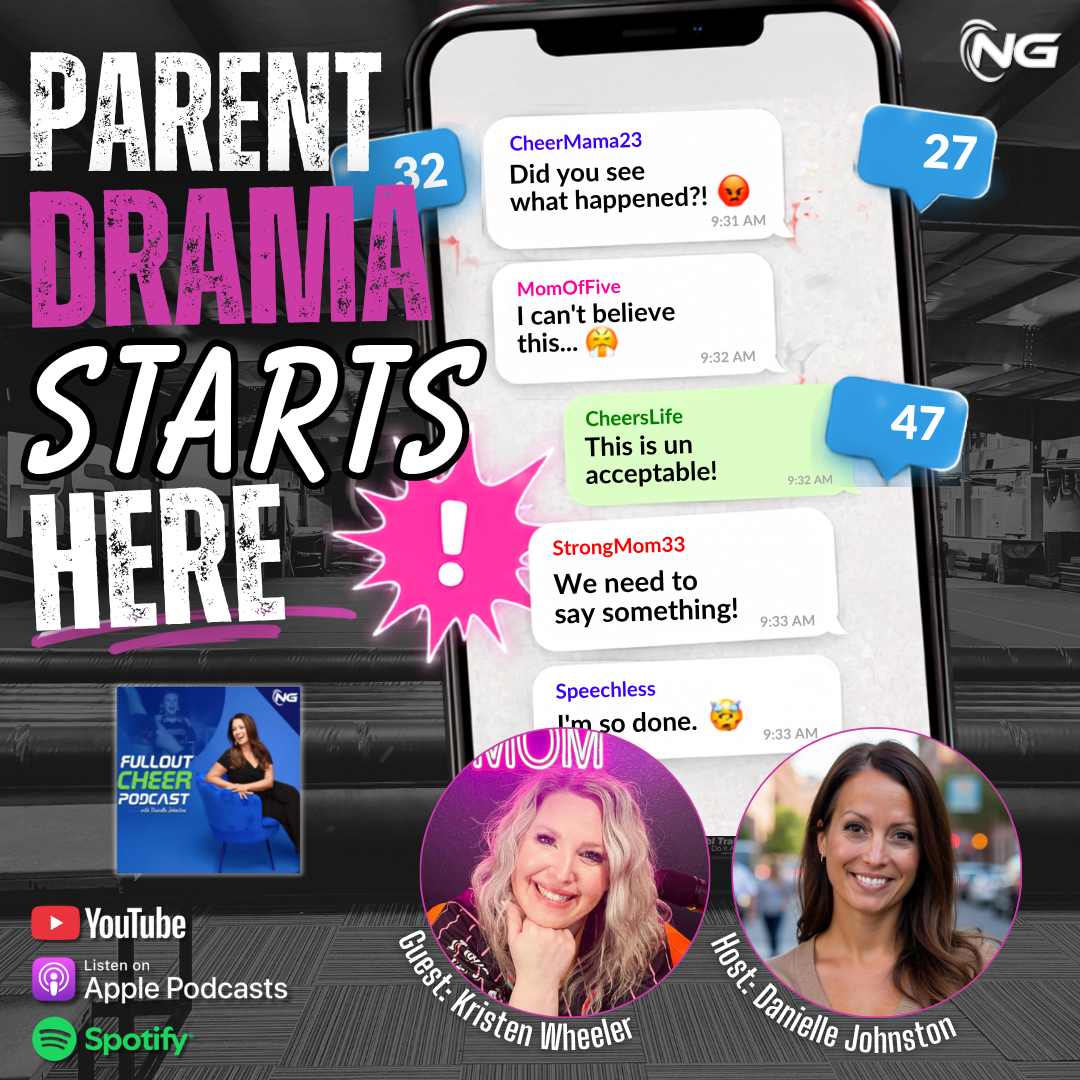
On a recent episode, Dan and Danielle talked about toxic coaching, but they are not the only ones in the gym who can be toxic sometimes. On this episode of the Full Out Cheer Podcast, Danielle Johnston talks with Kristen Wheeler from the Cheer Mom Podcast and the Cheer Mom blog about toxic parents.
Meet Kristen Wheeler
Danielle: All right, guys, I’m excited to be here today with Kristen Wheeler from the Cheer Mom Podcast. Kristen, tell us a little bit about yourself.
Kristen: Thank you so much for having me, first of all. A little bit about me: I’ve been a cheer mom for almost fourteen years now. My daughter started kind of like all of us — just doing a cheer rec class for fun while she was doing something else — and the rest is history. She went on to compete at a D1 all-star gym, competed in high school, competed at a D1 university, and was on multiple Worlds teams. She’s turning 22 this weekend, and she’s still in and out of retirement. I think cheer will always be part of her life.
Kristen: But I hated being a cheer mom for most of my time as a cheer mom. I didn’t understand anything. It was incredibly intense and emotional, as we all know. Somehow, though, I’ve stayed in cheer almost longer than my daughter has, and I started the Cheer Mom blog because at the time, there wasn’t one place just for cheer parents that was independent of any other organization. Parents wanted to know: what is a bid? How do you take a good picture of your team on competition day? Are private lessons really worth it? Things you’re all talking about now, but ten or so years ago, there wasn’t a resource for that. So I started the Cheer Mom blog, then TikTok came along, and the Cheer Mom podcast followed. And here I am, with the honor of getting to talk with you today.
Danielle: I love that. And I have to say, I’m actually on the flip side of it this year with high school cheer. I’ve never done it before, but I’m the team mom for the varsity high school cheer team. So if you’ve got tips, I’ll take them.
Kristen: Ooh, high school cheer. High school cheer and all-star cheer are just so different. I feel like high school cheer across the board is more chill — probably more intense in the South than out here in Colorado — but it’s just different. Definitely not as intense as the all-star scene. Best of luck to you. Godspeed.
Danielle: I’m excited. Luckily, I know a lot of the girls and their parents because they’ve cheered at my gym before. But I’m looking forward to some tailgating in the fall.
Kristen: There you go! You’re a shoo-in. The tailgating, the football, the cheerleading — it’s so fun.
What Toxic Parenting Looks Like
Danielle: I wanted to bring you on today because a couple of weeks ago, Dan and I did an episode about toxic coaching. But I think that isn’t the only area where a gym’s culture can be negatively impacted. I also think that if we’re not careful, there are elements of toxic parenting that can really hurt gym culture too.
Danielle: So let me start here: in the years when your daughter was younger, were you one of the moms in the lobby watching and paying attention, or were you more of a “I’m sitting in my car until she comes out” type?
Kristen: I was a bit of a hybrid. I’d watch when she asked me to, or right before a big competition when they were doing full-outs and I wanted to see that. But for the most part, I sat in my car and read a book, or if I was in the lobby, I was usually sitting by myself.
Danielle: Usually the people who sit by themselves are really good listeners. Am I wrong to say that?
Kristen: You’re absolutely right.
Danielle: Okay. So I want to talk for a second about what toxic parenting looks like. I can give my perspective as a coach and owner, but I’d love to hear it from a parent’s point of view. Have you seen this kind of toxic parenting yourself, or experienced it as a cheer parent?
Kristen: Yeah, a little bit. The best example I can think of is the “flyer mom.” And I hate to single out moms of flyers — I never could have handled my daughter being a flyer. I hate watching other people’s kids fall out of the air. My husband hates it too; we make all the noises when we see flyers being dropped. But I have witnessed parents of flyers kind of eyeballing the other children who are basing their flyer, and those athletes feeling very uncomfortable because they know the flyer’s mom is upset with them or watching them — sometimes she’s even made a negative comment to the child.
Kristen: I think that’s probably the most extreme form of toxic parenting in the gym, and it’s something I cannot stand for. I understand the intensity, and it’s your baby out there, but you have to be able to trust the coaches and the athletes. There’s no scenario where you should be disciplining someone else’s kid in a negative way. Period.
Danielle: Yeah. And I think gym owners and coaches can do better at educating parents — like, while we want your help holding your own kids accountable, we don’t necessarily want you holding other kids accountable. I actually did an All-Star 101 presentation at my gym, which we do at the start of every season, and I was pretty direct about it. I said, it’s your job to hold your child accountable, but please don’t hold other kids accountable if their parents aren’t there — that’s my job.
Kristen: Absolutely. And that’s not to say kids don’t come home and twist the story a little. Speaking of toxic coaching, some toxic coaches actually teach kids to say things like, ‘Well, Susie decided not to do her job, she decided to sit down, she decided to do this.’ And it’s like, okay, well, we can’t help what Susie decides to do — we have to hold ourselves accountable. But it’s so hard.
Kristen: Being a cheer parent, especially in all-star, is just so emotionally charged and intense. It’s hard not to fall into some of those toxic traps in the name of caring, or fear of injury, or wanting your kid to succeed. I’m not trying to make excuses for parents, but you really have to stay alert and pay attention to your own mindset, where you’re at emotionally. We all have outside stressors that affect our mood. I don’t think anyone is exempt from falling into a toxic trap at least once in their cheer parenting experience.
Comparison and the “Fixed Mindset”
Danielle: I totally agree, and I think you hit the nail on the head — it’s emotional because those are our kids out there. I’ve actually seen it the opposite way too, as a coach and owner: parents comparing a flyer to what they believe their own child could be capable of, if their child had been in that position. I don’t think it starts from a nasty place — I think it starts from a good place, believing in your kid. But over time, it can convolute from that positive belief into comparison.
Kristen: Absolutely. And I don’t know when this episode will air, but as we’re recording this, the Next Gen Gym Owners and Coaches Conference is this weekend, and I get to speak there. It’s interesting because I get to experience both sides — I’m going to talk about how cheer parents want communication and transparency from coaches, simple and clear. But at the same time, we as parents need to learn how to be better communicators to our coaches and gym owners, and to our kids — not reacting out of emotion or anxiety, but taking a breath, regulating ourselves, and remembering to keep the main thing the main thing.
Danielle: Absolutely. I’ve talked to gym owners as the season wrapped up, asking how it went, and for some of them, there was a lot of drama in the gym this season. I noticed it most between years two and five at my own gym — lots of changing policies, and I was still figuring out communication standards and what parents actually expected from me. You hire coaches in the beginning without always knowing what you’re looking for, because you don’t have an established culture yet to say, ‘This is who we are, is this the right fit?’ Years two through five were probably the hardest for me, because I didn’t have my tribe of parents yet — the people you almost expect to see when you walk into the gym.
Danielle: As an owner, I love having that tribe — people where you just know we’re all here for the same reason: we all want the kids to thrive.
Kristen: Right. And not just that — of course that’s the number one goal — but parents who have your back, whom you can trust, who are there to promote the success of the culture you’re building. One thing I learned when I first became a team mom is that we need to be present in the viewing area, or in the middle of groups of parents when appropriate, not to police but to implement and defend the culture. To say, ‘Hey, let’s not focus on that, let’s focus on the positive,’ or to tactfully steer the conversation away from gossiping about a coach or another mom and toward something like the next team bonding event. Allies who can steer the vibe into what the culture really should be.
Danielle: I actually talked to our parents about this in that presentation last week. I told them, we want to teach our kids how to recognize a ‘mean girl’ culture and steer away from it at school — and that means as coaches, we have to model that, and as parents, we have to model it too. So I told our parents: if you have a concern, talking to your friends about it won’t solve anything. But if you bring it to your coaches or the owner, I can solve it. So come to me — that’s what keeps our culture positive.
Kristen: Absolutely. And boundaries are always a good thing.
How to Raise a Concern the Right Way
Danielle: Surely over the years, when your daughter was younger, you had concerns at times. How did you approach those questions to make sure you weren’t coming across as ‘the questioning parent’?
Kristen: That was always so tricky, and I was always nervous about it. I really think the moms who get labeled ‘that cheer mom’ are coming from the same place I was — they’re just not using the right words. So it comes down to communication. When given the opportunity, I wouldn’t just call or text the coach or director or owner willy-nilly. I’d always try to get out in front of it.
Kristen: Placements were always my ‘why.’ I rarely questioned whether she’d be in the front or anything about the routine — it was usually about what we could expect for placement. So at the end of the season, after all the end-of-season festivities, I’d call her coach and say, ‘Thank you so much for everything. Evaluations are coming up, and you’ve been working with her all season, doing private lessons with her — I just want to get a feel for what we can expect next season.’ I always made clear I wasn’t asking for promises, because coaches are often afraid that if they say something like, ‘She could level up, she could be a flyer,’ parents will hold them to it later, even though they don’t yet know what teams they’ll have.
Kristen: So I’d say, I’m not asking you to make any promises — I’m just trying to get a sense of where she’s at so I can help her set realistic expectations for next season. I always tried to disarm that defensiveness, that fear of being held to whatever they said in the moment. It was never, ‘What are you going to do for me,’ it was, ‘Help me help my kid.’
Kristen: I think I was a little extreme in being so subservient to the leadership at my gym — there were times my husband would say, ‘Hey, don’t forget, you’re the customer too.’ But I actually think that mindset can become toxic. I see a lot of cheer parents saying, ‘We’re the customer, we pay your paycheck, we keep your gym open.’ That’s not really true, and we can talk about that. But I think you have to set aside any sense of entitlement — entitlement is a big toxic trait in cheerleading. If you can frame it as, ‘I want to have a conversation so I can set my kid up for success,’ because we all want our kids safe and successful, and if you can communicate that — ‘I just want my daughter to feel successful, how do we work together to make that happen?’ — you’re much more likely to get the result and the conversation you’re looking for.
Danielle: Intention is everything. I’ll hear gym owners say, ‘These parents are just questioning me,’ and I always say, there’s a difference between questioning someone and asking questions. Asking questions comes from genuine curiosity — I just want to know why or how. Questioning someone is more like trying to corner them into saying, ‘I messed up.’ I think the way we communicate our questions reveals that intention.
Danielle: I told my parents last week: if you ever have a concern, first, take an emotional pause — give yourself time to come down before you reach out. Second, use ChatGPT. It makes it so much easier to convey what you actually want to say in a professional way.
Kristen: Yes! I actually did a whole episode about using ChatGPT as a cheer parent on the Cheer Mom Podcast. You don’t just have to say, ‘Here’s what I want to say, turn it into an email.’ The secret is to say, ‘Write it in the tone of’ — I like to use Hoda Kotb, Savannah Guthrie, or one of my favorite writers, Erin Foster. They’ll give you a tone you can adjust until it sounds more like you.
Danielle: As a coach and owner, honestly, if a parent uses ChatGPT and it’s got all those dashes and emojis, it actually shows me the effort. It shows me that however it lands, they weren’t intending it that way. I love that. I didn’t know you did that episode — I’m going to go listen to it.
What Pushes a Concerned Parent Toward Toxicity
Danielle: So let’s talk about what elevates a parent from ‘I’m concerned’ to developing more toxic patterns. What contributes to that shift?
Kristen: I’m not sure your listeners will appreciate this, but I think it starts in the visible places in all-star cheerleading — with coaches, popular athletes, and high-profile teams and programs. People look at those figures and bring that into their own vernacular and mindset. There are some intense, dare I say immature, people who have a platform, and I think there’s something in the overall culture of all-star cheerleading contributing to this.
Kristen: It’s what our friend Jeff Benson calls the fixed mindset — rather than a growth mindset. There’s a sense of scarcity in all-star cheerleading as a whole that we adopt when we step into those spaces as parents. I know parents who are high-level executives, business owners, even a rocket scientist — outside of cheerleading, they’re calm, rational, some of the smartest people you’ll meet. But step into a cheer competition venue, and they’re a basket case. I think there are things in our industry we need to adjust so we’re not contributing to those environmental factors.
Danielle: Don’t feel bad about being honest — I think the listeners of this podcast are totally okay with direct honesty.
Kristen: Not your listeners, they’re all perfect, I’m sure.
Danielle: I don’t know about that, but I agree with you. I’m not a fan of cheerlebrity culture either — I don’t take my child to camps or clinics just because there’s a cheerlebrity there. Now, if they possess a great skill they’ve demonstrated they’re capable of teaching, I’m all about it, because now you’re bringing in the value of education. We watch Pro Tier League and things like that because these are athletes. The same way you can have football players who get arrested for things like that and still have valued athleticism, you can have pro-tier athletes whose character isn’t who you want your kids following, but their athleticism can still be valued.
Danielle: I also think a lot of times owners and coaches are the problem. They go into these owner groups and ask, ‘What do you guys do to fix attendance?’ and take suggestions from people who don’t really have credibility. Someone says, ‘Assess a fee — if someone misses for a funeral, they pay a fee, then they won’t be gone anymore.’ We take the logic and compassion out of our decisions sometimes. I think policy and compassion can go together. You can have a policy and still have the compassion to know that sometimes that policy needs to be broken.
Kristen: Write that down, everybody: policy and compassion can go together. Absolutely.
“It’s Just Cheerleading”
Danielle: I think a lot of times, as parents, we lose perspective that it’s just cheerleading.
Kristen: Right! I end every podcast episode with, ‘And remember you guys, it’s just cheerleading.’
Danielle: I love that. And again, policy and compassion — I have compassion for the fact that we invest so much time and money into this. But when your kid is 35, they’re going to remember how it felt, not what they won or what skills they had. No 42-year-old is sitting around saying, ‘Well, I had my full.’ It’s just not what we talk about anymore.
Kristen: What if they had their double, Danielle? Come on.
Danielle: Gosh, maybe then. But they’re not going to sit around still pouting about the year they didn’t make Level 5 and made Level 4 instead. Maybe they’ll use it as a lesson in perseverance for their own kids someday, but they won’t still be upset about it twenty-five years later.
Kristen: That’s something I rant about too, and it’s not popular, but you can walk down the street with a Worlds ring on your finger and nobody will know what it means. It’s a huge deal — I love seeing athletes at cheer competitions with necklaces full of rings, it’s so cool — but that’s basically the only context where anyone understands it. You’ll go to college, get a job in the real world, and nobody will know you’re an NCA champion. That’s not to diminish the prestige within the cheer community, but you’re absolutely right that it’s about the experience you had, not the specialty pass you landed at one specific competition.
Danielle: I also think coaches lack perspective sometimes too. They get into a mode of ‘this is all I do, this is my love, my passion, my job,’ and they forget that for families, this is just one part of their lives. I also think comparison is a thief of joy. When parents watch their child’s best friend getting skill after skill while their own child isn’t, that can create some jealousy and some harbored feelings. Unless parents are really having those conversations with coaches and owners, I think it can turn into a really bad feeling.
Kristen: Yes, perspective is the key word. When you’re a coach who eats, sleeps, and breathes cheerleading — it’s your passion and your livelihood — it’s so easy to get sucked into that bubble and lose perspective, not just on skills, but on bigger things. I’ve seen firsthand coaches give athletes a hard time for having an injury — ‘You’re not that bad, if you could buck up a little, maybe you’d have a better spot on the team.’ That’s devastating to the kid and the parents. The doctor told them something, and now what are they supposed to do? It’s that same fixed mindset, that FOMO — I’m going to miss out on an opportunity if I don’t just shake it off, or if my body can’t do this specific skill. I think that’s truly sad.
Danielle: I agree. There was a conversation at my gym last season that I heard about from one of my coaches — a parent talking about another athlete who’d left for a different gym, saying, ‘Wow, that gym must be really great, she’s getting so many new skills.’ My coach pointed out that the parent didn’t realize they were in comparison mode — they had no idea how much time that athlete was putting in outside of practice, the private lessons, the workouts at home. We only see a fraction of the picture, and yet we compare our kids to others.
Kristen: Right. There’s genetics, athletic build, things my daughter’s body can do that mine never could — never mind her neighbors and friends. That comparison, we really need to watch it, not just at the athlete level but at the program and team level too. Just because you see a team being successful doesn’t mean those athletes are having the best mental or emotional experience they could be having. It doesn’t mean they aren’t either — you just don’t know what happens behind closed doors. It’s like in everyday life, seeing the happy couple out to dinner all the time, having expensive dates, and thinking, ‘I wish we could be like that.’ You have no idea what they’re going through to get there.
Danielle: Most athletes are filming the new skill and posting it to social media, not the reps and the workouts and the falls that got them there.
Warning Signs and How to Self-Regulate
Danielle: So what are the signs that you might be heading down that toxic-mentality road as a parent?
Kristen: I’m going to give a little bit of a woo answer here, but I think mindfulness — the practice of mindfulness and meditation — is something not just cheer parents but every human should learn something about. Just breathing for five minutes, sitting still, the art of rest, listening to our bodies. We’re so caught up in a fast-paced culture that we forget to pay attention to ourselves, our mental health, our bodies. That gets compounded in cheerleading.
Kristen: For me, when I feel myself heading to a place where I’m not going to have a productive or healthy conversation, it’s when my heart starts pounding, my palms start sweating, when I feel the need to interrupt. That’s a big one — when I’m having a conversation and start feeling defensive or spiraling, I’ll start cutting people off. Those are physical markers worth paying attention to in a heated discussion with a coach, your kid, your spouse, your best friend, whoever. What am I feeling right now, and how do I regulate myself? Maybe it’s a deep breath in through the nose and out through the mouth. Maybe it’s going for a walk and reconvening. For me, I need about fifteen minutes to gather my thoughts.
Kristen: I do better when I put something in writing first — journaling, or writing the email but never sending it. Those are all ways to ask, ‘How can I cope with this?’ and then work backward to identify your triggers — what are the trigger words, what are the physical sensations that send me down that road. At a higher level, it’s worth asking yourself: am I contributing to a positive culture, or do I just want to control the situation? Anxiety, especially around our kids and especially around cheer, is so often about control. Am I trying to control where my kid is at, prevent an injury, control the outcome? Asking that question honestly really helps.
Danielle: That absolutely answers it. And coaches and owners, I want you to go back about sixty seconds and listen to that as if Kristen’s talking to you too — because we’ve all sat in that parent meeting where your heart starts racing, you feel defensive, and you want to cut the parent off. We’ve all been there, and I think it goes both ways across the table. Coaches and owners can do a lot to mitigate frustration, or a lot to add to it. We have to do exactly what you just described before firing back with a response in a high-pressure moment.
Kristen: Absolutely. And planning what to say. I’m a huge fan of therapy, and my therapist has me write down and plan what I’m going to say or ask ahead of time. As an example — cheer parents everywhere will tell you, if they hear the words ‘trust the process’ one more time. If I had to sit in a meeting with coaches today and they said ‘trust the process,’ I’d be so triggered, thinking, what does that even mean? So instead of reacting in the moment, planning ahead means I’d say, ‘Can you explain what that means to you, and how I can contribute to that?’ Planning the conversation out ahead of time helps you stay centered.
Danielle: I agree completely, and I think coaches and owners should just take those three words out of their vocabulary entirely. That said, I had a couple of conversations with athletes this year about their placements where I said, ‘I am going to ask you to trust me.’ I don’t ask that of people often — usually I can give you the exact reasons — but I coached you the last couple of years, and I do think this is the right team. I’m asking you to trust me, and we can reconvene in a month or two and see how you feel.
Danielle: But I also think that as coaches and owners, if we’re always playing defense and protecting ourselves, not letting people know who we are, what our values are, what culture we’re trying to build — if we’re not vocal about that, we can’t ask people to trust us. If we don’t have a track record of decisions made clearly for the kids, we can’t ask for that trust.
Kristen: Absolutely. And I’d say parents need to have some kind of relationship with their coaches too — it doesn’t mean being best friends or buying them dinner, but as a parent, communicating your own values if you want that two-way relationship and open lines of communication. It can be as simple as a check-in: ‘Hey, I trust you with my kid, and you’re going to see her some weeks more than I do. I want you to know we’re partners in this, because I want my kid to be successful in life. If there’s anything you need from me to help make that happen, to help her become a whole, contributing person to this program and this team, let me know.’ That might be the only conversation you have with your child’s coach all year outside of that, but just opening that door and saying, ‘I value the leadership you have in my kid’s life,’ can go a long way.
Danielle: And I also think we can’t call our gym a family if we’re not willing to get to know the families of our athletes. The most important people in your athletes’ lives are their family. I can’t call my gym a family if I have no interest in getting to know their parents.
Kristen: Absolutely true.
Advice for Parents Headed Down the Wrong Road
Danielle: As we wrap up, what advice do you have for parents who see their friends heading down the wrong road with toxicity, or even recognize a few of those traits in themselves?
Kristen: I think it’s important to have at least one ally in your cheer gym — another parent you can offer to be a sounding board for, or go to yourself, someone who gets it, who understands the context, where you can just say, ‘I need to get this out,’ and have it be a safe space.
Kristen: I’m honored to be that for cheer parents all over now. I get the most heartfelt, raw, emotional emails and DMs — ‘I don’t want to have this conversation with my coach, what would you do?’ And by the end of writing it out, they often say they feel better just from typing it. If you can find someone who understands the context to run it by first, I think that clears your head and helps you have a healthier conversation — because cheerleading is so niche and specific that your coworker isn’t going to get it, your friend from church isn’t going to get it. You’d have to explain so much background, and even then they’ll look at you like, ‘I don’t get it, what’s the big deal?’
Kristen: So finding someone in the cheer industry who understands where you’re coming from will help. That doesn’t mean never talk to your coaches, never ask questions — but if you’re feeling a certain way about something, especially if you’re emotional, find someone you can talk it through with who can just listen. That helps a lot.
Building a Bridge Between Parents and Coaches
Danielle: One last question — this will actually air the week after the Next Gen Conference. You’re going in a pretty unique capacity; I think you’re the first cheer parent we’ve ever had speak at a Next Gen conference to coaches and owners. What do you hope to contribute to the industry through that?
Kristen: I kind of see myself straddling the fence a little, but I really want to be a bridge. I’m excited to tell the coaches and owners: I’m not here to say all cheer parents aren’t a little wack-a-doo, and I’m not here to say we don’t all get emotional, and I’m not here to tell you how to do your job. I’m here to say, when a parent says this, here’s what they might actually mean — because I’m in the unique position of hearing from cheer parents all over the country. They say one thing, but they really want something else. At the end of the day, we all want our kids to be successful, so how do we build that bridge and communicate in a way that we can understand each other?
Kristen: I hope to bring some tools to coaches, the same way I’m telling parents on my side, ‘Here’s how you properly communicate to your coaches, because right now you’re not doing it in a way that’s going to get you the result you want.’ I really hope to be that liaison between parents and coaches. And on the flip side, I want to learn too — I love going to the Next Gen Conference just to be around at breakfast and the mixers, hearing what coaches are stressed about. I attended a couple of sessions last year and heard coaches talking about things parents don’t think about — like whose feelings might get hurt by who’s placed in the front of a formation.
Kristen: Hearing what coaches are thinking about and how they’re trying to improve the industry — I love taking that back to parents and saying, ‘They’re not sitting around gossiping about you. They’re learning how to make the sport better, safer, and more exciting.’ That’s what I hope to accomplish this year.
Danielle: I love that. I’m looking forward to seeing you in Nashville, and I want to thank you for coming on — this was your first time on the Full Out Cheer Podcast. Thank you for joining us.
Kristen: Thank you so much for having me.
Danielle: And with that, you guys, I want to thank Kristen for being here, and we will see you on the next episode.