
YouTube | Spotify | Apple Podcasts
Meet CheerDad: Jay Yoder on Viral Cheer Videos, Autism Advocacy, and Life on the Sidelines
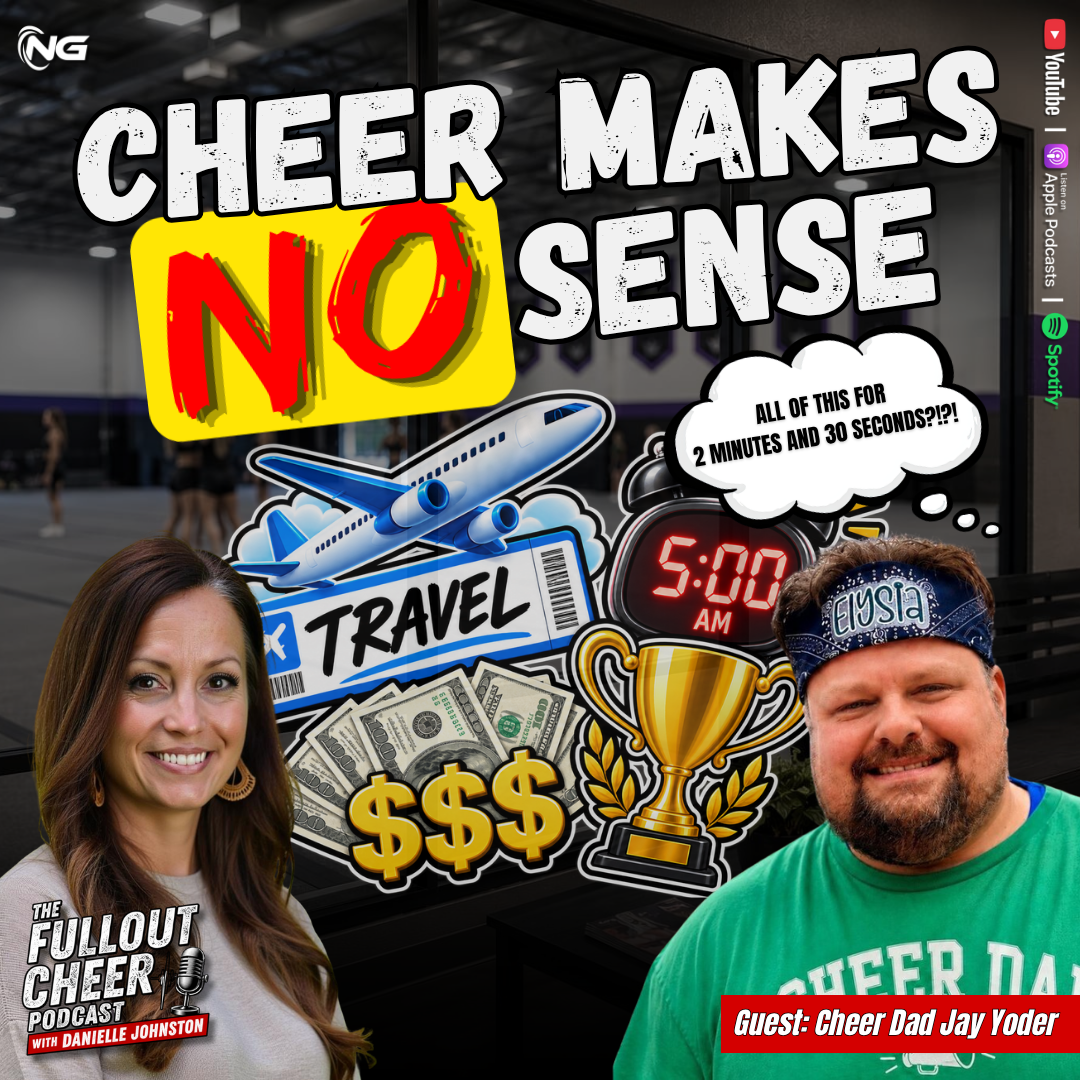
Hey guys, and welcome back to the Full Out Cheer Podcast! I’m Danielle, your host, and today I’ve got a guest I’ve been dying to have on the show: Jay Yoder. If you’ve spent even a minute on cheer social media, you’ve probably scrolled past this cheer dad sitting in his car talking about glitter, pom-poms, and backpacks. Today he’s telling us how it all started, what makes cheer culture so wonderfully weird, and why he’s bringing his comedy show straight to the competition floor.
How a Cheer Dad Became CheerDad
Jay’s story starts simply: he began making silly videos to connect with his daughter, who has autism and cheers. There were times he couldn’t be right there with her, so he started poking fun at the things he was noticing from the sidelines — and it resonated with people far beyond his own family. Judges, gym owners, athletes, parents — all facets of the cheer world found something in his videos to laugh at and relate to.
That connection recently earned him Cheer Daily’s Social Media Presence of the Year award, an honor he says caught him completely off guard. “I didn’t know how much it was going to mean to me,” he told me. Being recognized at a gala alongside industry giants from Varsity and Redline, all for making videos to connect with his daughter, was a full-circle moment. “That’s the one thing I’ve loved about the cheer community,” he said. “It’s been so embracing and so inclusive.”
The Moment Cheer Culture Clicked
Jay’s introduction to the deep end of cheer came at a big convention in Charlotte — his daughter’s first taste of nationals-level competition. The merch table alone stopped him in his tracks: rhinestone-covered ducks, mystery collectibles he still can’t identify, and nothing resembling the simple concert t-shirt he was used to. “I want a panini press that says Summit on it,” he joked.
But what really got him was the team names — and the sheer intensity behind them. We swapped stories: I told him about naming a youth team Annihilation just because nobody in my part of Missouri expected that kind of edge from a group of eight-year-olds (nobody could spell it all season, either). Jay’s take on the whole phenomenon is a perfect encapsulation of cheer culture: teams with names like “We Ride at Dawn” walk out looking like toddlers who need help opening an Apple Pouch. “We’re dangerous, but we need help opening our snack,” he laughed. It’s that exact juxtaposition that inspired one of his first videos to really take off — a bit asking, only half-jokingly, whether he’d accidentally joined a cult.
Judging, Scoring, and Why Cheer Is More Complicated Than It Looks
Once Jay got past the merch table and the team names, the scoring system became his next fascination. He compared it to learning to score bowling before everything was automated: it looks simple until you actually have to understand it. He even made a video about a rubric that scores certain elements out of 92 points instead of 100 — “100 was too logical,” he joked. “They probably sell the other eight points at the gift shop at the World of Sports.”
The joke led to something real, though. One of the judges, a fellow social media presence named Mimi, responded to his video, and the two have since teamed up on parent-education events where she explains the scoring system and Jay plays comic relief, asking the questions some cheer dads are too intimidated to ask. Digging into the rubric gave him a much deeper appreciation for what actually separates a good routine from a great one — technique and execution before difficulty, precision before flash.
That appreciation for complexity tracks with Jay’s background: he taught Latin for 21 years. “My brain naturally wants there to be complexities,” he said. “We love stories that have complexities.” Cheer, it turns out, is exactly that kind of story — far from “the quarterback’s girlfriend at halftime,” as he put it. “This is the main event.” I couldn’t help but share that I taught Latin for two years as a homeschool mom myself, and how I used to turn division problems into stunt-group math — sixteen kids on a team, four per stunt group, back spots included. Jay’s response summed up his whole teaching philosophy: if a lesson connects to something a kid already loves, they’ll actually use it.
The Unique Bond Between Coaches and Long-Term Athletes
One thing I’ve always believed is that all-star cheer coaches get something classroom teachers rarely do: years, not just a single season, with the same athletes. I’ve coached kids in my gym on and off for thirteen years — long enough that it starts to feel like watching a family member grow up.
Jay related this directly to his seventeen years coaching competitive baseball. Because he moved up through the grades with one particular group of players, he ended up with them from age twelve to eighteen — their entire formative years. “There’s something special about that,” he said, pointing to educator John Dewey’s philosophy that the classroom should be a microcosm of the world. Coaches, like teachers, often don’t realize they’re the pivotal adult in a kid’s life — which is part of why Jay now spends time speaking to teachers and gym owners about taking care of themselves so they can keep showing up for the kids who need them most, even the ones who hide it well.
What He Won’t Post — and Why Authenticity Still Wins
I asked Jay what he sees other cheer accounts post that he’d never put out himself. His answer: not much is really off-limits, but he’s noticed plenty of accounts leaning into outrage because the algorithm rewards it. He mentioned lurking in cheer parent Facebook groups where people post anonymously just to stir up a reaction — pitchforks in the comments over things that, on reflection, were probably rage bait all along.
His own approach leans positive. He talks openly about his daughter and her autism because he wants to shine a light on it, not because it’s easy content. “Nobody was willing to share that somebody in their family was different,” he said, reflecting on how much that’s changed. He pointed to a young TikTok creator with Tourette’s who now has her own TLC show as proof that social media, for all its flaws, has also given people the platform to be seen and understood in ways they weren’t before. His bottom line: everybody’s responsible for the energy they bring into the chat.
What Makes Jay Stop Scrolling
Acrobatics get him every time — he compared the feeling to watching Derek Jeter field a ground ball, or the choreography of a busy professional kitchen: people moving in perfect sync, doing something with their bodies he can’t imagine doing himself. He’s also drawn to accounts that break down scoring and technique, like Gabby Butler’s and Judge Mimi’s, because he actually learns something. “I want to be bedazzled,” he said. “I want to be in awe of the athleticism.”
Bringing the Comedy Tour to Cheer Competitions
Jay is expanding his live shows this year, partnering with Redline Championships for roughly a dozen events. The plan includes evening comedy shows for parents, plus daytime interactive games and trivia to fill the long stretches of downtime between warmups and awards. In Chicago, that meant a surprise appearance from Gabby Butler, who joined a game where a cheer coach had to guess Gabby’s moves based only on another parent’s frantic play-by-play description.
Working directly with a competition company has been a relief compared to his earlier solo attempts to gather a crowd. “That’s so much better than me just trying to go to the city and wrangle people during a chaotic schedule,” he said. Next up: Fort Worth, San Antonio, and Plano the week after this episode airs — his first time in Texas, which he’s especially excited about given how big the cheer scene is there.
Rapid Fire with CheerDad
Most expensive thing bought at a cheer competition: a bedazzled hoodie.
The cheer term that makes absolutely no sense to him: “standing full.” (“That’s what I do after every meal,” he joked.)
5 a.m. arrival or 10 p.m. awards? 5 a.m., no contest — mostly for the easier parking.
The one thing every cheer dad should bring to a competition: a pad to sit on.
You know you’re a cheer dad when: you’ve spent more time parking the car than watching your daughter perform.
A Full-Circle Cheer Family
Jay closed by reflecting on how much cheer has become part of his life, with both of his daughters now involved — including his younger daughter’s first practice on an inclusive middle school sideline team, a moment the family has been hoping for. Between the comedy tour, the Redline partnership, and the ongoing videos with his daughter, he’s found a genuine home in this community.
If you haven’t checked out the Redline Comedy Tour yet, do it — and catch Jay live if he’s coming through your area this season.
If you enjoyed this episode of the Full Out Cheer Podcast, make sure you head over to our Facebook groups — Cheer Gym Owners for our gym owners, and All-Star Cheer Coaches and Owners for those who also like to get on the mat and coach. Thank you so much for listening, you guys, and with that, I’ll see you on the next episode.