
YouTube | Spotify | Apple Podcasts
From a Recess Dare to Trinity Valley and Weber State Cheer
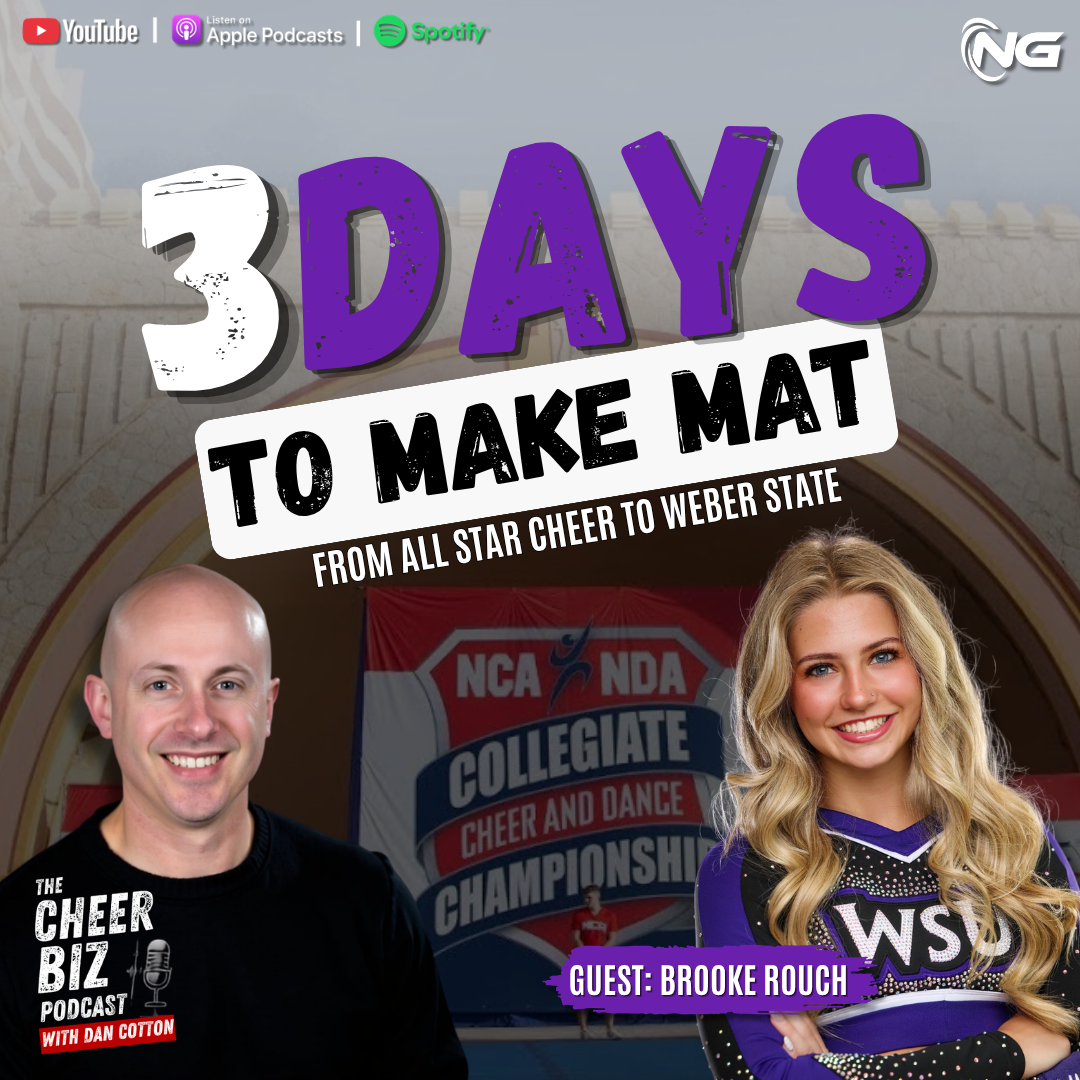
Former Trinity Valley and Weber State cheerleader Brooke sits down with host Dan Cotton to share her journey from a childhood dare to a broken back, a last-minute spot on the mat, and what comes next as she eyes a pro cheer career.
A Recess Dare Sparks a Career
Dan Cotton opened this episode of the Cheer Biz Podcast by welcoming Brooke, a former Trinity Valley Community College and Weber State University cheerleader, to talk through her winding path from a small hometown gym to two of the sport’s most decorated college programs. The conversation covered how she got started, the injury that nearly derailed her career, and where she’s headed next now that her collegiate eligibility has run out.
Brooke explained that her path into cheerleading started almost by accident, back in fifth grade. A group of friends were doing back walkovers and cartwheels at recess and daring her to try, telling her she couldn’t do it. Never one to be told she couldn’t do something, she signed up for classes to prove them wrong and ended up sticking with the sport for good. She grew up training at a very small gym, which was later bought out by a larger program, and it was there that she landed her first spot on a Worlds team, where she stayed for four years before heading to Texas.
Racing Toward a World’s Team
Brooke’s first competitive team was a level two squad at that small hometown gym, a far cry from the large, specialized programs many level twos train at today. From there, her progress moved fast. She estimated the jump from back walkovers to standing tucks happened within just a couple of years, and by around age 12 she had a full — though she described it as a scary one, learned in a gym where skills weren’t broken down carefully so much as picked up amid a group of kids bouncing around together.
A turning point came when the owner of a nearby tumbling-only gym in Colorado, who occasionally helped her team prepare for competition, invited her to train with him directly. He took her back to basics, rebuilding her tuck from the ground up before building her back to a double. Not long after, her gym was bought out by Steel, and within months she was throwing doubles, whip doubles, and a standing full, spending hours after Sunday practices working privates and staying late in the gym.
That rapid growth landed her on Steel’s Worlds team, a placement she hadn’t expected going into tryouts. She recalled feeling star-struck walking into practice with athletes already throwing doubles and stunts she’d never seen in person. The team overhauled its routine and visions just two months before Worlds and picked up a bid at Pack West along the way, yet Brooke remembers that first Worlds appearance less for the pressure and more for how present she felt just being there — a mindset she believes served her well as the team made finals. The following season brought a shift into a highly competitive medium coed division and a far more demanding routine, which is when the pressure of the sport started to build in earnest.
Finding Trinity Valley
Brooke’s route to Trinity Valley Community College came through a circle of older teammates on her medium coed team who had taken her under their wing and spoke highly of the program, along with a Colorado cheerleader named Molly who shared the same coach and had cheered there herself. What started as background awareness turned serious at NCA, where she performed on the arena floor and drew interest from multiple college programs. A combine clinic sealed it: watching a teammate perform a standout full to showcase the program, and connecting with the coaching staff, convinced Brooke that Trinity Valley was where she’d fit.
She arrived in Athens, Texas — home to one Walmart, a feed store, and the college — without ever having visited or attended a clinic there. The town itself felt isolating at first, she admitted, but walking into the gym for her first collegiate tryout gave her an immediate sense of calm, despite being, in her words, a naturally anxious worrier. What stood out most was how welcoming the team was, greeting new arrivals with open arms and hugs from the moment they stepped in.
Life in the Cave
Brooke described Trinity Valley’s culture as one built around a simple reality: with so few things to do in town, the team spent enormous amounts of time training together voluntarily. Athletes would head from practice straight to the cafeteria for dinner, change out of their required red, black, and white practice colors into their own outfits, and walk back to Cardinal Gym to log extra hours in what the team called the cave — often laughing, blasting music, and rolling out tumbling strips on the gym’s extra floor space until coaches had to ask to go home.
Though Trinity Valley is typically a two-year program, Brooke stayed for three seasons. Part of the motivation was falling short at Daytona her sophomore year in a way that left her hungry to finish what the team had started. But just as important, she said, was wanting one more year to grow personally in a place that felt safe and comfortable, and a desire to give back to a program that had given her so much. She calls that final season the best year of her cheer career.
Breaking Her Back and Fighting to Return
One of the most dramatic parts of Brooke’s Trinity Valley experience was a back injury that started quietly and ended in a fracture. She had dealt with nagging back pain for roughly a year, dating back to her senior year of high school, but chalked it up to normal soreness and never saw a doctor. Shortly after arriving at Trinity Valley, the pain became severe enough that she couldn’t tumble at all, prompting her coach to ask what was wrong. Trainers initially suspected a herniated disc, and after a week off, she seemed to recover.
The real injury happened during a conditioning circuit. While attempting a standing tuck after a round of V-ups, Brooke felt a pop and a slip, followed by pain and numbness shooting down her left leg. What felt to her like a fluke soon revealed something far more serious: her muscles had ripped apart the small connecting bone between two of her vertebrae. An MRI later showed the bone had actually been fractured halfway through for roughly a year, worn down slowly and never able to heal because it went undiagnosed. The tumbling accident completed the break, resulting in a bilateral fracture, damage to three discs, and a crushed nerve canal — and her first X-ray missed the break entirely, with doctors calling her back the next day once radiology caught it.
Given her age and a core strengthened by years in the sport, Brooke and her medical team opted to skip surgery and, eventually, skip the custom back brace originally planned for a four-month recovery, since the fracture was never going to heal on its own regardless. What followed was months of extremely limited movement: no carrying a backpack, no long walks, and sleeping with her legs bent at a 90-degree angle for two months. Physical therapy broke her recovery down step by step, and once she passed those benchmarks, her coach joined her in sessions to help build a structured plan for returning to tumbling, skill by skill.
That plan paid off in dramatic fashion. Three or four weeks before Daytona that season, a teammate suffered a serious tumbling collision and broke bones in her face, opening up a spot in the lineup. Brooke, who had quietly kept herself conditioned and ready despite not being on the competing roster, learned the teammate’s entire routine in about a month and competed at Daytona — helping Trinity Valley win the program’s first-ever small coed national title.
A Bigger Pond at Weber State
With two years of eligibility remaining after her three seasons at Trinity Valley, Brooke transferred to Weber State University, a program known for some of the most talented athletes in the sport. She likened the jump to going from a comfortable small pond to a massive one overnight, describing genuine shock at the level of stunting she witnessed, even though the tumbling gap between the two programs felt smaller. Life outside the gym opened up too — teammates might go snowboarding or hiking during the day, then still put in three hours of stunting until midnight.
Brooke started on Weber State’s large coed team before moving to the small coed side, giving her a direct comparison between the two team cultures. She found the small coed environment brought back a sense of joy and lightness that had quietly slipped away amid the pressure of upper-level cheer — more laughter at practice, less self-imposed judgment about every stunt or pass, even while training at an elite level.
Three Days to Earn Her Spot
Brooke’s first year at Weber State tested her in ways she hadn’t experienced before. During her first semester, she battled a mental block on her full that lasted until around November, unable to bring herself to throw the skill without freezing up. Around the same time, she transferred from large coed to small coed alongside her close friend Tasa, a switch that was difficult to explain to teammates and initially felt shaky, even though the small coed environment itself turned out to be a great fit.
Despite training at full capacity and hitting every skill required of her once choreography began, Brooke did not make the small coed mat that year. She had joined the team midseason and understood the coaches’ caution, but found it uniquely difficult to be told, in effect, that whatever was meant to happen would happen, with no clear path to earn a spot. She responded by training even harder, determined to prove she belonged.
That determination paid off just three days before showoffs for Daytona, when a teammate who had been deducted from the routine multiple times lost her spot. Brooke’s coach asked whether she knew the routine’s counts; after two walkthroughs and a cold full-out, she earned the position. The following day, he tested her on the pyramid counts as well, and just like that, she was in. Brooke described the pressure that followed as intense — not because the routine itself was difficult, but because every mistake felt like it could cost her the spot she’d fought so hard to win. In the end, she hit her routine all three days on the panel at Daytona, competing with fewer than ten full-outs under her belt heading into the season.
What’s Next: Pro League and Grad School
With her college cheer career complete, Brooke is turning her attention to trying out for a professional cheer league, a new and still-developing space for the sport. Since Utah doesn’t currently have an open Worlds team, a pro league tryout is her primary path to keep competing at a high level. Because she’s coaching during the tryout window, she expects to submit video tryouts rather than attend in person, likely focusing her efforts on one team rather than several.
Outside of cheer, Brooke recently started a master’s program in special education with a concentration in applied behavior analysis, marking the next chapter of her career off the mat.
Her Advice for Cheerleaders and Coaches
Asked what advice she’d offer coaches and athletes listening in, Brooke returned to something she said she gets asked about often: protecting the joy in the sport. She encouraged coaches to keep their programs rewarding and celebratory rather than letting the intensity of competitive cheer turn it into something that feels like a job. Everyone starts cheering because they love it, she said, and that has to stay at the core — kids need to feel like mistakes are okay so they keep wanting to show up and put in the work because they’re passionate about it, not because they have to.
If you enjoyed this episode, you may also like “From Athlete to Coach: Jalani Keo’s Journey Through College and All-Star Cheer”