YouTube | Spotify | Apple Podcasts
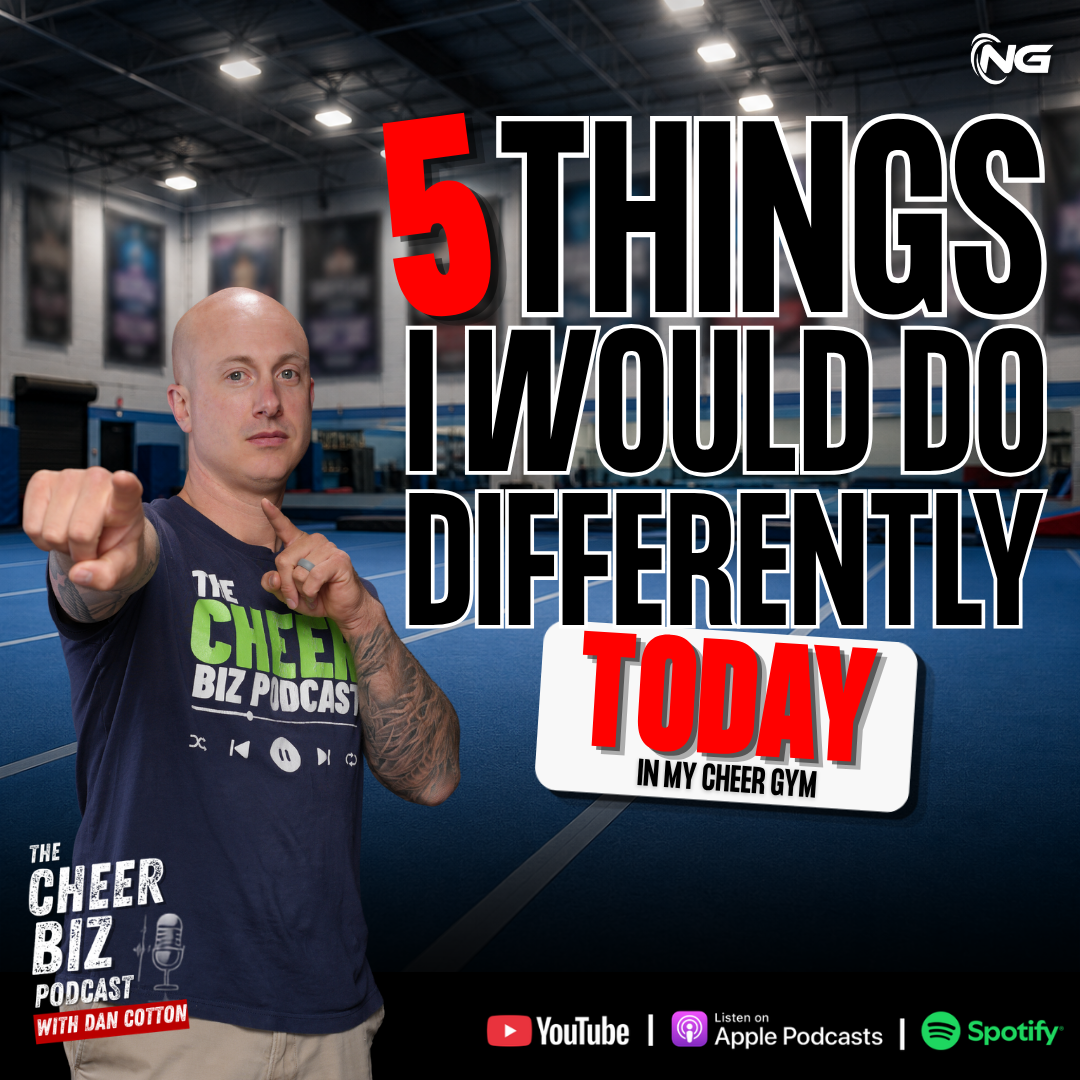
Five Things Dan Cotton Would Do Differently Opening a Cheer Gym
Cheer Biz Podcast host Dan Cotton looks back on taking over his Oregon gym in 2011 and shares the five moves he’d make first if he were starting from scratch today.
Revisiting the Early Days of Ownership
Dan Cotton opened this episode of the Cheer Biz Podcast by taking listeners back to the moment he and his wife Tori took over their gym from a previous owner. At the time, the two of them knew how to coach cheerleading, but they knew almost nothing about running a business. Looking back, Dan admitted he wasn’t even coaching all that well in those early years. In this episode, he walks through the five things he would do differently if he were opening his gym today, drawing on the lessons that took him nearly a decade to learn the hard way.
Before diving in, Dan pointed listeners toward the Cheer Gym Owners and All-Star Cheer Coaches and Owners Facebook groups, both free communities for gym owners to connect and learn from each other. He also announced a new project: a learning community called SKOL, built specifically to help cheer gym owners understand how to use AI in their business, from setting up platforms to applying the technology day to day. The community was launching that same week, available for a low monthly membership to anyone not already part of the Cheer Biz Accelerator program.
Dan also mentioned that the Cheer Biz Accelerator, his in-person event series with his team including Danielle, has one remaining event with availability in 2026: November, hosted at his gym, Oregon Dream Teams, in Portland, Oregon. Additional events are already booking for January, February, March, and April of 2027 for anyone who can’t make it to the November date.
Most gym owners, Dan noted, open their doors because they see a need in their community, spot an opportunity, or simply don’t want to work for someone else anymore. That last motivation was close to his own story. He and Tori weren’t thrilled with how their previous gym was being run and wanted to do things their own way, so buying the facility let them take over without displacing the athletes already training there. Dan was candid that, in hindsight, he probably wouldn’t have purchased the gym for what they paid, and it took almost seven years before they saw a real return on that investment. The five changes below, he said, are the ones that would have shortened that timeline significantly.
Hire the Right Front Desk First
The first change Dan would make is hiring a great front desk employee before ever worrying about a first coach. He acknowledged this goes against instinct for most cheer coaches turned gym owners, who assume their biggest need is more coaching talent. But Dan argued that a gym has two customers to satisfy: the athlete on the mat and the parent in the lobby. A gym staffed only with coaches is essentially ignoring that second customer, the one who actually pays the bills.
A strong front desk employee answers the phone, greets families walking in the door, sells prospects into classes, teams, or private lessons, and builds a genuine connection with clients. Dan said his gym missed enormous amounts of revenue in the early years simply because no one was covering the front of house. His first attempt at solving the problem was hiring a parent who needed to offset tuition costs but wasn’t systemized, trained, or particularly outgoing. She functioned more like an answering machine, jotting down messages on sticky notes for Tori to handle later.
The next hire was another parent who started strong but was given too much autonomy without proper training or oversight. She eventually took over payroll and embezzled thousands of dollars by overpaying herself, a costly lesson in the importance of supervision. The turning point came with Jesse Bolt, who had coached for the gym before stepping up to systemize the front desk. She built out real processes and managed a small team, and she’s since gone on to become the first franchise owner of an Oregon Dream Teams location. After Jesse moved on, a longtime staff member named Carrie took over the role and has been essential to the business ever since. Dan credits the gym’s growth in enrollment and retention over the last five years largely to having the right person running the front desk, and said it’s the single hire he’d prioritize first if he were starting over.
Price by the Numbers, Not by Guesswork
The second change is building pricing around actual expenses, profit margins, and the value delivered to customers, rather than simply copying whatever the previous owner charged. That’s exactly what Dan and Tori did when they took over, and it led to roughly four painful years of pricing problems. He covers the full story in his book, Charge What You’re Worth, and noted that the Cheer Biz team has since built an online pricing calculator to help owners run the math without needing to work through the formulas by hand.
Because their pricing was never built correctly, Dan said their net revenue barely moved even as enrollment grew, since expenses climbed right alongside it. Tactics like profit-first budgeting can help around the edges, but they can’t fix a pricing model that’s broken at its foundation. Dan pointed to two common mistakes gym owners make: charging whatever competitors charge, or worse, undercutting the market without the financial cushion to sustain it for the three to five years it typically takes to build a client base that way. The other frequent error is pricing based purely on the cost of delivery, like a coach’s pay rate, while forgetting to factor in operating expenses and profit margin. Dan was direct about the responsibility this creates: gym owners owe it to their customers to run a profitable business, because a business that isn’t profitable can’t stay open to serve them.
Invest in a Website and CRM That Convert
Third, Dan would pay for a high-quality, conversion-focused website paired with a real CRM system from the start. He acknowledged that some listeners might roll their eyes at what sounds like a sales pitch, but pointed to the results: after implementing CRM systems over the past two years, his gym saw close to a 45 percent increase in new class enrollments in the last year alone, driven by better lead capture, faster response times, and automated follow-up like text nurture sequences.
For roughly the first seven years of ownership, Dan said his gym’s website functioned as little more than a digital billboard: attractive photos and a friendly message, but no real path for a visitor to actually sign up or get in touch. He was blunt about how common that problem still is across the cheerleading industry, and how avoidable it is given how little a quality website costs relative to the return it generates. In his view, a functional, high-converting website isn’t optional anymore. It’s simply how people find and choose a gym today.
Make Class Programs the Business Backbone
The fourth change is building the class program to be the true backbone of the business rather than treating it as an afterthought to all-star. When Dan and Tori first took over, classes were run the way the previous owner had structured them: five dollars a class, drop-in only, with no commitment and essentially no structure. Today, Dan charges $129 a month for a weekly tumbling class plus a 30-minute supplemental session, a price point that’s higher than some local competitors but reflects, he believes, a stronger value.
Dan was careful to note he’s not suggesting owners copy his exact prices, since pricing has to be built on each gym’s own numbers as described earlier. The bigger point is structural: a strong class program keeps a steady stream of new members entering the funnel, many of whom stay enrolled for eight to twelve months on average and, ideally, eventually move into all-star programming. As long as churn stays manageable, that steady inflow is what allows a gym to keep growing, cover rising costs, and reinvest in the business, with all-star growth building on top of that foundation rather than being the only thing the gym is built around.
Find a Business Coach Who Knows Cheer
The fifth and final change is hiring a business coach with real experience in the cheer industry specifically. Dan said that while there are excellent business coaches outside the cheerleading world, very few of them are equipped to mentor a cheer gym owner effectively. Even skilled coaches from other industries are often too far removed from the grassroots, day-to-day realities of building a cheer gym, and their advice doesn’t always translate.
He emphasized that the market has changed significantly since he and Tori bought their gym in 2011, and that owners need guidance from people who understand where the industry actually stands today, not just general business theory. Dan compared it to athletic training: it’s possible to learn tumbling in a backyard, but progress comes much faster with the right coach, equipment, and resources. He’s worked with a range of business coaches over the years, some better than others, and stressed that the volume of business content now available online, much of it generic or simply wrong for the cheer industry, makes finding the right, experienced guide more important than ever. Part of what makes cheer gyms unique, he added, is that they serve two very different customers at once, the athlete and the parent, each with distinct goals and expectations, which is exactly the kind of nuance a generalist coach is likely to miss.
Dan closed the episode by thanking listeners for tuning in and encouraged anyone interested in leveraging AI in their gym to check out the new SKOL learning community, along with the upcoming Cheer Biz Accelerator events. He also invited listeners to subscribe to the podcast on Apple Podcasts, Spotify, or YouTube, and to join the Cheer Gym Owners and All-Star Cheer Coaches and Owners Facebook groups to keep the conversation going with fellow gym owners.