YouTube | Spotify | Apple Podcasts
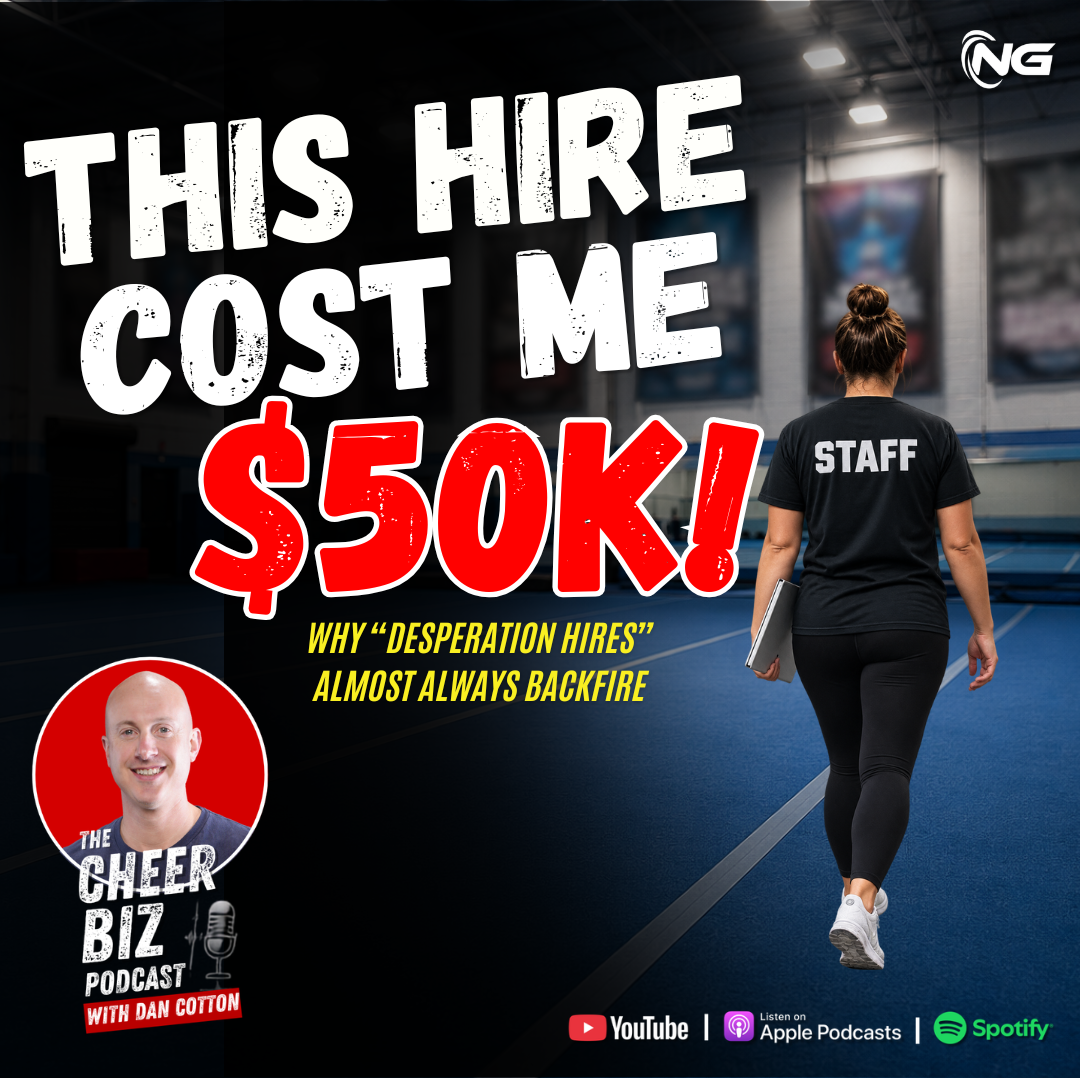
The Hidden Cost of Desperation Hiring in Cheer Gyms
In this solo episode, Cheer Biz Podcast host Dan Cotton draws on nearly two decades of gym ownership to explain why hiring out of desperation almost always backfires, and what smart owners do instead to protect their culture, their brand, and their bottom line.
A Partnership Gone Wrong
Dan opened the episode with a story from early in his career as a gym owner. When he and his wife Tori first bought their gym, they brought on a business partner who had coached their World’s team alongside Dan. The partner was relatively new to the gym, having been there only about a year, but he came with serious credibility: he was a World Champion who had also won an NCA National title. Dan and Tori brought him on as a partner without requiring any financial investment, largely because they believed his reputation would lend the gym credibility.
The partnership did not go the way Dan hoped. What started as one of his closest friendships deteriorated, and the two eventually split as business partners. Dan was careful to note he holds no ill will toward his former partner and genuinely wishes him well, but the fallout left a real gap in the gym. The two of them had been the primary celebrity coaches on staff, and when his partner left, that leadership hole needed to be filled immediately.
The Desperation Hire That Followed
With the gym suddenly missing a key coaching presence, Dan admitted he panicked. He wanted someone with a recognizable name who would reassure parents and staff, so he went to significant lengths to find that person, at one point calling Tanaz at California All-Stars to ask if any of her coaches might be willing to travel in periodically to help coach the World’s team. That search eventually led him to a coach he had never met, who had never even visited Oregon or seen the gym in person.
Dan recalled that his gut told him the fit wasn’t quite right from their very first phone conversation, but desperation won out and he hired the coach anyway. To be clear, Dan described this person as a genuinely wonderful human being, someone he would still greet warmly today. The problem wasn’t character in a moral sense; it was cultural fit. That single hire set off what Dan called a trickle-down effect of desperation hiring, leading to one of the worst staffing years he has ever experienced, one that included multiple additional terminations. Of everyone brought on during that stretch, only one person lasted more than two years, and she remains one of Dan and Tori’s closest friends today.
Why Talent Alone Keeps Backfiring
Reflecting on years of hiring decisions, Dan identified a clear pattern. Nearly every hire made purely out of desperation, chasing a name, a resume line, or a reputation, has ended in disappointment. Meanwhile, nearly every hire made because Dan simply believed in someone’s character, even without a defined role for them, has turned into one of his best decisions.
He pointed to Emily as a prime example. She had worked for the gym previously, then left to coach collegiate cheer, and eventually reached out to say she was moving home and needed a job, ideally full-time, at Oregon Dream Teams. Dan and Tori didn’t have an open full-time position. Rather than pass on her, they took a financial risk, elevated their front desk role, and folded her into their Next Gen team. Emily has since grown into one of the most integral people in the organization: she runs ODT’s marketing campaigns, manages all of its social media, and serves as Operations Director for Next Generation Gym Owners, effectively performing the bulk of what would normally be a chief operating officer’s role. Dan credited her success directly to the fact that she was hired for who she was, not for a specific title she needed to fill.
Skill on the Mat Isn’t Enough to Coach
Dan also warned against equating athletic talent with coaching ability, a mistake he said has become more common as collegiate and professional cheerleading have grown in popularity. Many high-level athletes now arrive with large social media followings and impressive skill sets, but that doesn’t automatically translate into being a strong instructor.
He shared a cautionary story from early in the history of Dream Camps, when the team brought in a celebrity instructor with multiple World Championship titles and a large following. The arrangement came with steep demands, including a paid meet-and-greet structure where athletes had to pay extra just to interact with the instructor and more still for a photo. Once on site, the instructor largely refused to coach, at one point making a dismissive comment about an athlete’s skills and gesturing for Tori to handle the work instead. That experience became a turning point for Dan, reinforcing that reputation and title wins are not proof of coaching ability or professionalism.
How Dream Camps Vets Every Instructor
That incident helped shape the hiring philosophy Dream Camps still uses today. With very few exceptions, every one of Dream Camps’ 42 instructors was brought on through a direct, personal recommendation from a member of the organization’s core staff. Those staff members understand that when they vouch for someone, they are putting their own credibility on the line alongside the new hire’s.
The result has been a remarkably low miss rate. Of the small number of hires that didn’t work out, most were young staff members Dan personally brought in because he liked them, only to find they weren’t ready to handle the demands of the role. He was candid that those misses were on him, not on the referral system itself, which has otherwise proven highly reliable.
Talking Candidates Out of the Job
Dan described a somewhat unconventional practice he uses at Oregon Dream Teams: actively trying to talk potential hires out of joining. When coaches reach out wanting to work at ODT, he’ll walk them through exactly what the role does and doesn’t include, whether certain team levels are already staffed, how private lessons are structured through the gym rather than run independently, and other specifics that shape day-to-day expectations.
His reasoning is straightforward. If being fully transparent about the realities of the position causes a candidate to lose interest, that’s a good outcome for everyone involved. It saves both sides from a mismatch built on false expectations, and it ensures that the people who do come on board are doing so with clear eyes and genuine enthusiasm for the actual job.
The Real Price of Skipping Onboarding
Beyond the desperation hire itself, Dan pointed to a second, related mistake: bringing on a highly skilled or highly credentialed person and assuming they need little to no onboarding. Gym owners often treat a talented new hire like a genie granted from a lamp, someone who will simply solve every problem the moment they walk in the door.
Dan used tumbling instruction as an example. A coach who excels at delivering a great class or private lesson doesn’t automatically know how to lead a team of instructors, manage a growing program, market it effectively, or build the kind of retention systems that make families feel part of a community. Those are entirely different skill sets. Without a real onboarding process, ongoing training, and clear management oversight, even a technically excellent hire is likely to fall short of what the business actually needs from them.
The $50,000 Lesson From One Bad Hire
To illustrate just how expensive a bad hire can be, Dan shared a story from that difficult staffing year. A local high school, located less than a mile and a half from his gym, had switched its tumbling training over to Oregon Dream Teams, bringing more than 35 kids into the program. Dan assigned two undertrained coaches to run that curriculum. Within three months, the school pulled out, telling Dan they simply didn’t enjoy working with his instructors.
Nearly a decade later, that program still hasn’t returned, even though its athletes now drive close to an hour round trip, passing directly by Dan’s gym, to train elsewhere. By his estimate, that single relationship would have been worth somewhere in the neighborhood of forty to fifty thousand dollars in revenue over those ten years. As Dan put it, the bill for a bad hire always eventually comes due. He also referenced a study Danielle had recently shared, which found that introducing just one negative, disengaged team member into a high-performing group can drag that group’s productivity down by more than 25 percent, a reminder that the cost of a poor cultural fit extends well beyond any one client relationship.
Take Your Time and Hire It Right
Dan closed the episode with a direct message to gym owners who feel pressure to fill a position immediately. When a role opens up and the urgency to hire someone, anyone, sets in, that is exactly the moment to slow down. A hire made in a panic is far more likely to need replacing within months, and that replacement cycle costs significantly more than simply waiting for the right person.
He encouraged owners to be upfront with families when a program isn’t fully staffed yet, whether that means a temporary wait list or a short delay before a class launches. In Dan’s experience, clients are far more understanding of honesty about a staffing gap than they are forgiving of a poor experience delivered by the wrong hire.
Thanks for tuning in to this episode of the Cheer Biz Podcast. Make sure you’re part of the Cheer Gym Owners and All-Star Cheer Coaches and Owners groups on Facebook, where Dan and the community continue these conversations year-round. If you want to learn directly from Dan and his team, spots are still open for the November 2026 Cheer Biz Accelerator event, with 2027 dates now booking as well. And don’t miss the new AI for Cheer Gym Owners community on Skool, where Dan’s team shares practical, industry-specific guidance on using AI to streamline systems and build better experiences for staff and customers alike.