YouTube | Spotify | Apple Podcasts
What Dan Cotton Does When He Wants to Quit His Gym
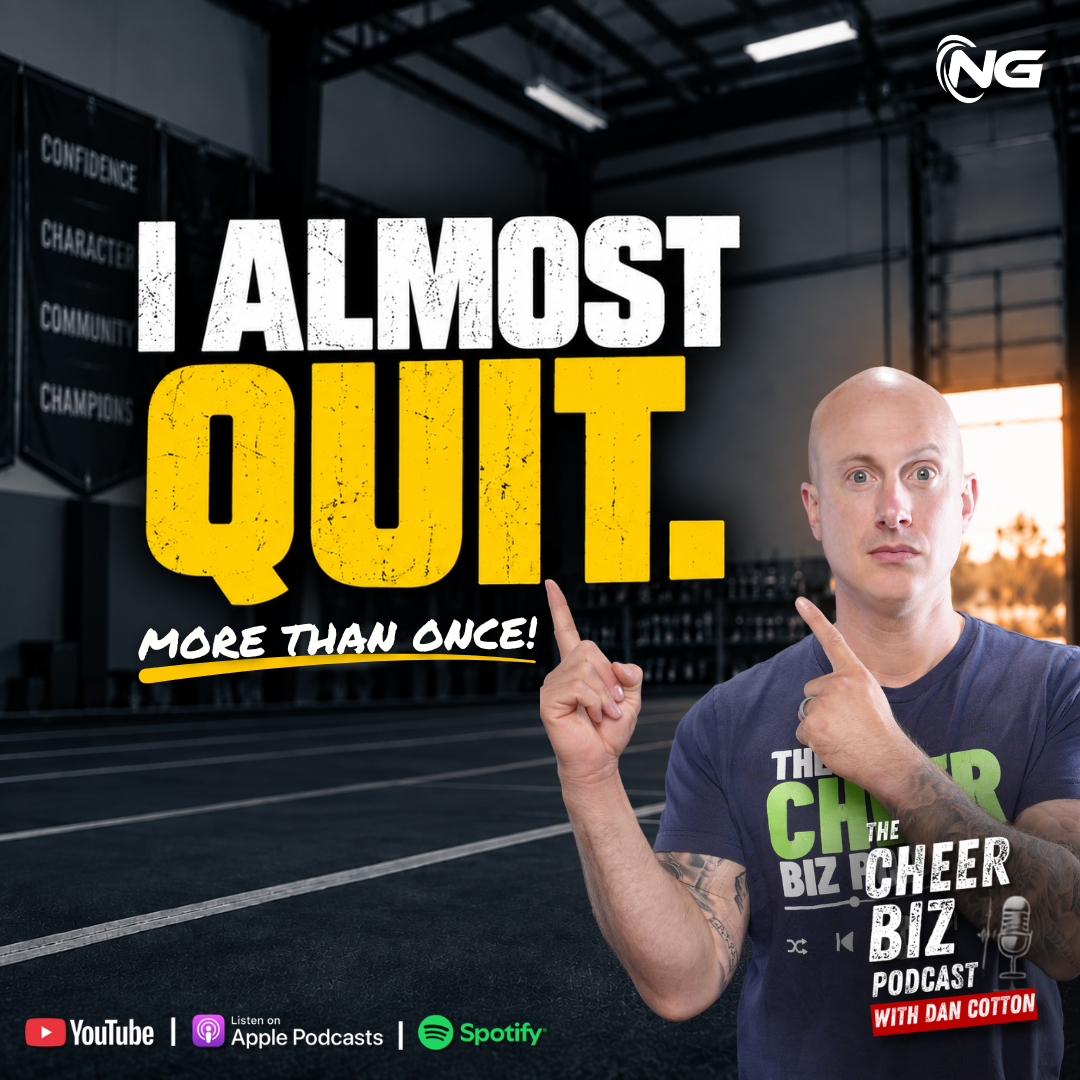
In a solo episode, Cheer Biz Podcast host Dan Cotton, owner of ODT All-Stars, opens up about the moments he’s wanted to walk away from his gym, his coaching, and even his own business coaching work, and shares the exact mental process he uses to push through instead.
A Host Who’s Been There
On this episode of the Cheer Biz Podcast, host Dan Cotton steps away from the usual guest interview format to talk directly about something every gym owner wrestles with at some point: the urge to quit. Dan is candid that this isn’t a topic he’s approaching from theory. As the owner of a competitive cheer gym, a coach, a parent, and a business coach who works with other gym owners, he’s faced the temptation to give up more times than he can count, and he says it still happens today.
Before diving in, Dan reminded listeners to join the Cheer Gym Owners and All-Star Cheer Coaches and Owners groups on Facebook, where these conversations continue year-round. He also pointed to the AI Cheer Gym Owners Lab on Skool.com, where he shares guided walkthroughs on how he’s using AI across his businesses, and mentioned the Cheer Biz Accelerator events happening later in 2026. The October event is sold out, but a couple of spots remain for November for anyone who wants to see firsthand how Dan and his team run ODT.
The Early Days Were Brutal
Dan didn’t sugarcoat what the first five or six years of gym ownership looked like. He and his wife, Tori, would regularly look at each other and ask whether any of it was actually worth it. During that stretch, he said, they weren’t building a business so much as reacting to it, constantly putting out whatever fire was directly in front of them and letting everything else fall by the wayside.
That survival-mode mentality, he explained, is something a lot of gym owners will recognize. It’s not a sign of failure so much as a phase many businesses pass through, but it’s also exactly the kind of pressure that makes people want to walk away. Dan said the doubt hasn’t fully disappeared even now. There are still moments, as a gym owner, a coach, a parent, and a content creator, where he looks in the mirror and questions whether he’s making the right call.
Step One: Reframe, Then Vent to the Right People
The first thing Dan does when he hits one of these low points is a mental reframe. He’s quick to acknowledge that there’s a real, healthy need to vent first, what he jokingly called letting yourself “crash out” for a moment, whether that’s to a spouse, a mentor, or a trusted confidant. But once that initial frustration is off his chest, he moves into a deliberate filtering process for whose advice he actually listens to.
Dan laid out three qualifiers he uses to decide if someone is the right person to give him advice in a moment of wanting to quit. First, does this person actually understand what his ideal end state looks like? If they don’t know where he’s trying to go, their advice will be shaped by what’s right for them, not for him. Second, has this person actually been where he’s trying to go, or do they have unique, actionable knowledge about how to get there? Dan pointed out that the people closest to us, like parents, are often the first ones we turn to, but they may be more interested in removing our challenges than helping us push through them. He contrasted that with the role he sometimes plays as a business coach, telling clients bluntly to buckle up because things are going to get harder before they get easier.
The third qualifier is whether he actually wants to emulate the behavior of the person giving advice. Someone might know his goals and have even achieved something similar, but if the tactics they used to get there don’t align with who Dan wants to be, their advice isn’t the right fit either. He also cautioned that there are people who, consciously or not, would rather see others quit, because it validates their own decision not to keep pushing. Surrounding yourself with people who can see the long game, he said, is essential in the hardest moments.
Playing Out the Worst Case Scenario
The second tool Dan relies on is a mental exercise around worry itself. He referenced a story from a business coach he respects, about a man who built a nearly billion-dollar company but lost his friends and family in the process. When that man died, his entire life was summed up in a two-paragraph obituary that mostly covered where he was born, what he did for work, and who survived him. For Dan, that story is a reminder that whatever is causing him to want to quit right now is rarely as significant, in the grand scope of a life, as it feels in the moment.
From there, he walks through both the worst-case and best-case scenarios for whatever is weighing on him. Using ODT’s early struggles as an example, he described a worst case where enrollment never grew, revenue stayed tight, teams never became competitive, and employee issues never resolved. Playing that scenario all the way to its logical end, the answer is simply: the business closes. And then what? Pride takes a hit, maybe you leave the cheer industry. But even then, life goes on. On the other end, the best-case scenario might mean multiple locations, financial freedom, and a thriving family life. Reality, Dan said, almost always lands somewhere in the middle, and simply mapping that out tends to shrink the fear driving the urge to quit. In his own experience, the number of times he’s worried about the worst case far outweighs the number of times that worst case has actually happened.
Never Quit Is a Muscle
Dan’s third principle traces back to basic training. A drill sergeant once told him that the first time you quit, you make it that much easier to quit the next time. During a particularly difficult run, when Dan started falling behind, that same drill sergeant fell back to run beside him and told him to keep his feet shuffling, because as long as you’re still moving, even slowly, you haven’t quit.
Dan admitted he didn’t always live up to that standard back then, sometimes walking a few steps during a hard run, but he said the drill sergeant’s underlying point was completely right. Giving yourself permission to quit, even in small ways, tends to snowball. Five steps of walking becomes ten, then twenty, until the whole run is a walk. That lesson has shaped how he thinks about quitting as a broader mindset, to the point that “never quit” is now a core value at his gym.
He was careful to draw a distinction, though, between quitting and stopping. Never quit doesn’t mean never stepping back from something or never making a strategic retreat. Quitting, in Dan’s definition, is walking away from something that’s still actively in motion, something you still have the ability to execute on. Stopping is a deliberate decision to no longer pursue something that isn’t bringing value to your life. Those are two very different things, and figuring out which one applies in a given moment is part of the work.
Why the Hard Days Are the Point
Dan closed the episode by tying these three tools together into a simple process for anyone facing a moment of wanting to give up: find the right person to talk to, play out the realistic best- and worst-case scenarios, and land on the honest middle ground, then decide whether what you’re facing is genuinely quitting or simply the need to stop something that no longer serves you.
He also reframed the difficulty itself. Hard days, he said, are guaranteed in business and in life, and that’s actually part of what makes the work worth doing. For Dan, running a gym has filled the same need that being an athlete and a soldier once did: always having something to work toward, something to prepare for. If everything were easy all the time, he said, it wouldn’t be nearly as rewarding.
Join the Conversation
Dan thanked listeners for tuning in and encouraged anyone wrestling with their own version of these questions to run through the same process: find the right advisor, play out the scenarios, and get honest about what quitting versus stopping really looks like in their situation. He invited everyone to keep the conversation going by joining the Cheer Gym Owners and All-Star Cheer Coaches and Owners Facebook groups, where gym owners regularly share exactly this kind of mindset work, and to check out the AI Cheer Gym Owners Lab on Skool.com for more hands-on content from Dan. Anyone interested in learning directly from Dan and seeing how ODT operates day to day can still grab one of the remaining spots for the November Cheer Biz Accelerator event.
If you enjoyed this episode, you may also like “Beating Burnout: The Mindset Shift That Changed Everything”