YouTube: https://youtu.be/DwmXyvU0HIg
Spotify: https://open.spotify.com/episode/6A2Pa7KxrTLnIAS7HDQ9mt?si=OoDEyeROQc6GcaEKkU_oHA
Apple Podcasts: https://podcasts.apple.com/us/podcast/the-cheer-biz-podcast/id1596523298?i=1000771852645
Why Do We Keep Making the Same Mistakes as an Industry?
Cheer Biz Podcast | Host: Dan Cotton
Introduction
I’ve been in the cheerleading industry for over 26 years. And I’m here to ask: why do we keep making the same mistakes on repeat?
Welcome to another episode of the Cheer Biz Podcast. Today we’re talking about why we keep going in circles as an industry — and when we’re going to stop shooting ourselves in the foot.
Before we get into it, a couple of quick things: head over to the Cheer Gym Owners and All-Star Cheer Coaches and Owners groups on Facebook to join the conversation. And check out the Cheer Coaches Handbook — our newest release, co-written by myself and Danielle Johnston with a guest chapter by Jeff Benson, dropping June 1st, 2026. It’s focused on what it means to be a great employee and coach beyond the technical skills. Head to nextgenowners.com to learn more about the academy and how we can help your gym grow.
Mistake #1: Skill-Based Scholarships
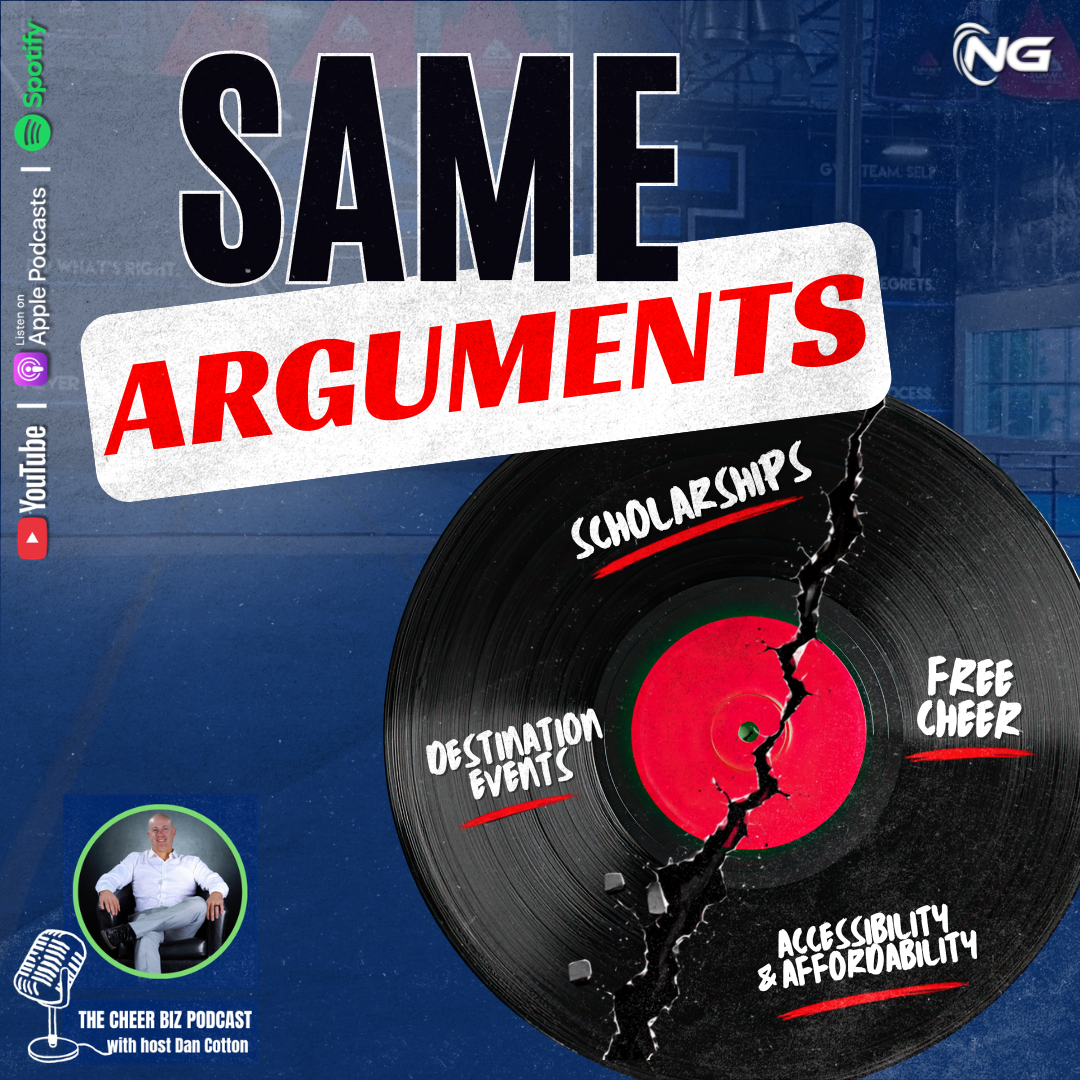
I thought we’d figured this out. I thought we’d had the hard conversations as an industry and collectively agreed to stop scholarshipping athletes purely for skills. And then I saw a social media graphic just this week — something along the lines of scholarships for fulls, or get paid for your double — and I thought, here we go again.
Scholarships originated in college athletics. Universities, as nonprofits with donor bases, could offer financial packages tied to athletic performance because the arrangement had a funding source behind it. In a cheer gym, 99.99% of scholarships don’t have a donor on the other end. You’re essentially discounting your own revenue.
Now, I do believe in helping families find a way to afford cheer — through fundraising, flexible payment plans, work-study arrangements. And I’m personally working on building a fund at my own gym where alumni and former athletes can donate to support current kids in need. That’s a real scholarship model. But handing out discounts based on skills alone? That’s not it.
Here’s why it especially shows up in the Worlds division: it’s incredibly hard to compete at that level. Top programs carry 28 athletes for an 18-person team. They have alternates waiting in the wings. It feels impossible to out-recruit them, so gyms feel pressured to give skills away. But when you recruit an athlete by paying for their skill, you get a transactional relationship. They’re in your program for what they’re getting, not because they’re invested in it. In my experience, the homegrown athlete — the one who goes out of their way to earn their spot — almost always brings more value to your program long-term.
I’m seeing this trend from my own camp company, DreamCamps. The number of parents reaching out to ask about scholarships to attend camp has noticeably increased. And when I explain that we’re a for-profit business with real costs — instructors, lodging, food — some are genuinely caught off guard. I’m not judging anyone for asking. I’m just calling out the pattern. We got away from this, and now we’re sliding back.
Mistake #2: Coaches Running Their Own Private Lesson Programs
I’ve talked about this one so many times, but here we are. Why are gym owners still letting coaches set their own private lesson schedules, charge their own rates, and keep 100% of that revenue?
I get it — some of this comes from newer gym owners who were coaches first. It’s what they were used to, and it felt normal. But it is genuinely bad business practice, and it creates problems on both sides.
At my gym, the rule is straightforward: if a coach wants to do private lessons outside of their scheduled hours, they need to be working a minimum of 25 hours per week at the gym first. And those outside lessons can’t happen during hours when they’d otherwise be teaching or coaching for us. If someone reaches out wanting to run stunt privates in our facility and offers me $10 per lesson to do it, I pass. I’m not going to let people circumvent the structure we’ve built.
Here’s the bigger issue: coaches who are primarily there to run private lessons are not invested in your program. They prioritize their own revenue. And when they eventually leave, they leave with an unrealistic expectation of what a coaching career looks like — one where they were essentially running a side business inside your gym. That’s not fair to them, and it’s not fair to the gym owners who are trying to build something sustainable.
Mistake #3: Becoming What You Said You’d Never Be
This one is less about gym owners and more about companies and organizations in our industry — but gym owners, you’re not off the hook either.
Everyone knows about Varsity — the antitrust issues, the dominance, the reality that they essentially own the ecosystem. And when competitors and new players enter the space, the rallying cry is always the same: We’re not going to be like them. We’ll put the customer first. We’ll stay affordable. We won’t require you to use our systems.
And then, slowly, incrementally, they start to become exactly what they said they wouldn’t be.
I understand why it happens. Varsity is profitable because they’re diversified — competitions, uniforms, choreography, gyms, camp companies. When all roads lead back to your company, the revenue model works. From a pure business strategy perspective, it’s not a bad play. But you can’t tell the industry you’re the alternative and then follow the same blueprint.
The non-affiliated division — whatever it’s called now — is a perfect example. The whole point was to create a lower-cost, accessible version of competitive cheerleading. No $3,000 music fees. No $5,000 choreographers. No cross-country travel to massive events charging $200 per athlete. Just cheer, for less.
Now? Those programs are following the exact same trajectory that All-Star followed. They started small, moved to events, and now they want blingy uniforms, expensive music, expensive choreographers, and their own end-of-season event in Florida. They’re building a parallel universe of all the things we’ve been saying for years we wish we could go back and do differently.
A Note on End-of-Season Costs
I want to be clear: I’m a Varsity fan in a lot of ways. I go to their events. I have friends who work there. I try to call it like I see it — good and bad. I also really like what the Open Championship Series is doing, and I think All-Star Worlds is an incredible experience for the right program. These things can coexist.
But the cost of end-of-season events is a real problem, and I don’t think we talk about it honestly enough.
Here’s a real example: a family flying from the West Coast to Summit with their athlete. Mom, dad, and a sibling who can’t be left home — that’s four plane tickets, around $1,800–$2,000. Hotel, food, and incidentals add another $2,000 or more. Park hopper passes, registration fees, Disney parks if they’re going — another $2,000–$4,000. You’re looking at $8,000–$10,000 for one weekend. Meanwhile, the full cost of their athlete’s season — tuition, assessments, uniform, everything — was around $6,500.
When I ask our families each season whether they want to attend end-of-season events, they say yes — every time. I understand why. It’s an incredible experience. But it’s also a significant financial burden, and it’s one that gets passed down and replicated as new divisions and organizations grow. The moment a division says it wants its own nationals in Florida, we already know where that road leads.
Closing Thoughts
Look, I know this was a bit of a rant. I appreciate you sticking with me through it.
I’m calling out gym owners. I’m calling out coaches who are gym owners. And I’m calling out service providers in this industry. Because we keep doing this cycle — we get better, we make progress, someone has what seems like a good idea, it turns into the same mistake, and around we go again.
If you felt called out by anything in this episode, it’s not because I don’t love you. It’s because I want better for our industry. And I genuinely believe that if we don’t call ourselves out when we’re making mistakes, we can’t actually get better. That includes me. When I mess up, I want my friends to tell me. You can’t always see it clearly when you’re in it.
Learn from the mistakes. Do better. And we’ll catch you on the next episode.