YouTube | Spotify | Apple Podcasts
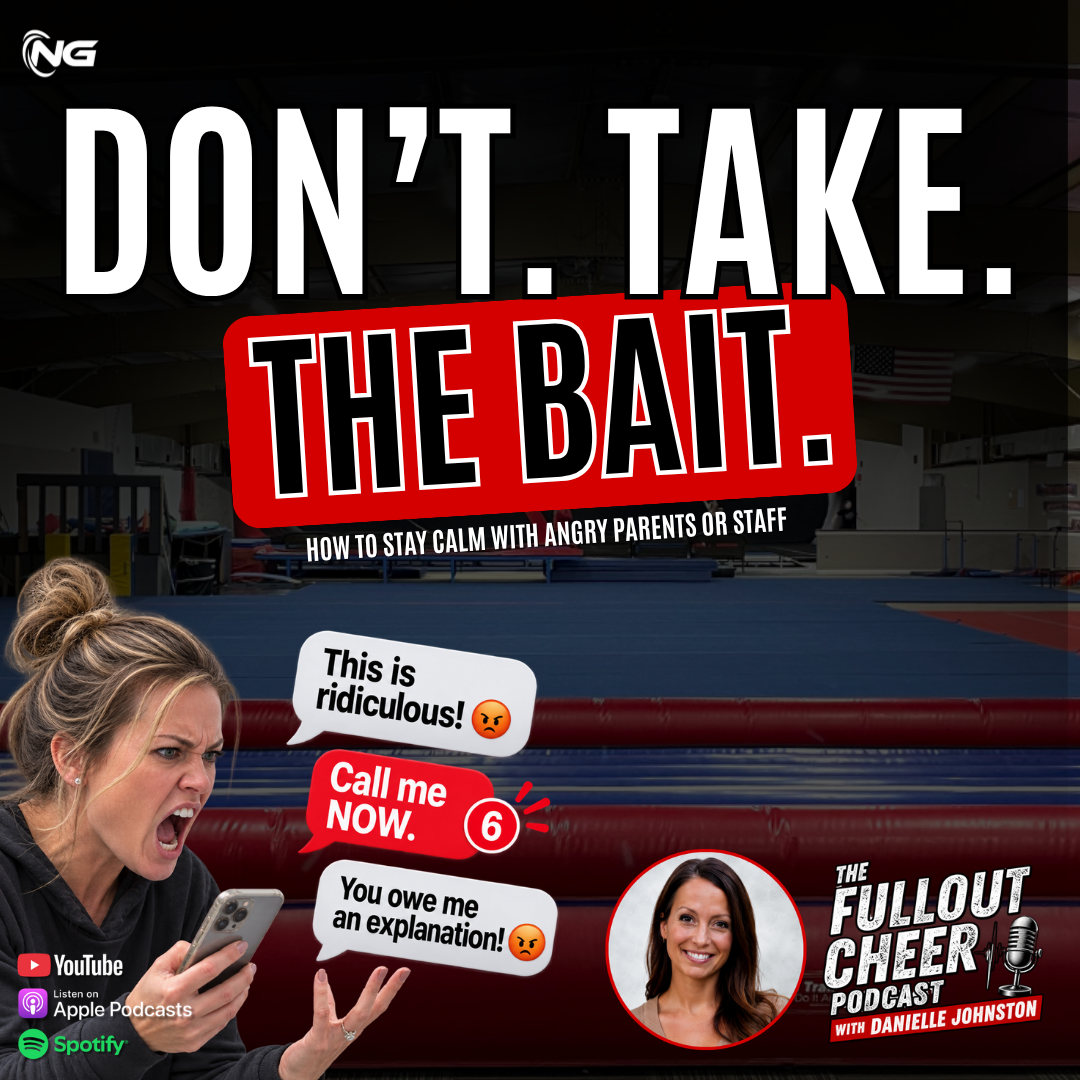
Don’t Take the Bait: How Gym Owners Can Handle Angry Parents and Staff Without Losing Their Cool
I know you’ve probably had a parent or staff member really freak out on you at some point since you’ve owned a gym. Maybe they were yelling at you and lost their temper, whether privately or right in your lobby. Today I’m going to teach you how to not take the bait.
Hey guys, and welcome to this episode of the Full Out Cheer Podcast. I’m Danielle, and I’m your host for today.
My Worst Travel Day Ever
A couple weeks ago, I was on my way back from Dream Camp. My daughter and I go out to Portland every summer so she can spend a week at their individual camp — their staff also comes to Missouri for our team camp. My kid is Dream Camp’s number one fan. She’s sixteen and she genuinely loves it, and if you follow me on Instagram you’ve seen all the great new skills she posts. Nobody pays me to say that, by the way — Dan, if you’re listening, I’ll take my coupon code for next year.
Anyway, I took her to Dream Camp, and on our way back we had the worst travel day of my life. I won’t go into full detail because it could be its own episode, but it started with a flat tire six miles from the airport on the busiest highway in Portland, and it ended with us nine minutes from landing in Kansas City — twelve hours later — when we were told we were being diverted to St. Louis because air traffic control was down. We sat on the plane another forty-five minutes, waited an hour to see what would happen, and then took a forty-five-minute flight back.
Somewhere in the middle of all that chaos, I witnessed something that blew my mind. My patience was already pretty thin — our flight had been delayed thirty-eight minutes, and I’d gotten a text saying they were rerouting our connection so we wouldn’t miss it. Except the reroute meant our luggage might not make it. Then, right as we reached our original boarding time, they announced we were no longer delayed — and when I asked to get back on the original flight, they said no.
Eventually we had a three-and-a-half-hour delay in Denver anyway. While I was sitting there, I watched a man get pulled off a plane after the boarding door had already been closed and reopened — something that almost never happens. From what I could piece together, his wife had left her ID at security, he’d asked the gate agent to hold the flight for her, and the agent had said yes. Then they closed the door without her, and he made a scene. Security pulled him off, and as that door opened, he was yelling.
Where the Gate Agent Went Wrong
I’ve dealt with plenty of angry people myself. I used to have a second location, and I remember a mom literally screaming in my lobby so loud you could hear it through two doors. I’m not sure I handled that one well, but I’ve learned a lot since then — so this time, I got to sit back and watch the whole thing unfold like a train wreck of a TV show, and that gate agent made some huge mistakes.
When the man first came off the plane, he was yelling at the gate agent, but he was still keeping his distance — his voice was elevated, but he wasn’t losing it in front of everyone. That was the moment the agent should have just let him vent. Instead, the agent argued back. He was sarcastic, he was rude, and he denied things. The man said, ‘You told me you’d hold it for my wife.’ The agent said, ‘I never told you that.’ The man said he’d been right there, that he’d told the agent his wife left her ID at the TSA checkpoint and the agent agreed to hold the gate. The agent kept denying it — until the wife walked up and confirmed the whole conversation herself.
At that point the agent turned out to be flatly wrong, and instead of saying, ‘I’m sorry, I remember now — you’re right, I did say that. The FAA doesn’t allow us to hold the gate, and I shouldn’t have said what I did,’ he doubled down. He got sarcastic, told the man he was now off the flight and in some kind of no-fly situation, and kept arguing.
Watching it happen, I found myself almost justifying the customer’s anger. In my head I thought, this guy would make me furious too — the agent wasn’t calming him down, he was escalating him. When a supervisor came over and asked me to write up what I’d witnessed, because the man was eventually escorted out by police, I had to hold myself back from pulling that supervisor aside and telling her flat out that her gate agent had been unprofessional and had made the situation worse.
It’s Not About Being Right — It’s About How You Handle It
I’ve watched this exact dynamic play out with gym owners, event producers, and staff at AllStar events more times than I can count — parents yelling at coaches, parents yelling at staff, staff yelling at gym owners. Somebody is baiting you, and you’re taking the bait. So let’s talk about how to prevent that in your own gym.
First, leadership isn’t about winning. It’s about finding the win for both of you, not proving you’re right. Three years from now, nobody is going to remember who was right and who was wrong — they’re going to remember how the situation was handled. I’ll remember how that gate agent handled things long before I remember who was technically correct.
In your gym, if someone loses it in the lobby, people are going to remember how you handled it far longer than they remember how the parent behaved. You’re the constant — the gym owner, the leader — and the expectation on you is always higher than it is on a parent, because parents come and go as their kids grow up. A new family walking in might think, ‘wow, this gym has some dramatic parents,’ but they’re absolutely going to judge you if you’re the one who lost your cool.
How to De-Escalate Instead of Rage Baiting Back
Second, you have to maintain your emotions — and sometimes emotions matter more than logic. When someone comes at you with that kind of anger, they’re essentially rage baiting you, whether they mean to or not. In this case, I don’t think the customer set out to bait the agent, but I do think the agent was rage baiting the customer right back, almost trying to justify his own behavior by making the other guy angrier. It didn’t work out well for either of them — one got escorted out, the other looked like an unprofessional mess in front of an entire terminal.
It’s okay to tell someone you need them to lower their voice a little, but you have to do it carefully — telling an upset person to calm down can sometimes make them angrier. A better move is something like, ‘Do you mind if we step into my office so you can talk about this privately?’ That gives them a win and gets the conversation out of public view.
Listening to someone vent doesn’t mean you’re agreeing with them, and validating their feelings doesn’t mean admitting fault. Saying, ‘I completely understand how stressful that must have been for you,’ isn’t the same as saying you were wrong — it just acknowledges what they’re feeling. If that gate agent had opened with something like that, I think he could have de-escalated the whole situation. Looking back at my own early days as a gym owner, when that parent was screaming at me in the lobby, I wish I had calmly invited her into my office instead of arguing back in front of everyone. It would have made me look more mature, more credible, and it likely would have de-escalated things far faster than continuing to argue in the moment.
Let people vent — sometimes they genuinely need to get it out, and you won’t always like what they have to say. That doesn’t make their feelings any less valid. Keep your own body language calm, and understand that when someone is that emotionally dysregulated, you may not be able to fix things for them right away. In that airport situation, I could see exactly what should have happened: the agent should have said, ‘Sir, I understand how you’re feeling. Would you like to walk over to the desk with me so we can figure this out?’ Instead, he put the man on a no-fly list, and honestly, I was rooting for the passenger.
Professional Doesn’t Mean Passive
Remember that your tone as the leader sets the temperature for everyone else. If you let yourself get escalated, other people will escalate too, and you will be judged for it — your eye rolls, your body language, matching someone’s volume, interrupting them, debating facts, or jumping in to defend yourself or others too quickly. People will remember your tone and body language far longer than they remember what was actually said, because people are visual, and everyone in the room is paying attention, whether they look like it or not.
Being professional doesn’t mean being passive. It doesn’t mean accepting abuse, verbal or otherwise. It does mean staying composed and holding your boundaries. You have the control, as the leader, to redirect a conversation — but also to make sure the other person has had a real chance to vent first, because they need that to regulate their own emotions. Boundaries come into play after you’ve genuinely tried to de-escalate. If that gate agent had stayed calm and professional and the man had kept escalating anyway, it would have been completely reasonable for him to say, ‘Sir, at this point we’ll need to call security and resolve this through our customer service line.’ I would have understood that. What I didn’t understand was the sarcasm and the attitude that made an already-tense situation worse for no good reason.
Key Takeaways for Handling Conflict in Your Gym
This matters in cheer because conflict is inevitable throughout your season — whether you’re correcting a staff member, an athlete, or a parent whose behavior doesn’t fit your culture. Don’t let someone rage bait you into arguing back in a way that’s unprofessional and, honestly, makes you look bad. Don’t confuse listening with agreeing, and don’t confuse agreeing with accepting that something wrong happened — you can listen to someone without agreeing with them. Don’t let their emotions dictate your own.
Anyone can stay calm when everyone else is calm. What sets a professional gym owner apart is staying composed when someone else is actively trying to reel you in. That’s what your customers will remember, and that’s what they’ll value. And for what it’s worth, all of this applies online too — if people are talking badly about you on the internet, stay calm and don’t argue. Part of owning a gym means sometimes only one side of the story gets told, simply because you’re too professional to air the other side. It’s part of the job.
Keep Learning With Us
Thanks so much for joining me on this short but important episode about not getting rage baited. Make sure you’re following us on Facebook, Instagram, and TikTok at NextGen Owners, where we put out tons of free content for gym owners looking to grow. And if you have more than 60 kids in your gym, check out the Cheerbiz Accelerator at cheerbizaccelerator.com — a two-day, in-person deep dive we run at my gym and Dan’s gym to help you grow in 2026 and 2027. We’ve also got the new Cheer Coaches Handbook for training your staff, and my Cheer Gym Owners Handbook, which walks you through getting your gym into the profitable zone without burning yourself out.
Thanks so much for joining me on this episode of the Full Out Cheer Podcast. I’ll see you on the next one.