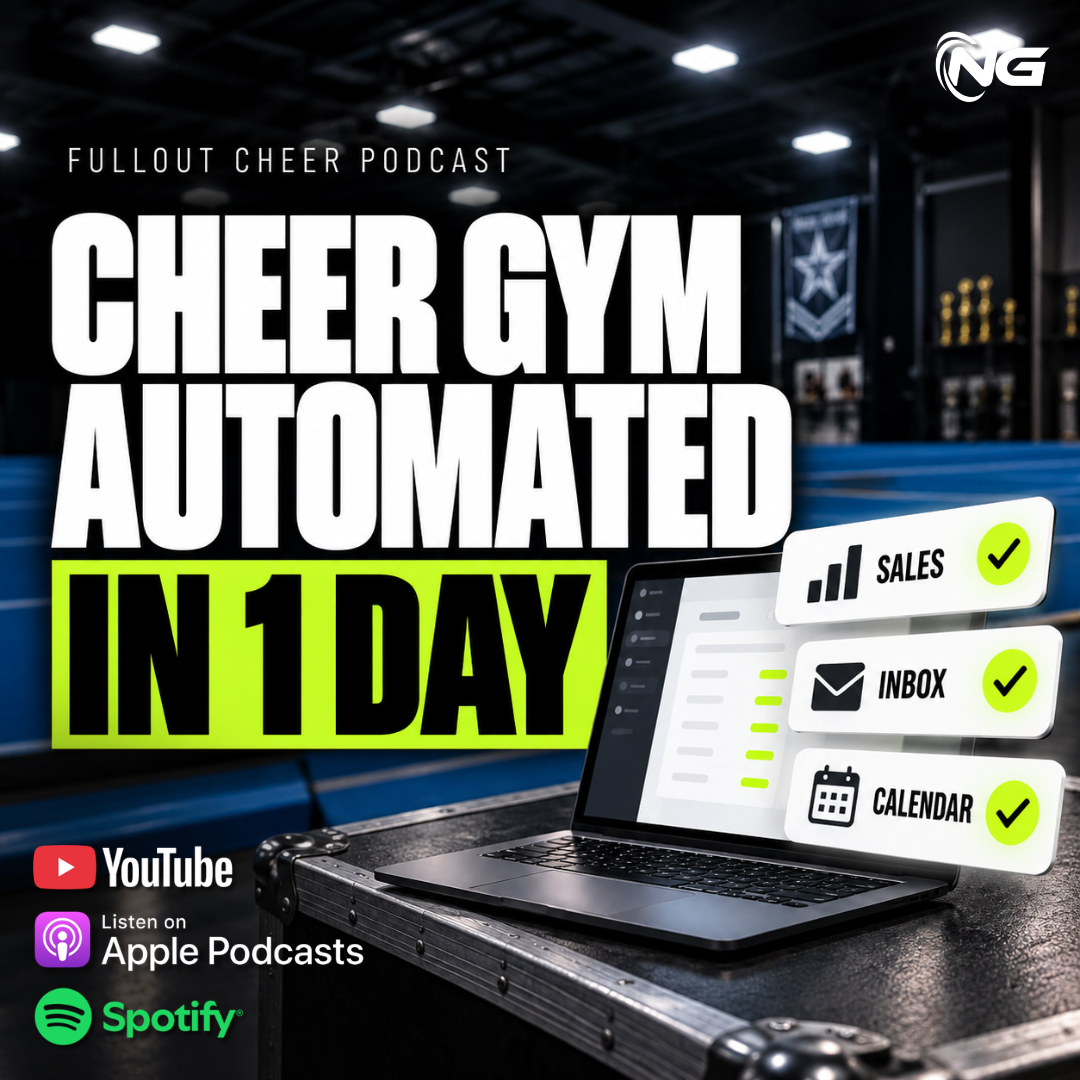
YouTube | Spotify | Apple Podcasts
How I Automated My Cheer Gym with AI in One Day (and Saved Hours Every Week)
Why AI Isn’t Just Another Thing on Your To-Do List
We’ve been talking about AI on the Fullout Cheer Podcast for months. If you’re thinking this is just another episode trying to get you to use AI when you don’t have time for that, stick around, because I’m going to tell you how I set up all of these automations in my gym in about a day, and what it has saved me.
Life gets busy. If you’re new here, I have four kids. Three are grown and out of the house, two of them on the West Coast and one close by. Our fourth is a junior in high school who does all the things: high school cheer, all-star cheer, four honors classes, and two homecomings this year. For years I’ve been a big fan of automating what I can in my gym and in my life, so I can spend more time on what really matters. As your kids grow up and move out, you’ll see that less time behind a computer means more time with the people you love.
Here’s the deal: I feel pretty good with AI, but I am no expert. I’m not going to talk about deep coding, because I don’t know how to do that. Maybe one day I’ll learn, but in the meantime I’ve found some wonderful workarounds.
The Math: A Day of Work and a Small Monthly Cost
I understand some people have moral concerns about the water and waste involved, and others worry about taking people’s jobs. I fully agree that we shouldn’t be taking jobs. Instead, I’m teaching my staff to use AI so we can create more with the same number of people.
Think of it this way. If your landlord offered you extra space for a tiny charge, say a hundred bucks, in exchange for about a day of work getting it ready, you’d be crazy to say no. Yet when it comes to labor costs, we hesitate over $20 for ChatGPT or $30 for Grok or Claude because we can’t quickly see the ROI. I’m here to tell you there is absolutely an ROI, probably even more than that extra space.
You can resist AI all day long, but that train is moving fast. Twenty years ago, your gym website was basically an online brochure. There were no opt-ins, no good way to safeguard your packets, and we printed and printed to get information to parents and hosted in-person parent meetings. Once websites could handle all of that, most of us switched. Skipping AI now is like keeping one of those old websites. The rest of the world will move on, and you’ll face a huge leap, learning everything months behind everyone else.
Why Getting Kids in the Door Feels Harder Than It Used To
I was talking with a gym owner friend last week (I’m going to have her on the podcast in the next couple of weeks, because our phone conversations are so good I wish I could record them), and we agreed that we’re working harder to get the same number of enrollments we got 10 or 12 years ago.
People love to blame the economy, but I have clients opening gyms right now who are seeing wild success because they’re the new option in their area. I also walked into a Tesla dealership recently, and there were more people wanting to buy a Tesla than there were salespeople. Yes, the economy is tough, but people invest in what they think is important. If your program matters and getting kids active matters, families will keep investing.
The difference is that it takes more from us now. Email marketing alone isn’t doing it, and a Facebook post in a group isn’t doing it either. If you’re struggling to get new kids in the door, maybe you’re still running things the way you did four, five, six, or ten years ago. Five or six years ago, nobody else was doing text message marketing, so you paid attention when a business texted you. Today lots of people do it, and I don’t just mean texting current clients. I mean automatically texting leads who give you their information. If you can’t do that, you’re behind.
Technology Is Where the Future Is Headed
I went on a college visit yesterday, and I was a little disappointed. The tour guide mentioned the science building and said they’d just started an IT program there. Any university that isn’t heavily teaching science and technology right now is a bit behind the curve. What we display to the next generation tells them what matters.
My daughter’s entrepreneurship teacher recently told the class they can’t use AI because they won’t be able to use it in the real world. She came home to tell me while I was sitting there with ChatGPT, my Claude browser extension, and Grok all open. I told her to offer to have me come speak to the class about how people actually use AI in the real world, because that is crazy to me.
AI Won’t Replace Your Coaches: It Amplifies Them
This is a way to save money in your gym and, essentially, to get the help of employees without the hiring and firing. You’ll want to fire your AI at some point, but it’s nowhere near as hard as dealing with an employee who is sick or can’t show up. And if you get really good at AI, you can still employ people, which matters for small business and the economy. You’ll just employ them for different things.
Remember when we first heard about the Ruby Slipper grip? I thought we already had grips for a 360 and wondered why we needed new ones. Then I went to a conference, saw it, and realized it was significantly easier and often better for my kids. Or think about the triple jump. Years ago we all did triple toe, then the score sheet changed and we had to adapt: a double toe then a pike, or a double hurdler, some motions, then a toe touch. The gyms that stuck with the triple jump spent their time on something that wouldn’t score better today. Technology changes much faster than any score sheet.
AI isn’t here to replace your employees. It’s here to amplify what they already do so they can do what no technology can. No technology can hug a kid and tell her to have a good day at school tomorrow. No technology can teach your stunts or spot back handsprings. But I can talk into my phone and say Gabby isn’t at practice today, and the AI connected to it can go into iClass and mark everyone else present and Gabby absent. It knows my calendar, so it knows which practice I’m in. I don’t have to pull up the app and click through every athlete.
Three AI Platforms, Three Very Different Jobs
We have an entire school group you can join for $37 a month, which is literally pennies to learn how to use these platforms. Today I’ll be brief, and this isn’t a duplicate of anything we’ve released before. If you’ve listened to the Tearbiz podcast, you know Dan and I have very different opinions on which platforms we prefer and what we use them for. I’m good with technology, but in some ways I’m far behind Dan, and I know many of you need to hear from someone who isn’t an expert, because AI can feel overwhelming. I even pulled up a Grok 101 video last night while brushing my teeth, after using it for weeks, and still picked up several things I’d missed.
I use three platforms, and in my opinion each has a very different job.
ChatGPT: My Creative and Marketing Partner
ChatGPT is what we all started with, a glorified Google at first. I still use it to turn ideas into usable concepts, though it’s rarely the only platform I use on a project. It’s still the best for email marketing copy and text message drafts, and for things like letters of recommendation: tell it how you feel about a kid and what she’s great at, and it turns that into a letter. It’s also good at analyzing sales. It now has connections to platforms like Square, can run SEO checks on your website, and can analyze how well a site sells something.
I still think ChatGPT understands my voice best, and it’s great for planning. I needed to be in Bolivar, about an hour and forty minutes away, at 9:00 a.m., and wanted the most sleep possible, so I asked what time to leave. It factored in traffic and road construction. As a team rep for our varsity high school cheer team, I asked how many pounds of chicken I’d need for 120 people and the best way to cook it. We also bought a DTF printer to produce our pro shop items more affordably, so I took a picture of our second office, told ChatGPT what equipment we have, and asked how to make the room organized and efficient. For t-shirt designs, I’ll find something cute on Etsy and ask it to turn the idea into something usable for my gym’s branding. There’s also a browser extension that can read any page you’re on so you can ask questions about it.
For anything creative or sales-related, ChatGPT is the most effective, it knows me best as a human, and it’s the most entertaining. At the end of each week, I go back through each platform and ask what it did for the gym that week. If one of the three stops earning its keep, I’ll drop it, but at the time of this recording in September 2026, all three work really well in their own element.
Claude: My Analysis and Operations Person
Claude is probably my least favorite of the three, but it’s valuable. Part of why is that I can use it to analyze anything in my gym. I went deep on Claude for a couple of months, creating packets and analyzing retention and class vacancies. The reports were amazing and about 90% accurate, but I could create them much faster than I could implement the changes.
For example, I had it pull a retention report: which programs retain best and worst, and when athletes drop off. Toddler programs weren’t a surprise, since kids finish a session and move on to swim or dance. (Side note: one day we’ll talk about sessions versus months, and why you should quit doing sessions for most tumbling programs.) Ninja was seasonal. But it also showed the biggest drop in Ninja happens at month four, which means we can add a check-in at month three and highlight the skills athletes earn in their first three months to see if it keeps them longer.
Another great use: we had someone come in for staff training, and I recorded the whole thing. I put the transcript into Claude and asked for 12 weeks of staff training, because expensive training is pointless unless the concepts are reinforced in staff meetings over the next year. With the browser extension, you can log into iClass or Jackrabbit and ask for your biggest class vacancies or places you may be overstaffed. You can open a P&L statement and ask it to explain what the numbers mean. If Dan is listening, his skin is probably crawling, because he uses Claude for far more than that, but this is my preference. ChatGPT is my marketing and sales person; Claude is my ops person, my mathematician, and maybe my finance person.
Both ChatGPT and Claude have some automation capabilities. You can ask either to check your inbox every day and do something specific. But I’ve had trouble with Claude staying on task. It’s like the employee who calls in sick all the time, and ChatGPT doesn’t connect to as many things. Neither has been quite the automation tool I hoped for.
Grok: The Platform Almost Nobody in Our Industry Is Using
Now for the third platform, which from what I can see almost nobody in the industry is using. In our school group there’s a survey asking which AI platform you use, and I’m the only one who clicked Grok. Dan got me onto it, and I thought, one more platform? I don’t have time to learn it. But they all work in a similar way: you talk to your phone or type what you want, and it does it. They just do different things.
What got me there was Tesla. I want to be a passenger princess and not drive anymore. A parent in our gym drove her Tesla six hours to a competition last year and played cards with her daughter along the way, and I was so jealous. So we ordered a Tesla, due in about six weeks. While testing one, I tried Grok in the car, and my mind was blown. Every automation I had hoped Claude and ChatGPT would handle, Grok can do.
With Grok, you have one master delegator and then lots of agents. Think of a gym manager with a marketing person, a salesperson, an ops person, an HR person, and a finance person: all the positions most gyms don’t have. Unless you’re a mega gym franchise, you and maybe one key staff member wear all of those hats. I’ve enlisted agents to take many of those tasks so I can run my small business like a large company.
Finance Frank and the Daily Sales Report
I have a finance agent I call Finance Frank, and his picture is Frank Sinatra. I don’t know why; it’s just what I do. Every day he goes into iClass and Square (which we use on our website, through our NG engine, and at the front desk for t-shirts and snacks), pulls the numbers, and analyzes them. Recently I had him compare this time last year with this time this year and break down the categories, because we had a big sales goal this month and I wanted to know where I was missing.
Every morning at 8 a.m., I get a report with yesterday’s sales, split between Square and iClass and then combined. It includes the same day last year, month to date last year, and a category breakdown. I don’t analyze it for half an hour. I look at it for two or three minutes and ask whether there’s anything I can do today to sell more in a category. It showed me pro shop sales were down compared with last year, and it reminded me of several projects I’d put on the back burner. Last week I noticed birthday party revenue was behind last year and asked Lexi if she could push to book more parties. She said yes. That little bit of pressure helped, and we’re already running about 10% higher in revenue than this time last year in September, and the month isn’t even over.
It also pulls my comp fees from Saturday through Friday and gives me the totals on Monday morning. Since I follow Profit First and keep a separate account for comp fees, I can transfer the money right away without pulling reports. Sometimes I have to log back into iClass because of security measures, or reconnect a platform, and that’s fine. It still saves me about 95% of the work and brings the results to my inbox. I still double-check occasionally. And with Grok, you can hit record, do the task yourself, and it records how you did it and builds a system from it.
Inbox, Attendance, Ads, and Travel: Agents That Run My Life
Grok manages my inbox. Every morning it gives me a list of what’s sitting there, and I can be driving to Starbucks and say, “Delete numbers one, four, and six. Put two and three in the insurance folder. Draft a reply to Melanie with number seven that says this, but I want to see it first.” You create limiters, and mine is that it never sends an email I haven’t seen unless I say go ahead. On the drive home from our college visit yesterday, I cleared every email in three inboxes just by talking, while fully focused on the road. Grok can talk back, too, like a passenger in the car, and there’s data showing you’re faster talking to AI than typing. It also gets to know you better through the nuances in how you speak.
My personal assistant agent is named Donna, from Suits. My kids use SportsU for football and high school cheer, and Donna checks it several times a day. She flags practice schedule changes, cross-references my calendar, and tells me things like, “Addie’s cheer practice requires black leggings; it might be worth getting some.” I can have her email Addie to ask if she already has some.
For attendance, Grok knows my schedule from iClass and my Google calendar. I can say Gabby isn’t here and it marks her absent and everyone else present. It can ping me and ask, “Hey Danielle, you haven’t taken attendance for Senior 4 yet. Who’s here?” I’m the worst person in my gym at taking attendance because I get so into practice and forget.
Yesterday it ran an entire Facebook ad through NGE for me. I had ChatGPT write the copy and make the graphic, gave it to Grok, and asked it to set up the ad so I could look at it first. I glanced at it, said it looked great, and told it to publish. Grok also organizes my travel. I had it search my inboxes and Hotels.com for everything related to our upcoming season, and it told me which accommodations haven’t been booked yet. It reminded me I booked flights to Cancun in January but not the return, and it’s watching flight prices to tell me when to book.
I even connected my husband Justin’s email to a separate bot, a personal assistant he barely knows about, named Justin Bieber. Does anyone else have a husband who isn’t the best at checking email? It clears out promotional and marketing emails, gives me a list of what it removed, and tells me if there’s anything Justin needs to handle. I can say, “Justin needs to pick up Addie at 6:00 p.m. at the high school,” and it puts it on his calendar and accepts the invite so he sees it. I’ve also created a wellness agent that checks in on my steps, and a travel agent. Each one helps in a different way.
Use a Digital Calendar
If you’re a gym owner, coach, or manager and you aren’t using a digital calendar like Google Calendar or iCal, you need to be. It’s why you miss appointments and can’t manage your time. I love paper, but have something digital too so others can see your obligations. Yesterday everyone in my office knew I was driving to a college visit and would be slow to respond, because they can see my calendar.
What It Costs and Why It’s Worth It
Grok is about $30 a month, a little more if you use it as much as I do, because it literally runs my life. Claude is about $20 and ChatGPT is about $20. Why on earth would you learn three platforms and pay about $70 a month? If you pay an employee $15 or $20 an hour and these tools take work off their plate, they become so much more effective.
Last week one of my athletes dislocated her knee during a homecoming proposal gone wrong. Because Lexi has automated so many tasks, I could message her to go pick out flowers and get them ready for the athlete’s return to practice. She had time to invest in something meaningful for someone else instead of typing and pulling numbers. Those numbers are important, but they’re the first things to fall by the wayside on a busy day. If a report shows up in front of me at the same time every day, it works. If I have to log in and go look, I probably won’t.
Remember how often we say the sport is expensive. If you talk about that but do nothing to make it more affordable, you’ll have a hard time retaining athletes. Keeping labor costs reasonable by using these platforms so your team can get more done is how you save families money.
Your Takeaway: Automate as Much as Possible
What should you do with your AI? Automate as much as possible. Figure out what you like to use each platform for, and automate it. If it’s a glorified Google, you’re not making or saving money, and neither are the families in your gym. I do things better and more consistently because I’ve taught my agents to do them.
One of my Grok agents, All-Star Sally, goes into my weekly email, pulls off anything that’s old, and flags any TBA date that needs adjusting. She takes everything in the weekly email and puts it on the Google calendar, and she tells me about absences that came in on the form that week so my coaches know in advance. If you aren’t using AI to automate things, you won’t see an ROI.
I understand being resistant to new platforms and new costs, but AI is affordable for what I get. The best way to start is to think about what you and your staff do every week. I sent Melanie an email this week that said, “You have been replaced by AI.” Grok wanted me to tell her I was kidding, but I insisted on sending it as written. I took something off her plate that she was even doing on her day off to get the numbers we needed. Now she can invest more time in the creative side of marketing, and in doing her own AI analysis and implementing what it says. AI isn’t a business coach, I guarantee you that, but it frees your people to do what matters.
If you want to learn how to use AI to do these things better, head over to our school group, Cheer Gym Lab AI. It’s $37 a month, so even on top of the platforms you’re at about $105 a month, and you can automate your gym and put out a much higher quality product for your families and prospects.