
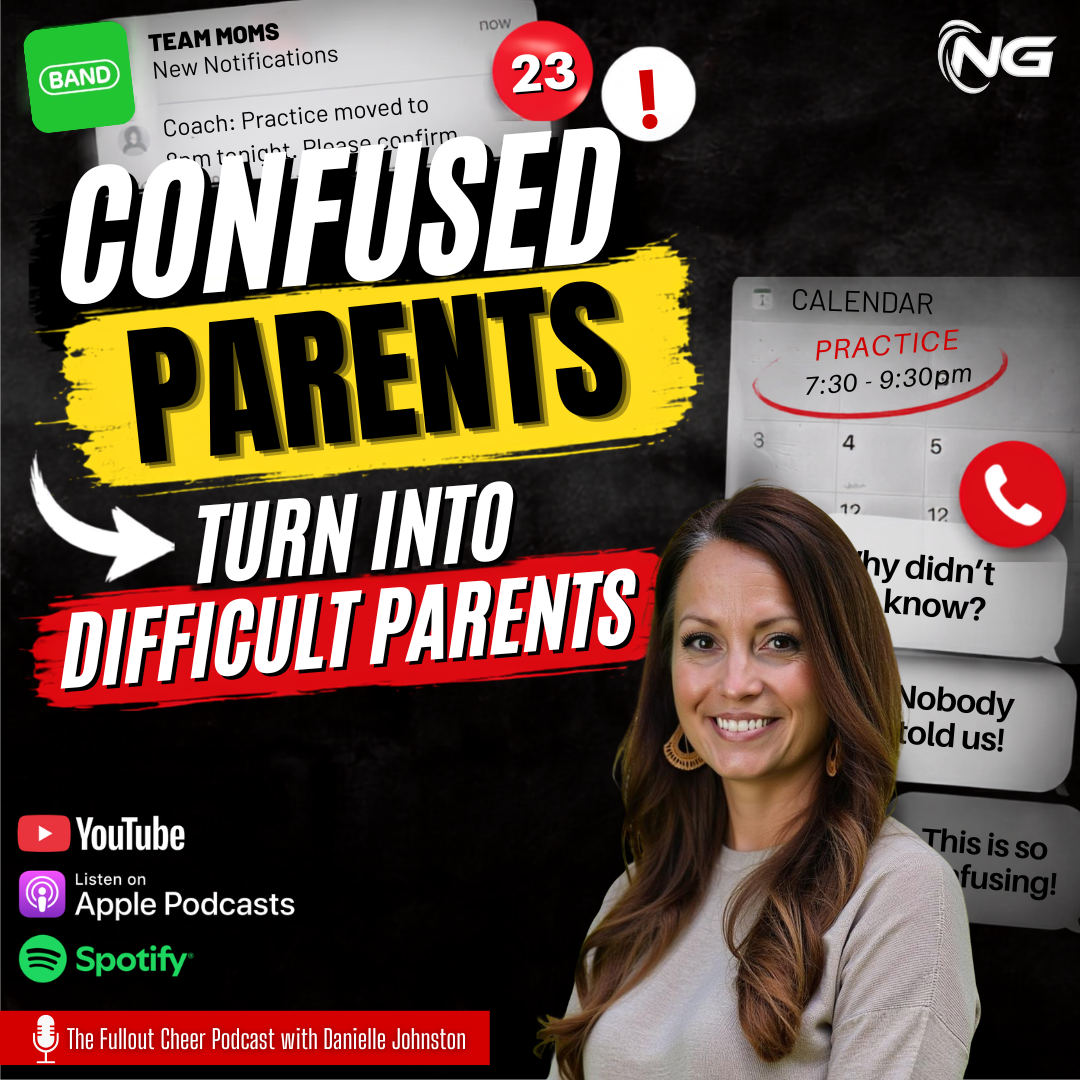
YouTube: https://youtu.be/t8CEPPOu9P4
Spotify: https://open.spotify.com/episode/3HjROEk2P2IlSbeI9YIM22?si=aJVgLHqzRHmGAXVEkT-Fnw
Apple Podcasts: https://podcasts.apple.com/us/podcast/the-fullout-cheer-podcast/id1763244914?i=1000769991555
Parents Aren’t Ruining Cheer. Your Systems Are.
Every gym owner and coach has thought it at least at one point. Hey guys and welcome to this
episode of the full out cheer podcast. I’m Danielle and I am your host for today.
Okay. I said it, I posted it on Instagram about a week ago and here’s what happened. A whole
bunch of gym owners said she just said it.
Parents are ruining cheer and some people even liked the posts without swiping to the next slide.
The next slide you guys talked about how parents are not the ones ruining cheer. Gyms who are
unwilling to change and modify and adapt their structures to make sense in 2026, they’re the
ones that are ruining cheer.
So let’s get into it today. We are going to talk about parent expectations and how your gym needs
to adapt to make sure that you can not only draw in new athletes, but keep them here this year.
The industry has changed.
Parents are more involved than ever before. I can tell you when I was a kid, my dad went to some
games. He maybe attended a couple of volleyball games a year, maybe a couple of basketball
games a year.
If I was cheering, he probably didn’t go to a lot of those. Not because he didn’t value cheer, but
because I was cheering for boys basketball or you know, the other boys activities or girls
activities that we cheered for back then. It wasn’t normal to be honest in the nineties to be that
soccer mom that is sitting there through practices and through games.
So a lot of us grew up with that mentality that our athletes do not need us there. However, I can
tell you the world has changed. It is very normal for parents to go sit along the sidelines during
soccer games, during soccer practices.
As you know, it’s normal for parents to want to come sit in the lobby and watch your cheer
practices. Is it because they don’t trust you? No, I don’t think that’s entirely it. Though I do think
there is a lot of reason for parents to have that little bit of mistrust in just about everyone these
days.
I think that social media shows that kids grow faster than ever. I know that if I go on my Facebook
today, it is going to show me memories from, in fact, it did. It showed me memories from when
my daughter was in second grade and it showed me, you know, the kid with no teeth with her
little cowboy boots on getting ready for the first day of school.
And it kind of popped up randomly. And now if you have things in Google Photos or your iPhone,
it’s showing memories from years prior. And what it does for parents that we didn’t have 20 years
ago is it reminds us how fast our kids grow up.And so we can’t assume that parents don’t want to be part of that process because I can tell you,
I have watched, you know, three of my kids grow up and move out of the house, graduate, all
those things. And they don’t even, two of them don’t even live close anymore. And if you could go
back in a time machine and let me have some more time at those ages, I absolutely would have
done it.
So we cannot fault parents for wanting to be part of something that for many of them, like this
was their greatest joy in life to be a parent. When parents say, I don’t want to be that parent, we
tend to immediately put up a little bit of a trigger. It’s like one of those red light emojis that you
see, right? Because you’re like, oh, what’s coming next? Well, social media has also created
parents who are fearful of being perceived a certain way.
And I do think some of these moms groups are really good at having some coaches and owners
who also happen to be moms. And that’s why they’re in their step forward and say, what you’re
feeling is normal or what you’re feeling is kind of wrong, right? And so I think a lot of times when
parents have questions, they don’t, they’re so afraid of being that parent and you have to teach
the parents in your gym that it’s okay to have questions. It’s okay to not always agree with the
decisions that you make.
We just have to be adults and we have to be respectful to one another in the way that we say
those things. We are making some decisions in our gym this year that might be a little bit different
than some of the things we’ve done in the past five years with our elite teams. And in the first
week of practices, which I’ll go into more later, I actually met with parents of all seven of my elite
cheer and dance teams this season, just to get a little bit of feedback on what they thought if we
were to modify our schedule just a little bit from the initial competition schedule I had already put
out.
Now, I haven’t released anything to my gym, so I’m not going to say it on this podcast, but I met
with those parents cause I just wanted to get some clarification and give them an opportunity to
provide some feedback before I made a decision. I was very clear in that. And I said, I want to
hear from everyone and then we will go forward from there and make what we believe to be the
best possible decision for parents and athletes.
And I did have a couple of emails and one was just so respectful. I was really like proud of the
culture that my gym parents have because it was disagreeing with the potential decision that we
might make, but I felt like it was done professionally and respectfully and in such a way that I was
like, I’m proud that that is one of our gym parents because I could see people having that same
kind of conversation go lots of different ways if they didn’t choose their words carefully. And so I
think that we have to open the door for those kind of conversations and we have to welcome
them and we have to really like take everybody’s thoughts into consideration.
You know, like I said, I was clear with parents that maybe not everybody will agree with whateverdecision it is that we make, but I did want to hear all the feedback before we move forward and
try to make those decisions. And I think that that’s important for your culture, for parents to know,
like you heard us out, right? I can tell you my, I had a, I had a local experience at another gym
recently. I took my daughter over for a tumbling clinic.
It was a couple hours away and it was an interesting experience. When I say that parents are
more involved than they ever were before, I can tell you that I don’t think that applies to every
single gym, but I think that a gym controls how involved the parents are. In this particular gym, I
went in and we were, you know, like I said, it was a little ways away and so we got there early.
We were up at the front for probably 15-ish minutes before anybody even came up there. There
were other athletes that were in there that went to that gym who like took care of their shoes and
then just walked right through, you know, to go into the gym. And we didn’t, we didn’t know, like at
my gym, you don’t go onto a floor unless the coaches said, okay, it’s time.
And so I didn’t exactly, even as a gym owner, I was like, I don’t really know what their policy is.
Nobody’s up here to talk to us. I don’t, I don’t really know what to do.
Well, I, someone I believe to probably be an owner did come over at one point and we had
probably been there 15 or 20 minutes and just had a super quick with the athletes only
conversation and then took them in the gym. I’ll be honest, as a parent, I was never
acknowledged during the clinic itself. I was like one of two or three parents who stayed the entire
time.
There was a little window. There was pro shop apparel in front of the window. It was, I would say
perception was very clear that parents were not necessarily invited to stay.
It wasn’t a welcoming environment. It wasn’t even easy to see. There’s like a small window that
went into one of the gyms.
But then within that gym, there was an opening that went to a back gym and the athletes like
started the clinic and did an awful lot of the clinic in there at no point throughout the clinic. This
was a two day clinic that I was there for a total of about four, four and a half hours at no point
throughout the clinic. Did any of the coaches from that gym actually come talk to me and say,
Hey, she’s doing really good.
Here’s what we’ve been working on, et cetera. In fact, were it not for my next gen connections, I
literally would have had no one come talk to me. And the reason I say that is because one of the
skills clinicians who come to next gen conferences is the reason I drove up there and took my
daughter there.
And he came out at the end just to say hi and give, you know, a quick update. But I noticed that
you just as a parent, like nobody knew I owned a gym except the one other parent from my gymthat was with me at the time on day two, she didn’t go. I took her daughter up there with us.
And so nobody knew that I owned a gym. Nobody knew that, you know, I’m part of next gen or I
have a podcast or I’ve written a couple of books like nobody knew this stuff. So it was really
interesting to just be able to be there as a parent and experience this as a parent, especially a
parent for the first time.
And I will tell you a day two was a Saturday morning. There was nobody at the front desk the
entire time I was there. We couldn’t have bought a bottle of water if we wanted to.
There was a coach who had been teaching a private lesson and one other mom who stayed and
that mom, he came through and kind of talked to her at one point. But I will tell you, maybe I was
misperceiving this. But again, I work in the gym industry and I do it every day.
There were times I felt like the coaches were actually kind of irritated to walk through the lobby
from one gym to the next. They were irritated to have to walk through parents. And I just think this
is one of those examples of like the industry has evolved.
Like just because your gym did well 20 years ago doesn’t mean it’s going to continue to do well
today, regardless of how many wins you have out on that mat. On day two, it was a Saturday
morning and there was a rec class going and there was a first time parent who brought their child
in and she ran in and that coach did greet them in the lobby, which was great, and walked the
kids through to that back gym. And the dad came in and he was really clearly, evidently
uncomfortable that he could not see where his daughter was at any point on her first day in a rec
class because there was no camera.
Like it was through a gym, through a gym where you just couldn’t see anything. And I just thought
to myself like, man, that coach didn’t come talk to the parent at the beginning saying, Hey, I want
to introduce myself. I’m excited to be coaching her today.
The coach didn’t say anything at the end because I was there for hours. So I got to see all of it.
The dad honestly only had communication with another mom who had been in there, who said
this is how it runs and this is how it operates.
And it was just interesting. It was interesting. At one point I did out myself, but it was by accident.
Another mom had come in and her daughter, it was a twisting clinic and her daughter had chosen
to work on punch front step outs instead. She had done a little bit of twisting, but I, you know, I
don’t know if she just wasn’t ready for it or wasn’t comfortable with it, but the tumbling clinician
had allowed her to work punch front step out through to her layout, which I also thought was like
an appropriate level, you know, is it twisting? No, but is it the right skill level for what she would
ideally be working on? Yes. Well, at one point she was doing really good and I was watching this
kid cause I was just watching every pass.Yeah. I was the mom that stood at the window and watched everybody and I was watching her
and she did her punch front step out through to a layout and she did it by herself. And at one
point I stepped away from the window and the mom came in right near the end of the clinic and I
heard her say to another mom, she’s like, Oh, why is she working that skill? Why isn’t she
twisting? Like she’s here for twisting.
And that’s when I outed myself because I couldn’t help it. I was like, Oh my gosh, if these
coaches would just come talk to these parents, like here’s what I envisioned happening. The child
comes into the lobby and the mom’s like, well, why aren’t you twisting? And so the mom doesn’t
know.
Like I think that kid would have been so excited to be able to say, Hey mom, I got my punch front
step out through to a layout. And mom would have said, but why aren’t you twisting? And so I
like, I played the scenario in my head for a second and I finally stepped in and I finally said, so
actually she’s been doing punch front step outs and she’s landing them. She’s doing really good
through to a layout.
Like they’re really good. It’s, it’s a level four skill, but like, she’s really working hard in there. And
the mom, like you just saw her eyebrows, like kind of lighten up and her whole demeanor
lightened up.
And she’s like, really? She’s like, I didn’t, I don’t think she can do that. And I’m like, but she can
now like check this out. And so when the kid came in, mom had a totally different demeanor than
she had right when she, you know, had come into the lobby and said, well, why isn’t she twisting?
And I think a lot of times coaches take that initial reaction from parents and they get frustrated
with it.
Like, like a parent is expected to know that it’s an important skill that she can be working on. Like,
I think it’s strange that coaches think the parent should not be frustrated when it is in fact a
twisting clinic. And so for a coach to just come in and be like, Hey, we did work twisting for a little
bit, but she’s so close to this punch front step out.
We have the ability to spot it right now. And she’s super excited about it. So that’s kind of what
we’re going to push forward with for the rest of today’s clinic.
And I just think you can avoid so many problems by communicating. So needless to say, it was, it
was an interesting experience. In addition, number two, I think families are overwhelmed.
They are overscheduled. And I think that gyms don’t exactly recognize that or understand that. So
for a lot of coaches, this is their number one.
Like this is what I do all day. I coach cheerleading. I think about it from the second I wake up until
the second I go to bed and they get really frustrated that other people might forget that there’s anextra practice.
Or they forget that their child left their tear shoes at home because they had, you know, been at a
camp. They forget that a child is supposed to wear something specific today. And I think we get in
this as coaches and gym owners, we get in this world where we think that is our top priority.
And for us, it is, but for parents, it’s one thing they do within a day. And I know this because when
I had a full-time job outside of the gym industry, I took a kid to daycare. I took other kids to
school.
I went to work. I tried to work out on my lunch break. I went back to work.
I had a full eight-hour day of work. And then I left work and had to go pick kids up from daycare,
from school, go run them to their afterschool activities, go do all the things. And in the process of
it, try to like cook dinner because that was more affordable than taking them out to eat every
night.
Go home, help kids with homework, get them in their baths and get them ready for bed, put them
to bed. And then to be very honest, you’re trying to spend time with your spouse and you’re wiped
out. And that’s if you didn’t have to take any work home with you that night.
And put on top of that the number of parents that are in school that are doing classes at night or
on the side, put on top of that multiple kids in multiple sports, take on top of that the fact that kids
get sick so easily. So now throw a sick kid in there or a family member or a mother-in-law that
lives with you or something like that. And guys, cheerleading, when you have a crazy life, it just
becomes smaller and smaller.
And of course, we’re grateful for the people that are able to prioritize it. But I think our expectation
of parents sometimes is really unrealistic. We are expecting them to prioritize cheer at the same
level we do.
But that’s my full-time job. I can’t expect anyone else to prioritize it the way that I do. We need
more communication and we need to be helpful to parents rather than combative because they
maybe miss an email.
Okay, it’s good. We should be directing parents to the email. We should be reminding them that
this email has all the information they need.
But if they ask the question, snapshot the email and send it to them. Don’t be rude. People are
disorganized.
Okay, I literally meet gym owners and coaches who are disorganized. And yet those people are
the same people that get frustrated when parents can’t find an email. There’s one reason that I do
my weekly emails the way I do.And that email is long. It is like scroll, scroll, scroll, scroll, scroll. But it is chronological by the
different, I was going to say like departments, but by the different competitive programs we have
in our gym.
So it starts with competitive cheer and it goes to competitive dance because they do so many
things together. We created that into a single email. If you have a large program, maybe you
need to divide it by elite prep and novice.
Maybe you need to include your rec team in there because they’re a team that goes and
competes in the rec division. Nevertheless, what I’m saying here is that I have a lot of gym
owners who are like, yeah, I’m doing the weekly email, but it’s not working. And I’m like, send me
a copy of it.
I want to see it. And I’m like, but you only have two things on there. Do you not have your
competition schedule out yet? Do you not have dates for your choreography out yet? They’re like,
yeah, I sent it in a previous email.
I’m like, no, that’s not actually how that weekly email works. It has everything on there until that
date has passed. And I do it on purpose because a busy parent shouldn’t have to search through
emails.
I would rather that they have to scroll and scroll and scroll chronologically to see what’s coming
up nine months from now. But at the top of it, it’s chronological. So it’s what’s coming up this
week.
And they have that information all in one email. And so I tell my gym parents, you don’t have to
go back and search for previous things unless you’re trying to look and see what you missed. The
only thing you have to do is you have to go to the most recent weekly email and you will find that
information in there.
I tell coaches, please do not put anything out to your teams that also hasn’t gone in the weekly
email. Our team reps, all of the team bonding activities, they coordinate, they send me an email.
It goes in the weekly email in a little section that says team bonding activities.
So if I’m a parent and I am not super savvy on social media, or maybe I’m super savvy and I run a
whole bunch of Facebook groups and I don’t get my notifications very easily. I only have to go to
one email. I don’t have to worry about what’s being posted in the other areas.
And I can just get that information through the most recent weekly email. So I’ve talked about that
email like 1,001 times on this podcast. And I’m still seeing people who are trying to like modify it
and do it their own way.
And then they’re like, well, it doesn’t work. My people don’t read it. Well, it’s a new season.So I send the weekly email and I send a text message that says that weekly email just went out.
Please let us know if you don’t receive it in the next few minutes. Last minute communication
doesn’t work.
Guys, we have to be ahead of the game. We cannot expect parents to drop everything. I just
gave that example of how busy and overwhelmed people are.
So to come at the last minute and say, I want to schedule this at the last minute is really
unfortunate for your gym families. We are better off being so far ahead of the game so that when
we have a cheer emergency, like a kid breaks their finger a week before a competition, parents
have that grace and they understand you would not ask me to do something last minute unless it
was truly important. If you are ahead of the game 99% of the time and you are putting out dates
and you are sticking to them, then people are going to trust when you say, I’m really sorry, we did
have something come up and I want to see if we can schedule an extra practice.
Now you heard me earlier in this episode say that I am looking to make a modification to my
competition schedule. So how annoying is it that I put something out and now I’m looking to
change it? Yeah, I get it. Maybe it’s a little bit annoying and I acknowledge that at these parent
meetings.
I’m like, I’m sorry. I normally wouldn’t change something, but we put out the competition schedule
and then as we form teams, I saw some things that I thought maybe could modify to make our
teams have a year that kind of matches what I would like to see from them this season. I
honestly, I think it went well.
I didn’t have any parents complain that I’m changing something. I’m literally looking to change
something that is 11 months out at this point, but I do think that people know to expect something
far enough in advance that I’m taking into account potential travel, the additional costs they’re
investing to go to these things so that they know that this is not a common occurrence that I’m
going to put stuff out and then change it. I also might put things out and say, hey, I’m putting this
out, but just it is a TBA.
So for example, I had to call five different high schools this week and say, please tell me when
your graduation is because I would like to schedule my banquet and put it on there, but I don’t
wanna do that and overlap graduation for some of our juniors or well, not juniors, but for some of
our seniors and two high schools still do not have a date for their graduation yet. And so I put out
to parents, we are expecting to have our banquet on this day. Please know there could be a
modification because I’m still awaiting a graduation announcement from this high school.
Your customers expect as much transparency as possible. Expect that they are not going to trust
everything until they learn to trust you as a human. So if they are new to your gym, they might be
in these groups like Crazy Moms of Cheer or All-Star Cheer Moms or whatever it is.And they may see the horror stories of people who have literally, I mean, it’s like also in the news,
like gym owners who have stolen money, who have accepted money and then closed their gyms
and never refunded people for uniforms. And now there’s these like class action lawsuits and stuff
like that. People might be hesitant.
Maybe they had a bad experience at a previous gym or with a previous dance studio or
gymnastics gym. And so it’s okay that they are going to be a little bit hesitant. It is your job to
prove to them that they can trust you by earning their trust.
A gym owner that I work with recently lost a couple of kids to another gym. And she was telling
me, she’s like, Danielle, it doesn’t make sense. This other gym, their fees are out and their fees
look a little bit cheaper than mine.
But if you really take all of the nickel and diming here and there, and it says it in the packet, but if
you take all of those things, it is more expensive. And she’s like, and on top of that, the travel is
significantly more and you’re gonna pay more in flights and this and that. And she’s like, but
parents are leaving saying, I’m going there because it’s cheaper.
She’s like, I don’t know, do I literally sit there and do the math for them? And my answer to that
was, no, they’re adults. You can’t. I said, but you can do the math for your own parents.
You can go to your own parents and be transparent and say, when you are looking at things, I
want you to consider this is the entire cost. Here’s everything it includes. You know, the only
additional fees you’ll have this season are travel to this particular location and everything else.
I tried to make it affordable for you. So it’s driving distance. I said to her, my question was
basically, you know, how comfortable are you being transparent with your parents about the fees
that you have? And she said, oh, I don’t mind.
I’ll be completely transparent. And I connected with her the following week. She did a Zoom call
and she said, she had a bunch of parents on there and she was really transparent about the
costs and what they could expect.
She said that they were really great on that Zoom call. She said, you could tell that people
genuinely appreciated getting an explanation of things and felt a lot more confident in what they
were paying. Now she had to do this cautiously.
She couldn’t say X, Y, Z gym down the street is not including X, Y, and Z in their prices. She can’t
do that, right? That’s to anybody, that’s kind of an attack. However, she can say, when you’re
making your choices about what to do this season, it’s important to remember this, this, and this.
I chose to do this because of this, right? So it might be, it’s important to remember that every
travel event is going to have hotels, potential stay to play. It’s going to have the flights. You’regoing to have to park at the airport, blah, blah, blah.
I chose to do one travel event and all the rest will be driving events because I wanted to save you
that money. And so because she was able to provide that level of transparency and education to
her parents, they immediately built more trust in her. One thing I did last year, we collect a certain
amount of money for our costume fees for our all-star dance teams.
And last year I actually found the costumes significantly less expensive. I found them on Sheen.
And it was really funny because there was a post on the Crazy Moms of Cheer afterwards about
how a gym found all their stuff on Sheen and they were totally overcharged and blah, blah, blah.
I had already done this at the time. So I kind of understood where that mom was coming from, but
I had put it out to my families. Hey, I actually found your stuff on Sheen.
Now give me just a couple months because I want to make sure that we don’t want any additional
accessories or props for the routine. But once I know the final price, I am going to credit your
account, anything above and beyond what that was. So I accounted for my time.
I accounted for the administrative cost, the shipping, the credit card fees. I accounted for each of
those things. But at the end of the day, I still credited them.
I think it was around $40 because I felt like what you are getting, I need you to trust that even if I
have to collect X number of dollars and I can get it on Sheen, I’m going to make it right for you
guys because I would have collected less had I known that I could have gotten that costume
cheaper. I think it’s important to just do the right thing with people so that you can build trust. And
I’m not saying you shouldn’t mark those up.
Like I said, it takes a lot of time to do anything with uniforms. I think I probably had 80 hours into
our all-star tier uniforms that I had spent just getting them designed, ordering the mock-ups from
five different companies, reviewing the mock-ups, trying them on a kid, making sure that it fit the
right way, making the modifications. There’s so many things and you should account for the
markup.
But you also don’t want to price gouge. And that’s where that fine line comes in. And it’s important
to make sure that you are doing the right thing for your parents.
There’s also something that I think has become apparent in the all-star industry. And it’s kind of a
figure it out for yourself culture. And I don’t support this.
This figure it out for yourself culture is where we are safeguarding information. And I think this
happens gym to gym and coach to coach. But I also think this happens a lot with parents where
we’re telling them as coaches and owners to trust the process rather than educating them on
what that process looks like.So I had an athlete who isn’t quite throwing her level three skills though she was at one point and
she is a backspot and she was really disappointed that she didn’t make a level three team this
year or at least a senior level two team. And she is youth age by birthday. And so I think it was
really helpful.
I could have brought her in and said, just listen, trust the process. I could have brought her in and
said, like this team just really needs you. Like, it’s not that I didn’t want them to trust my opinion.
It’s not that the team doesn’t need her but I also know that I didn’t put her on that level in that age
division just for the team. I also did it because I thought it was the right fit for her. And so I
explained those things and I explained how I placed teams.
I explained how I placed tumblers first and then I have to look at, you know, stunting positions
and say, okay, do I have three flyers who can fly elite skills at this level? Do I have three
backspots? Do I have bases? And not to say that every so often a secondary base or a main
base could swap positions or a backspot in a base could swap positions. It could happen, but
you’re gonna pull your stunts often down a level when you do that. And I explained that to her.
I said, I could have put you on this level as a base but you are a good backspot. And I think you
need one more year backspotting at a level two before you’re ready for a three. Now I could have
put you on a senior two as a base but I think you would have had to start at level one because
you’ve always backspot.
So you would have, you know, even on a level two team you would have had to move backwards
a little bit and just learn some of the basing and learn some of the grips and stuff that, you know,
you’re more likely to advance to a level three in the stunting area if you maintain your position and
just do this one more year than if I put you over on this senior two team in a different stunt
position. Anyway, I think instead of telling people trust the process instead of telling them to trust
me instead of asking them to just figure it out or just like, hey, let’s just go with the flow here and
you know, she’s gonna love it and see how it goes. Like I brought them in and we had a
conversation and I think that we need to be as gym owners and coaches far more patient with
parents and athletes so that we can explain how things work.
I don’t want them to figure it out themselves. I want to be the one that can educate them because
when you figure something out on your own you may not always figure it out correctly. So it leads
to people inferring, you know, that you thought something or assuming things and I just don’t
think that that is positive for building culture either.
So to round out this episode guys, remember parents become difficult when they’re confused,
ignored or blindsided. If you truly think that parents are ruining cheer then you need to take a
strong look at the cultures and systems in your gym and see are you operating like it’s 2010 or
are you operating like it’s 2026? Okay guys, if you heard this and you’re like, okay, I need moreconversations like this because maybe I need to get myself into 2026 mentally with our processes
and stuff like that head over to All-Star Cheer Coaches and Owners to join our coaches group or
if you are a gym owner head over to Cheer Gym Owners on Facebook and join our Facebook
group. Additionally, make sure you head over and listen to the Cheer Bits podcast with my co-
owner of NextGen, Dan Cotton and make sure that you just get all the education this summer
because this is how we evolve from operating our gym like it’s 20 years ago to operating it the
way we do today.
With that you guys, thank you so much and I will see you on the next episode.