YouTube | Spotify | Apple Podcasts
Three Things You Need to Focus on to Actually Grow Your Gym
Many of you are wondering how you can grow your gym, but there are three things you’re probably not focusing on that need to be the focus before you can actually grow.
Hello, everyone, and welcome to another episode of the Cheer Biz Podcast. I’m your host, Dan Cotton, and today we are talking about the three things you need to be focused on to actually grow your gym.
Before we get into the episode, make sure you head over to Facebook and join the Cheer Gym Owners and All-Star Cheer Coaches and Owners groups, and pay attention to the conversations happening there — especially if you’re a gym owner, because there’s a lot that can help you grow.
If you’re a gym owner looking to train your staff, check out our newest release in our series of handbooks: the Cheer Coaches Handbook. It’s a short read, designed to be read with your staff. Our vision is that you buy one for every staff member — or buy ten and keep them on hand, passing them down over the years — and read it together annually or biannually, working through the worksheets as a team. Every new hire reads the book, does the worksheets, and everyone starts off operating from the same sheet of music. These are things you’re probably not used to discussing in onboarding: how to be a great employee, how to protect yourself from burnout, how to build a positive culture, competitive mindset, and other fundamentals most people aren’t talking about with their coaches nearly often enough.
Also, head to nextgenowners.com to learn more about our conferences, the Academy, and how to get to one of our Cheer Biz Accelerator events if you’re a gym owner. These are small group events — 12 gyms in the room. We’ve got four more happening at the end of 2026, and we’re planning to run another six to seven in 2027, so make sure you don’t miss out.
Why Growth Comes Down to Three Things
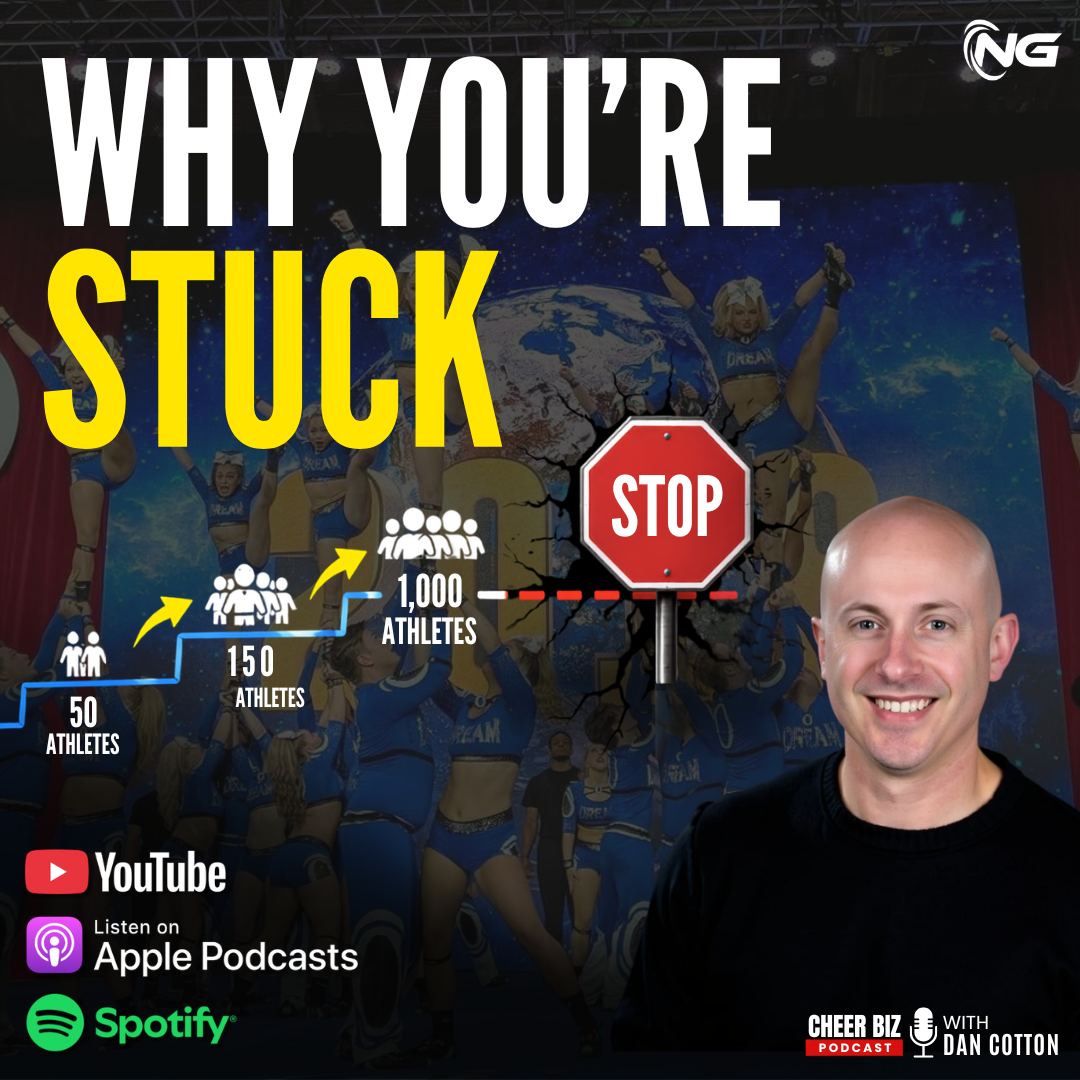
Let’s get into the episode. We’re talking about growth, and this is one of the most common things gym owners come to me wanting to strategize. They ask, “How do we grow? How do we get more kids? How do we get more profit? How do we get our gym to be bigger?” A lot of times they ask what I did to grow, because we’ve seen pretty significant growth over the years. I wouldn’t call it mind-boggling — we didn’t go from 10 athletes to a thousand — but we started with 45 athletes, and this next season, we’ll have well over a thousand athletes come through our doors across team training, tumbling classes, competitive teams, rentals, and more. On top of that, with DreamCamps, we work with somewhere between 3,500 and 5,000 athletes, factoring in choreography jobs and similar work. We’ve done a lot of growth over the years.
Most people assume growth comes down to specifics — how you market, what your offer is, what your sales funnel looks like. They try to get nuanced. But there are three main things you need to focus on if you really want to grow.
1. Systems
Number one is systems. You have to build systems to grow. The only way to expand is to build systems, because systems let you apply a force multiplier to what you’re already doing. Otherwise, you’re capped by your own capacity — or your current staff’s capacity — based on the operations you’re currently running.
There’s a lot you can do with systems today — using tools like the Next Gen Engine to automate lead generation and workflows that bring people into your business. You need to build your sales systems, your operations systems, your class systems, your marketing systems — all of them clearly defined.
Building systems has never been easier than it is today, because if you have a system in place, you can describe what you want to Claude and it can help build that system for you. You can even say, “Here’s what I want to do — help me strategize it, let’s build an app around it,” and it can help build that too.
That’s a high-level task, and I don’t suggest everyone jump straight to it. But if you already have some basic systems in place that only work so well, you can use AI to test, iterate, and improve them. I’m not a big fan of ChatGPT anymore — I almost exclusively use Claude. I think it’s the best AI product on the market at the time of this recording, though that could change. They recently released Claude for Small Business, which I think is going to be excellent and is really designed around building systems and getting them to talk to one another — running skills related to accounting, sales reports, and more. I’ve taught Claude how to use iClassPro, and now it can run certain skills and reports off a quick command, pull that information together, and report it back to me.
But it’s not just about AI — it’s also about how your staff operate. What are your systems for client outreach? For class scheduling? For building class curriculum? For placing teams? For leveling athletes? For creating choreography? Everything in your business needs a system, because that’s what gives you predictable results even when you’re not heavily involved in the process.
This is exactly where most founders get stuck — and it’s exactly where I’m at with DreamCamp right now. I’ve grown to the point where I can’t scale any further. I don’t have capacity left to take on more. The only thing I can do is build systems, delegate, and follow the other two steps we’re about to talk about. It’s critical. If I don’t, I’m capped out — realistically, I probably need to decrease my involvement because I’m already not executing as well as I should be, given our expansion and my limited bandwidth.
If I could dedicate 100% of my brainpower to DreamCamp — if I didn’t also own Next Gen and Oregon Dream Teams — I could take on a lot more. But my attention is divided, and I have kids, my wife Tori, and everything else I try to do, so I only have so much bandwidth. That means I have to build systems other people can execute on. That’s the only way for me to actually grow that company, and the same goes for you. You cannot grow until you build systems.
When I talk about systems, I mean a repeatable framework for executing an operational task — one that’s repeatable by others. If a task varies frequently and has a lot of variability in the right answer, that’s not really a full system; that’s more of a framework. Frameworks are looser — start here, then go here, more of a choose-your-own-adventure. Systems are structured: do this exact thing, with a few caveats. They’re more workflow than general guidance. You have to build your systems to expand.
2. Accountability
The second thing you need to focus on, after you’ve built your systems, is accountability. This is actually the biggest failure I see gym owners and founders make — they build the systems, but there’s no accountability when people don’t adhere to them. They don’t correct the behavior or step in to solve it; they just let it continue.
Once your systems are built, you have to make sure they’re followed, executed, and iterated on. What happens when a staff member doesn’t follow the system? Retraining? Termination? An adjustment to the system itself? What does that actually look like? People need regular, consistent accountability in order to grow.
One thing holding a lot of founders back is that many of us are people-pleasers — not especially confrontational, especially in the cheer industry. We want people to be happy, and accountability often doesn’t feel like it’s making anyone happy. It can feel harsh. But holding people accountable is actually one of the biggest kindnesses you can offer — far better than burying frustration and letting it build. You owe it to your employees to tell them as quickly as possible when they’ve made a mistake: here’s what went wrong, here’s how to correct it, here’s what I want to see going forward.
The worst thing you can do is let issues pile up and then sit someone down to go through a whole list of everything they did wrong. I may have told this story on another episode, but this was something my dad used to do that drove me crazy. I love him from the bottom of my heart, but because I was always gone — between theater, cheer, my all-star team, my girlfriend, and my friends — I was rarely home. He’d sit me down, pull out a legal pad with a list of everything I’d done wrong, and go down the list one by one: you didn’t take out the garbage, you left dishes in the sink, your room hasn’t been cleaned in two weeks, and so on.
I was so frustrated, because I felt like all he was doing was listing everything I’d done wrong — what about everything I was doing right? Was he proud of how hard I was working? I wasn’t slacking off; I was in the play, in choir, at cheer practice, juggling things that felt incredibly important to me as a kid. My dad, a business owner, probably found that adorable — he was waking up at 6 a.m. to write grants, then going to work, counseling clients all day, and managing employees and files. But those “unimportant” things I was doing eventually turned into my business. So yes, you’ve got to hold your people accountable. Even that approach was a form of accountability, and I think it mattered — if that’s all you’re capable of doing, do it. But my recommendation is to hold people accountable as quickly and as close to the moment of the issue as possible.
It’s like training a dog. Your staff aren’t dogs, but if you punish a dog a day after it got into something, it doesn’t make the connection — it doesn’t understand why it’s being punished. The further you get from the issue, the harder it is for people to remember the state of mind they were in, and the more frustrated they’ll feel facing a mountain of accumulated issues they don’t feel like they can recover from. Holding your people accountable is absolutely critical for growth — and critical for your people.
3. Execution
So if you’re looking to grow: build your systems, hold people accountable, and then focus on execution. Building a system isn’t enough. Holding people accountable isn’t enough. You then have to focus on how you’re executing and showing up day in and day out. If you want your business to grow, you have to execute consistently on the things that truly matter.
Oftentimes we spend too much time on things that don’t move the needle and not enough on the things that do. You should be focused on two things above all: delivery of the product and filling your funnel. Everything else is more tertiary — if I’m focused on product delivery, that naturally includes developing my staff and curriculum. But fundamentally, it’s about delivery and filling the funnel.
So many gym owners get laser-focused on delivering the product on the mat — but there’s so much more we deliver beyond the skill itself. In fact, I’d say the skill is more like the topping. The ice cream is everything else people experience in your business: the communication tempo, the relationship athletes feel with their coaches, the mentorship outside of practice, the relationships with parents. That’s the ice cream — that’s what people are really there for. The wins and the back handsprings are the sprinkles and the syrup. They matter, and they’re helpful — especially if you don’t just want plain vanilla — but they’re not the whole dessert.
You’ve got to focus on the execution of your products. Your marketing might not be working because it’s not being executed well. Your teams might not be winning because the coaching isn’t being executed well. Execution is the third focus. Build your systems, hold your people accountable to those systems, focus on execution, and iterate — then go back to the systems. When execution is failing, you return to systems: make sure the system is right, then go to accountability, then back to execution. You follow that cycle on repeat.
Master the Cycle
If that’s all you focus on — and you become obsessive about it — how do I build systems, how do I hold people accountable to those systems, how do we improve our execution — you continually iterate, improve, and dial in until you find something that’s working. Then you do that thing until it stops working. That’s it. That’s how you grow.
Focus on those three things, master them, and you will see growth — unless you haven’t actually mastered them, and you haven’t solved the underlying problems in your systems, your accountability, or your execution. Those are always where the problem lies. That’s all you need to do. I know I’ve oversimplified this, but I like to keep some episodes quick-hitting for you guys — I don’t always want to talk for hours and make you spend that much time with me.
Thank you for listening, I really appreciate it. Hopefully I’ll see you at one of our Cheer Biz Accelerator events. If you’re coming to Nashville, say hi — I’m super excited for it. We’ll be doing a book signing at that event, so I’m really pumped. It’s going to be a lot of fun. And with that, we’ll catch you on the next episode.