YouTube | Spotify | Apple Podcasts
Dan Cotton Steps Back From DreamCamps to Scale to $10 Million
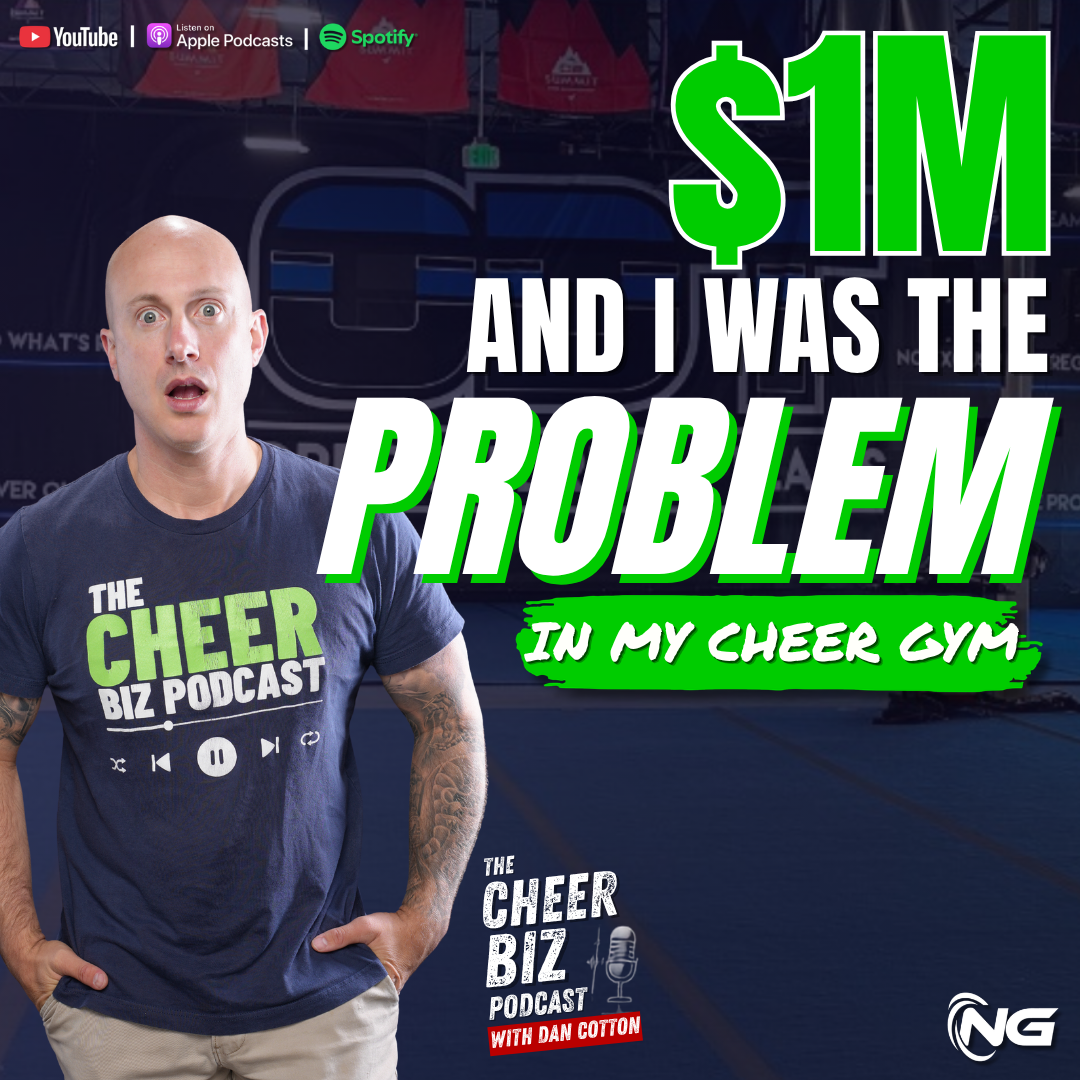
After eleven years running nearly every piece of DreamCamps himself, Cheer Biz Podcast host Dan Cotton shares how a midsummer round of internal promotions freed him to focus on the growth he believes can take the company from $1 million to $10 million.
Eleven Years of Doing It All
Dan Cotton opened this solo episode of the Cheer Biz Podcast by looking back on eleven years of running DreamCamps essentially by himself. As CEO, COO, director, and head of sales all at once, he built the company from the ground up while also coaching at Oregon Dream Teams (ODT) and running NextGen Cheer & Dance. This year, he said, he finally made a change he’d been putting off for too long.
DreamCamps traces back further than the brand name suggests, closer to thirteen years if you count Dan’s earliest ODT-only camps on the Oregon coast, where he’d rent a house and train one team at a time on the grass. As ODT grew past a hundred athletes and five teams, that model stopped working, so Dan moved the operation to the United States Basketball Academy, running camp for one team at a time before folding in outside school teams the following year. He eventually rebranded the camps to DreamCamps once he realized other programs were hesitant to send athletes to something branded under a competing gym’s name. Under a separate name, more teams felt comfortable attending.
From there, growth accelerated. A conversation with Sean Guzman and Kelly Seitzer at a NextGen conference pushed Dan to open a Florida location four years ago, followed by Missouri the next year. This past summer, DreamCamps ran sessions in North Dakota, Missouri, Pennsylvania, Oregon, and Florida, on top of a few locations that didn’t draw enough registration to move forward. Through all of that growth, Dan remained the one building registration pages, writing emails, designing flyers, and handling sales, essentially serving as the company’s entire marketing department.
The Podcast That Changed His Math
Last summer, Dan heard a business podcast host make a claim that stuck with him: any company, in theory, can reach $100 million in annual revenue. Dan’s first reaction was disbelief, but the host pushed back, arguing that the real barrier was Dan’s own limiting beliefs. That challenge sent him back to DreamCamps’ numbers.
This year marks the first time DreamCamps has crossed $1 million in annual revenue, a milestone Dan had pushed hard to reach, much like he had with a previous company. Once he cleared it, he started thinking about $10 million, and quickly identified the real limitation: himself. With only so many hours in a day, his own capacity to execute had become the ceiling on how big DreamCamps could grow.
Dan was careful to note that NextGen and ODT aren’t distractions from DreamCamps, they’re deeply connected to it. The relationships he’s built through NextGen bring him DreamCamps clients, and the knowledge he’s gained running ODT shapes how he runs camps. Walking away from either wasn’t the answer. The real fix was freeing up his own time so he could focus on the parts of the business that only he could drive forward.
Building an Internal Leadership Team
Rather than hiring outside experience, Dan chose to promote from within, filling out a full leadership structure in the course of a single midsummer meeting: an operations director, an admin and customer service lead, a staff manager (a role that already existed), a sales director, two head instructor positions, and a social media manager. Every person he approached had already expressed interest in taking on more responsibility.
The operations director role, filled by Chris, was designed to oversee the entire operation: managing logistics, supervising the staff manager, checking in on admin and customer service, and making sure sales was hitting its numbers. That structure let Dan step into a true CEO role, focused on growth and big-picture decisions instead of day-to-day operations. He pointed out that DreamCamps’ Florida camp was running as he recorded the episode. He flew out for one day, spent fifteen hours helping with setup at the new location, and then stepped back entirely, confident that Chris and the team had it covered.
The admin and customer service position was built to bring organization Dan admits he doesn’t naturally have, tracking details and fielding the questions and concerns that come with serving more than 3,000 athletes and coaches each summer. The staff manager, in place for about six months, is shifting away from booking travel, a task DreamCamps plans to outsource, and toward staff training, supervision, and contracts. Two head instructors, one for individual camp and one for team camp, took over running their teams day to day, roles Dan had always filled himself.
Handing Off the Director Role
Dan described the transition as fast and, at times, disorienting. He met with his new leaders over pizza, laid out the plan, and watched them step up almost immediately, drawing on years of watching him run camps in person. But letting go of a role that had defined his summers for over a decade wasn’t simple.
He shared a moment that captured the shift: a NextGen client texted Chris, the new operations director, to say this was her favorite staff experience she’d ever had at DreamCamps. Dan heard similar praise all summer, and while it was a clear sign the new structure was working, he admitted that hearing it secondhand stung a little. He wasn’t the one directing things anymore. At one point, he started avoiding walking into the gym altogether because staff would immediately ask him for ice, pulling him back into tasks that were no longer his to handle.
Dan joked with his team throughout the summer that they didn’t need him, and they’d insist otherwise. His honest response: there are things only he can do, but very few of them happen at camp. Letting go meant training himself to say “that’s so-and-so’s job” and redirecting people to whoever now owned it, even when it would have been faster to just handle it himself.
Knowing When You’re Ready to Delegate
Dan was candid that this change probably came a year, maybe two, later than it should have. But he also believes he wasn’t ready before. Without documented systems and processes in place, handing off responsibility earlier would have left his new leaders lost. The infrastructure had to exist first.
By the time he made the offers this summer, the people stepping into new roles had already been training for them, sometimes without fully realizing it, simply by being around Dan and absorbing how he ran things. That preparation is why the transition happened as smoothly and quickly as it did. Dan’s advice for gym owners eyeing the same move: delegate to the right people, and delegate the responsibilities that will actually move the business forward, not just the tasks you’re tired of doing.
He was also honest that freeing up his schedule didn’t mean idle time. The hours he used to spend directing camp got absorbed by other priorities, including more time with his NextGen clients and building out a new DreamCamps app aimed at improving the customer experience. The goal isn’t to create free time for its own sake, it’s to redirect that time toward higher-leverage work.
The Path to $10 Million
With a real leadership team in place, Dan is turning his attention to what only he can do as DreamCamps’ founder and CEO: finding new locations and expanding aggressively. He’s targeting three new overnight, residential camp locations next year, contingent on finding the right host sites. DreamCamps was the last of Dan’s companies to reach $1 million in revenue; he now believes it could be the first to reach $10 million, calling it a simple math problem of running enough camps in enough locations.
The new structure is built to scale that growth. Once Dan secures a location, he hands it to his operations director to build out, who then taps the staffing director to staff it and sales to sell it. Dan described the process as starting to work like a real machine, with each new location moving through the same repeatable system rather than depending on him personally.
Wrapping Up
Dan closed the episode with the deeper lesson behind the whole summer: at some point, every business owner becomes the constraint on their own company’s growth, not because anything is wrong with them, but because their personal capacity is finite. Recognizing that moment, and having the humility to hand pieces of the business to someone better suited to run them, is what allows a company to grow past what one person alone can build.
Dan thanked listeners for tuning in and invited them to join the Cheer Gym Owners and All-Star Cheer Coaches and Owners Facebook groups, where these kinds of conversations continue between episodes. He also pointed listeners toward the Cheer Biz Accelerator events, intensive, gym-owner-only sessions running at both his gym and Danielle’s gym later this year, for anyone ready to learn the systems and delegation strategies behind DreamCamps’ growth firsthand.
If you enjoyed this episode, you may also like “5 hard truths I have learned as a business owner”